.png)


National Tourism Development Strategy 2030 – A Strategic shift or the fine-tuning of an established model?

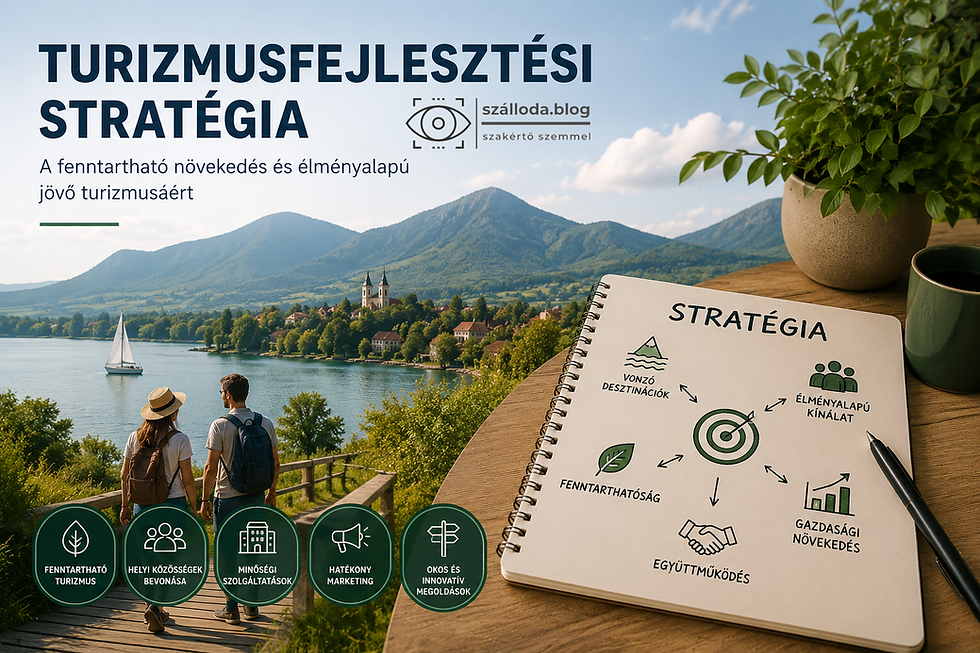
Hungary’s current tourism policy framework – the NTS2030 strategy adopted in 2017 and its later update, Tourism 2.0 – is not a fundamentally new strategy in the classical sense. Rather, it is an adaptive correction of a long-established and, by now, somewhat predictable tourism policy approach rooted in the late post-socialist transition era: Budapest, Lake Balaton, health tourism, MICE tourism, religious tourism, gastronomy and wine tourism.
The COVID-19 pandemic and the consequences of the Russian-Ukrainian war made it unmistakably clear that tourism is both a highly vulnerable and highly reactive industry — especially for those businesses that are financially strong enough to survive periods of crisis. Capital-poor enterprises or those without access to state support often simply disappear from the market.
The documents created under the umbrella of the Hungarian Tourism Agency (MTÜ) do not aim for a complete redesign of the sector but rather for adaptation: a rearrangement of priorities with particular emphasis on sustainability and digitalisation. In itself, this approach is rational. The more important question is whether fine-tuning is sufficient in an industry undergoing structural transformation.
The 12 strategic directions of NTS2030:
Development of destination-based products
Targeted sales and marketing
Visitor-centred developments
Digitally advanced tourism sector
Data-driven sector governance
Optimised governance model
Dedicated and well-trained professionals
Sector-specific financing
Transparent and predictable regulation
Comprehensive sustainability
Guidance and cooperation
Identity and emotional attachment
The Horizontal “Forces” of the Strategy:
Demand-oriented approach
Collaborative ecosystem
Family-friendly tourism
Digital tourism
Destination thinking and system logic

One of the greatest strengths of NTS2030 – retained in Tourism 2.0 – is its destination-based approach. From a professional perspective, this is the correct direction: the strategy no longer thinks in isolated developments but in integrated experience packages combining infrastructure, marketing and services. This is particularly important in a market where competition no longer exists between individual attractions but between complete tourism experiences.
At the same time, the strategy still pays insufficient attention to the deeper integration of rural Hungary beyond the well-known Budapest–Balaton–thermal spa triangle. Large parts of the country remain practically invisible not only for international inbound tourism but often even for domestic travellers. The issue of overtourism is also barely addressed.
It is also noteworthy that active tourism is largely absent from the program itself, despite having its own separate state secretariat and strategy. The Active Hungary program, operating under the Ministry of Public Administration and Regional Development, is professionally well-structured and contains concrete action plans, yet remains relatively quiet in the background. This deserves a separate and more detailed analysis in a future article.
Digitalisation and data-driven governance
One of the strongest elements of the strategy is its emphasis on data-driven tourism governance. The introduction of the National Tourism Data Supply Centre (NTAK) is indeed a milestone, enabling real-time market reactions and more precise marketing through mandatory data reporting by tourism service providers. This approach aligns Hungary more closely with established international practices, particularly in revenue management and demand forecasting. However, access to these datasets is still not equally available to all market participants, despite the fact that sales professionals, destination developers and strategic planners could also significantly benefit from broader access.
Sustainability as a horizontal principle
The strategy correctly recognises that sustainability is not merely “green marketing” but an operational necessity. Environmental, economic and social dimensions are all present — at least on a declarative level.
It is positive that local economies, short supply chains and community impacts are mentioned alongside energy efficiency. However, the strategy lacks operational detail and measurable implementation mechanisms, even though sustainability has become an increasingly important factor for conscious travellers.
Segment-based thinking
The separate treatment of gastronomy, health tourism, MICE and religious tourism is logical and necessary, although hardly innovative. Particularly in health tourism, one can observe a deliberate effort toward stronger positioning — and this could become one of Hungary’s genuine competitive advantages.
What characterises the NTS2030 strategy?
Excessive government dominance – Limited market dynamism
One of the key features of NTS2030 is the dominant role of the state in both coordination and control. While understandable in times of crisis, excessive state involvement can distort market dynamics in the long run — something already visible across multiple levels of the industry.
The problem is not state presence itself, but its scale and quality:
centralised decision-making
slower reaction times
reduced innovation dynamics
The strategy does not provide a clear answer as to how state coordination can be balanced with entrepreneurial flexibility.
Traditional pillars are present – But not systemically integrated
The strategy clearly identifies the main segments:
MICE tourism
health tourism
religious tourism
gastronomy and hospitality
However, these function more as segment descriptions than as truly integrated strategic pillars. There is no clear hierarchy defining which areas are driving sectors and which are supporting segments. Integration logic — such as combining MICE, wellness and gastronomy into complex tourism packages — remains largely absent.

Lake Balaton and priority destinations
Lake Balaton — one of Hungary’s strongest tourism brands — is surprisingly underrepresented within the strategy. This is a significant strategic gap because:
there is still no true repositioning toward a four-season destination model
differentiated target-group management remains weak
Although the strategy frequently refers to destination logic, it does not sufficiently define the roles of flagship regions versus peripheral areas.
Labour market realities are underestimated
The document correctly identifies several core problems:
outdated vocational education
extremely high career abandonment rates
labour shortages and high employee turnover
The weakness lies in the proposed solutions. The strategy:
offers no concrete incentive system
does not adequately address wage issues
barely reflects international labour market competition
This is particularly critical because service quality in tourism directly depends on human resources.
Marketing dominance over product development
The strategy places heavy emphasis on sales and marketing.
While understandable in the short term from a demand-generation perspective, this approach is strategically risky:
if the tourism product itself is not competitive enough, marketing can only generate short-term results
overpromised experiences ultimately damage guest satisfaction
The document does not always maintain a healthy balance between product development and promotion.
Sustainability: strong rhetoric, weak operational framework
Although sustainability appears prominently throughout the strategy, the operational framework often remains vague:
few concrete actions
missing measurement and control mechanisms
unclear or absent incentive systems
This is one of the strategy’s biggest blind spots: the intention is clear, but the execution toolkit remains underdeveloped.
The dominance of domestic tourism demand
During the pandemic, domestic tourism acted as a lifeline, and the strategy implicitly reinforces this focus.
At the same time:
the proportion of high-spending international guests has still not fully recovered
long-term growth requires a new generation of quality-oriented, high-spending inbound tourism
This duality is not fully resolved within the strategy.
International context
The direction itself is correct — but the lack of genuine recognition of Hungary’s competitive disadvantages may become dangerous.
The strategy aligns well with broader European Union priorities:
green transition
digital transformation
resilience building
From a strategic perspective, this alignment is essential.
At the same time, the document insufficiently reflects the fact that regional competition — especially from Austria, Croatia, Slovenia and Slovakia — is becoming increasingly intense, while these countries often react faster to market changes.
The ambition of becoming “Central Europe’s leading destination” is bold, but in its current form it remains more of a declaration than a fully operational roadmap.
Closing thoughts – from a professional perspective:
The document is a well-structured map.
The real question is whether there is:
a suitable vehicle (the entrepreneurial sector),
sufficient fuel (human resources),
and competent leadership (the governance model).
Without synchronisation between these elements, even the best strategy remains merely theoretical.
And in tourism — perhaps more than in any other industry — reality always changes faster than policy documents.
In upcoming articles, several topics only briefly touched upon here will be explored in much greater depth.
It is becoming increasingly clear that Hungary needs a more modern national tourism strategy developed through the genuine involvement of a broader professional community and based on a fresher, more adaptive mindset.
The original language of this article is Hungarian. The translation was created using artificial intelligence.

About the author:
Pakuts Tamás has been actively involved in aviation and tourism for nearly 35 years, and for more than 25 years also in the hotel and hospitality industry.
As both an executive and consultant, he has gained extensive insight into the operations of airlines, hotels, hotel chains and cruise companies, while successfully contributing to their operational management, crisis handling and strategic development.
Today, together with his colleagues, he is present in numerous countries around the world as an expert, consultant and trainer in both the hospitality and aviation sectors. Alongside his team, he is currently working on the development of several new and internationally noteworthy projects.


Comments