.png)


Active Tourism: the greatest missed opportunity of Hungarian tourism strategy — or an alternative deliberately marginalized by the NER (System of National Cooperation)?

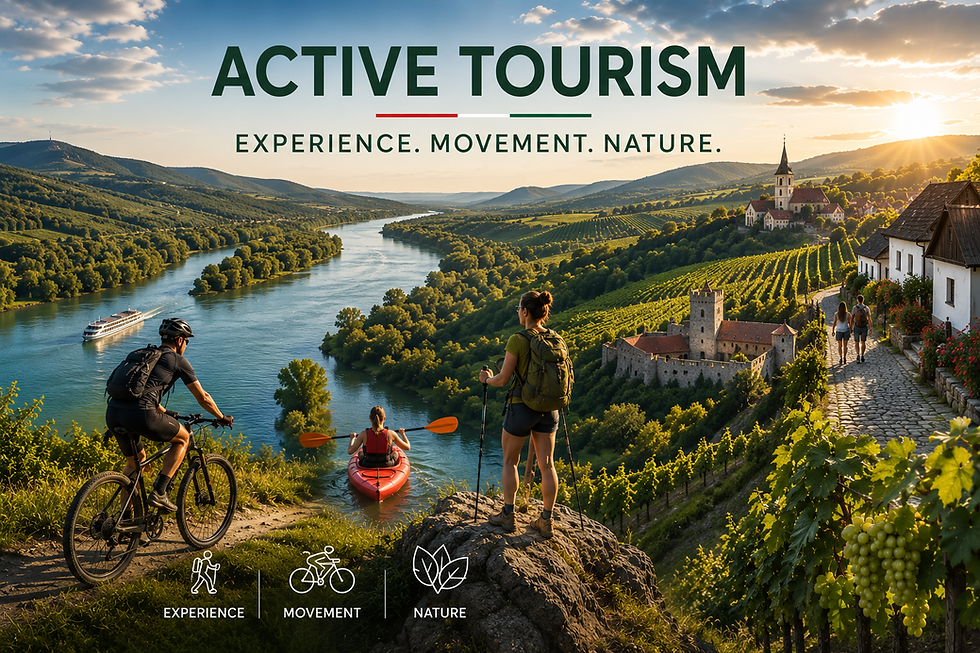
One of the most interesting — and at the same time most revealing — contradictions of the National Tourism Development Strategy 2030 is the role of active tourism, or more precisely, the lack of it, despite the fact that active tourism has become one of the fastest-growing segments of European tourism:
cycling tourism,
hiking and ecotourism,
water-based tourism,
slow tourism,
nature-oriented and experience-driven travel.

In Hungary, active tourism has continued to play only a peripheral role within the national tourism strategy, which is particularly interesting given that in recent years the “Active Hungary” concept was elevated to the level of a separate state secretariat.
The question, therefore, is not whether the government recognized the importance of active tourism, but rather why it failed to integrate it into the National Tourism Development Strategy with genuine strategic weight?
It is clear that this can no longer be seen as a purely professional or tourism-policy issue; the reasons run deeper, leading toward business circles close to the government and the oligarchic structures associated with the NER system.
Two strategies — two fundamentally different ways of thinking
The professional materials and strategic concepts related to active tourism are, in many respects, surprisingly modern, well-structured, and concrete. They analyze international trends and reflect a healthy sustainability-oriented approach. They also examine the potential for regional cooperation and interpret changing mobility patterns and lifestyle shifts, including their broader interactions and implications.

The National Active Tourism Strategy 2030 clearly reflects the logic of modern European tourism development. The strategy for active tourism accurately understands — and explicitly states — that the tourism industry of the future is not built solely around hotels, but around:
experience chains,
nature,
local service providers,
integrated transport systems,
digital ecosystems,
community-based experiences,
and sustainable regional ecosystems.

In contrast, the NTS2030 often feels more like a communication and political document than a genuinely coherent development strategy, as it contains too many marketing clichés, overly elaborate and forced political narratives, self-justifying communication elements, and far too little real systemic thinking. In many sections, the NTS2030 appears superficial, repetitive, and at times distinctly verbose, while several key areas lack:
concrete implementation models,
transport integration,
regional clusters,
analysis of multiplier effects,
connections to rural economic development,
or even credible sustainability indicators and metrics.
While the Active Hungary Strategy resembles a modern European destination development framework, the NTS2030 — developed under the umbrella of the Hungarian Tourism Agency — often feels more like a political presentation than a genuine long-term tourism strategy.
The fundamental problem with active tourism from the perspective of the NER system was that it would have been far too decentralized
This is precisely where the real reasons become visible: active tourism operates according to a completely different economic logic than the model on which Hungarian tourism policy has been built in recent years, because the Active Hungary Strategy would:
decentralize tourism development,
strengthen smaller service providers,
integrate rural economies into the tourism value chain,
activate local communities,
generate longer and more diverse guest journeys,
and distribute tourism revenues far more broadly across society and the regions.
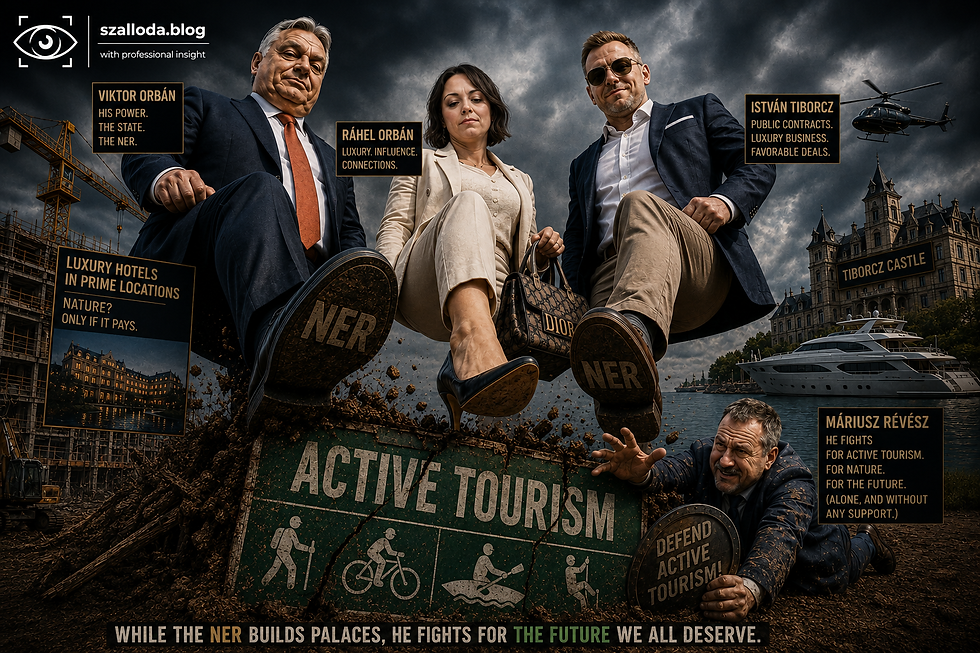
Active Hungary is not built around a handful of flagship projects, but around networks — and this already becomes a politically and economically sensitive issue, because the NTS2030 and especially the Kisfaludy Programme have, over the years, increasingly evolved into a centralized tourism financing system. The primary beneficiaries of this model have typically been large-scale hotel developments linked to business circles close to the NER, particularly premium and luxury projects, Balaton lakeside hotel investments, and strategically prioritized tourism real-estate developments.
This concentration was clearly visible within the subsidy and funding structures, and it has also contributed to significant distortions within the tourism market.
The growing dominance of active tourism, however, could partly have represented competition — and for many, a healthier alternative — to the model promoted within the NTS2030, because a successful active tourism sector:
is not necessarily built around luxury hotels,
does not concentrate exclusively on a handful of prioritized regions,
does not primarily increase the profits of large-scale investors,
but instead generates revenue opportunities for a much broader range of service providers.
And perhaps this is precisely why active tourism in Hungary under the NER era often remained more of a communication tool than a genuine strategic pillar.
The neighboring countries have long since shifted their tourism strategies toward active tourism


Slovenia has by now become one of Europe’s model destinations for active tourism: the Soča Valley, the Julian Alps, the cycling infrastructure, the extensive hiking trail networks, and sustainable mobility all operate as one integrated tourism system. They recognized early on that active tourism is not merely an “additional program,” but an essential and defining element of national economic strategy. Today, this approach fundamentally shapes the country’s tourism image and international perception.


Austria has gone even further: there, active tourism is no longer a separate segment — it has effectively become tourism itself. Rail infrastructure, alpine regions, skiing and hiking tourism, wellness, wine tourism, gastronomy, and the hospitality industry all operate within one highly coordinated ecosystem.


In recent years, Croatia has deliberately begun moving beyond the one-dimensional “Adriatic = Croatia” tourism model and has increasingly shifted its focus toward the development of its continental regions, as well as active and outdoor tourism.
Croatia does not treat hiking, cycling, water-based, and nature-oriented tourism as separate tourism products, but rather develops them as part of a complex and integrated destination development system aligned with gastronomy, wine tourism, wellness, local service providers, and regional transportation. Within this strategy, regional airports and domestic air connections are playing an increasingly important role, supporting not only coastal accessibility but also the tourism integration and accessibility of lesser-known inland regions. This approach simultaneously helps reduce seasonality, stabilize the economies of less developed areas, and ensure a much broader social and regional distribution of tourism revenues.

In contrast, Hungary still tends to think primarily in terms of Budapest, Lake Balaton, health tourism, luxury hotels, conference tourism, and the prestige investments associated with these sectors.
Hungary’s natural and geographical conditions are exceptionally well suited for active tourism

The paradox is that, from both a geographical and infrastructural perspective, Hungary could actually be even better suited for active tourism than many of its neighboring countries:
short travel distances,
a safe environment,
rivers and lakes,
national parks,
wine regions,
thermal water resources,
rich cultural heritage,
a relatively favorable climate,
and regions that can easily be combined into complex travel experiences.
Moreover, active tourism could be perfectly integrated with wellness, medical and health tourism, gastronomy, wine tourism, cultural tourism, and even conference tourism.
Perhaps this is the most important aspect: the active traveler does not consume just a single service, but moves within a complex chain of experiences. They book accommodation, visit restaurants, taste local wines, participate in programs, purchase regional products, often use public transportation, and — if satisfied — are far more likely to return. As a result, they generate a significantly stronger multiplier effect than the traditional transit or wellness guest.
The real question is no longer whether active tourism is necessary, but whether Hungary will be capable of moving beyond the centralized, investment-driven tourism policy model that has emerged over the past years.
In the long run, the key issue is not how many new luxury hotels are built, but how sustainable, livable, and economically balanced Hungarian tourism will become.
For this to happen, active tourism should not be treated as a separate governmental sub-project or isolated policy area, but rather as one of the fundamental pillars of Hungarian tourism, developing in close symbiosis with traditional tourism sectors.
The original language of this article is Hungarian.The English translation was generated with the assistance of AI.

About the Author:
Tamás Pakuts has been actively involved in aviation and tourism for nearly 35 years, and for more than 25 years in the hotel and hospitality industry as well.
As both an executive and consultant, he has gained extensive insight into the operations of airlines, hotels, hotel chains, and cruise companies, while also playing a successful role in their operational management, crisis management, and strategic development.
Today, together with his colleagues, he is active in numerous countries around the world as an expert, consultant, and trainer in both the hospitality and aviation sectors, currently working on the development of several new internationally significant projects.


Comments