


Asia Offers Beds on Buses. Europe Is Only Just Waking Up


In Vietnam, private sleeping cabins; in Japan, a premium coach with eleven cabins; and in Europe, seats that recline fully flat. The overnight coach is gradually moving beyond its role as a cheap last resort to become a travel product in its own right. The question is no longer whether one can sleep on a bus, but whether a sleeper coach can fill the gap between expensive air travel and Europe's incomplete night-train network.
In Europe, we have long filed long-distance travel neatly into three drawers. Flying is fast, rail is civilised and comfortable, and the bus is cheap. That division has become so ingrained in our thinking that we have barely asked the most obvious question: if someone spends eight, ten or fourteen hours in a vehicle overnight, why do we take it for granted that they must do so sitting up?
Several Asian countries have already answered that question. Rather than simply squeezing two extra rows into a coach, operators provide beds, private space, personal amenities and a genuine chance to rest. The result is not merely a more comfortable bus: they have begun to blur the traditional boundary between transport and accommodation.
As we have discussed repeatedly in Szalloda.blog's Monday Mobility series, a journey does not begin when a guest walks into a hotel. The time, cost, comfort and predictability of reaching it are just as much part of the tourism product. Sleeper buses are interesting because they take this idea unusually far.

Vietnam: Overnight Coaches Can Offer More Than a Sleeper Train
In Vietnam, sleeper buses are not a transport curiosity but an established part of long-distance domestic travel. HK Buslines, for example, operates cabin coaches between Hanoi, Sapa, Ha Long, Ninh Binh, Hue, Da Nang, Hoi An and other tourist destinations. According to the company, some vehicles have 24 separate, curtain-enclosed berths measuring 180 × 85 centimetres, with personal entertainment, charging, Wi-Fi and air conditioning. HK Buslines – vehicles and services. Booking websites also list the 180 × 85 centimetre cabin dimensions.
Of course, 'more than a sleeper train' does not mean every Vietnamese bus is more comfortable than a good European sleeping compartment. In terms of service design, however, some Asian sleeper coaches already offer personalised features — a private screen, massage functions and an enclosed personal space — that are not necessarily available in a traditional European couchette car.
The crucial difference is not the number of extras. It is that they do not treat the night as an unavoidable inconvenience. If the journey is long, they try to turn those eight to fourteen hours into time that can genuinely be used for rest.
This is transport thinking and hotel thinking at the same time.
Japan: A Premium Night Bus Targets a New, Demanding Customer Group
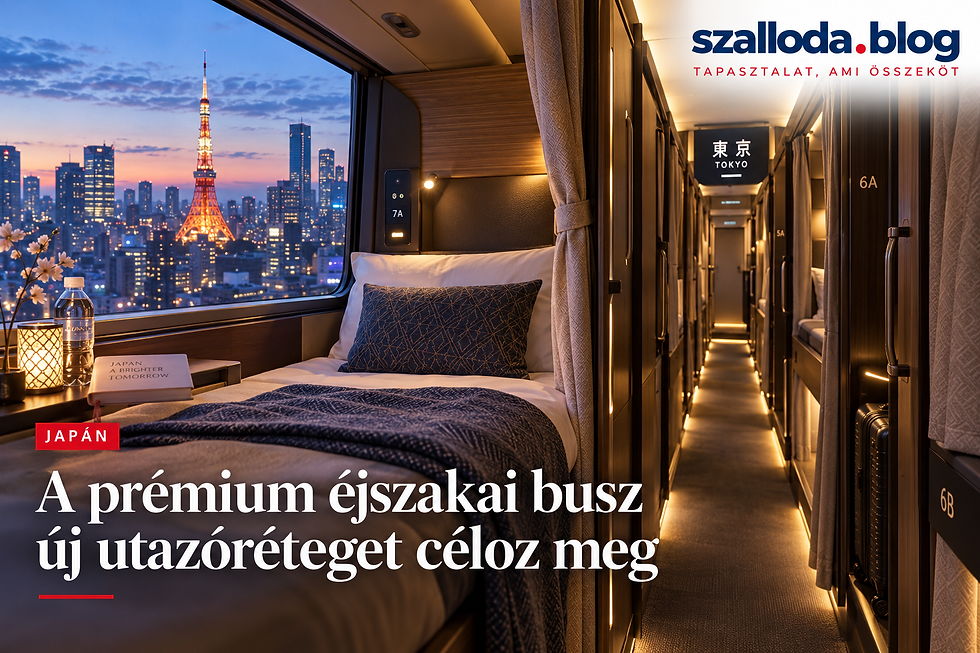
Japan has moved even more dramatically away from the notion that a bus must be a mass-market product. Dream Sleeper, operating between Tokyo, Osaka and Nara, has just 11 private passenger spaces on a full-size coach. Each has its own door, an electrically adjustable reclining seat, individual lighting, a table, power supply and Wi-Fi. The vehicle also provides a separate changing area and toilet.
The journey takes nearly nine hours, with adult fares currently around ¥18,000–22,000 (€100–125), depending on the route and date. This is clearly not aimed at people seeking the cheapest possible transport, which is exactly what makes it interesting.
Dream Sleeper is not trying to prove that a bus can be cheaper than a train. It demonstrates that a coach can also be a premium product.
Aviation recognised this decades ago. On the same aircraft, one passenger looks for the lowest possible fare while another is prepared to pay many times as much for extra space, peace and the prospect of stepping off at the destination as a functioning human being.
Long-distance coach travel in Europe has barely exploited this opportunity so far.

Europe Is Discovering the Sleeper Coach
Switzerland's Twiliner launched in December 2025 with two routes: from Zurich towards Brussels and Amsterdam, and towards Barcelona via Bern and Girona. Its 21-seat coaches have seats that convert into fully flat beds, with a toilet, changing area, a small snack bar, Wi-Fi and a checked baggage allowance of 23 kilograms. Again, the key point is not simply a seat that reclines further.
Twiliner positions itself from the outset as a hybrid of the sleeper train, business-class flying and coach travel. This is a significant change in approach: instead of trying to be an even cheaper substitute for a low-cost flight, the coach is addressing a different need.
The service took another important step in September 2026. From 15 September, Twiliner became available through the multimodal booking platform Omio, allowing passengers to compare sleeper coaches directly with trains, flights and other buses.
That may be a more important development than it first appears. A new transport offering truly begins to become a market when customers no longer have to search for it as a curiosity, but see it alongside the familiar alternatives in the same comparison.

The Ticket-Price Trap: Look at the Total Cost
The trip between Zurich and Barcelona takes around 14 hours, and a one-way Twiliner ticket starts at €165. That can sound expensive for a bus journey, especially when a low-cost airline search sometimes shows a basic fare of just a few dozen euros.
But the ticket price and the cost of a journey are not the same thing.
An airline ticket may come with baggage charges, airport transfers, parking, waiting before departure, getting from the arrival airport into the city, and perhaps even an extra hotel night. Add a cost most comparison websites never display at all: time.
We encountered exactly this issue in an earlier Szalloda.blog analysis, 'Rail & Fly: Genuine Intermodality or a Greenwashed Ticket Bundle?' Passengers do not care how many different companies and modes of transport make up a journey. What matters is the time, money and uncertainty involved in getting from the real starting point to the actual destination. Rail & Fly: Genuine Intermodality or a Greenwashed Ticket Bundle? – Szalloda.blog.
An evening departure from a city centre that arrives in another city centre the following morning must therefore be evaluated very differently from a fare-per-kilometre comparison alone.
The sleeper coach does not have to beat a €29 airline ticket; it must compete with every mode of transport.

Sleeper Buses Could Fill the Gaps in Europe's Shrinking Night-Train Connections
The prospects for sleeper coaches in Europe are especially interesting given the contradictory state of night rail. Despite years of talk about a 'night-train renaissance', the actual network is not growing everywhere.
According to Back-on-Track's 2026 map of European night trains, five new connections appeared while ten earlier ones disappeared, including several Nightjet services and the Stockholm–Narvik train. One of the main reasons is a shortage of appropriate rolling stock and inadequate investment.
That does not mean sleeper buses should displace sleeper trains. Quite the opposite: where a good overnight rail service exists, with suitable sleeping or couchette accommodation, it is hard to beat the railway for comfort and capacity.
The coach has advantages elsewhere. It needs no new railway line, does not have to coordinate international train paths and can serve city pairs much more quickly where no direct overnight rail connection exists.
We recently wrote about the importance of competition in rail transport in connection with Virgin's planned Channel Tunnel services. The lesson is the same: for passengers, real choice means not theoretical modes of transport, but usable, direct alternatives of appropriate quality. 'Richard Branson Returns to Rail' – Szalloda.blog.
Where an overnight rail link is missing, a sleeper coach need not wait years for new infrastructure to be built. That could be one of its strongest competitive advantages.

Premium Comfort Saves More Than Discomfort — It Saves Time
We tend to judge the value of overnight travel solely by comfort. Yet time matters at least as much.
Someone who leaves at ten in the evening, sleeps overnight and arrives at seven or eight in the morning has moved much of the journey into hours they would otherwise have spent asleep. That can be especially valuable to a business traveller, but on a long weekend or city break it can also yield half a day or a full extra day of usable time. In that sense, a premium sleeper coach is not merely selling a more expensive seat. It is selling time.
This is close to what the hotel industry has long done. A good hotel does not merely sell four walls and a bed. It sells rest, peace, safety and the promise that the guest can continue the following day in a fit state.
If a transport company can credibly make the same promise, the dividing line between the two industries really does begin to blur.
Asia Used to Follow Europe — Now the Tables May Be Turning
Europe likes to think of itself as one of the cradles of railway and transport culture. The great rail networks, sleeping cars and international luxury trains that shaped our idea of elegant overland travel for a century were developed on this continent.
Meanwhile, we were long inclined to view parts of Asia's transport market as followers of Western models.
Today, in more and more areas, it is worth reversing that perspective. Not because every Asian solution is better, nor because a Vietnamese sleeper coach should be transplanted unchanged between Berlin and Paris. Regulations, travel culture, infrastructure and passenger expectations differ. But the mindset is worth considering. Instead of asking how to make the same service even cheaper, the question is how to turn a long journey into a better product.
Europe has something to learn from that today.
Luxury Hotels on Wheels?
The biggest constraint on sleeper coaches is the same as for premium services generally: space costs money. If a vehicle carries twenty or twenty-five people rather than fifty, the costs of the coach, staff, fuel, road tolls and operations must be shared among far fewer passengers.
That is why traditional overnight buses are unlikely to become luxury hotels on wheels across the board. Nor do they need to.
Aviation did not develop by turning every seat into business class. Real progress came from creating distinct products for different needs. Anyone who simply wants to travel cheaply can still take a conventional long-distance coach. Those who prioritise speed can fly. Where the rail service is good, travellers can take a sleeper train. The sleeper coach may find a market among people who want to use the overnight journey rather than merely survive it.
Perhaps, then, the better question is not who would want to travel fourteen hours by bus between Zurich and Barcelona, but why someone who must travel all night should still have to spend it in a conventional coach seat.
The next great innovation in mobility may not necessarily be even greater speed.
It may simply be a proper bed.

Sources
HK Buslines — vehicles and cabin sleeper coaches
Kanto Bus — Dream Sleeper, Tokyo–Osaka–Nara
Twiliner — official service description and routes
Twiliner — Barcelona route, travel time and prices
Twiliner — launch of the service, December 2025
Omio — Twiliner integration, 15 September 2026
Euronews — Europe's night-train network in 2026
Euronews — Europe loves night trains — so why are many routes disappearing across the continent?
Szalloda.blog — Rail & Fly: Genuine Intermodality or a Greenwashed Ticket Bundle? https://www.szalloda.blog/post/rail-fly-val%C3%B3di-intermodalit%C3%A1s-vagy-z%C3%B6ldre-festett-jegycsomag
Szalloda.blog — Richard Branson Returns to Rail: Could Virgin End Eurostar's Channel Tunnel Monopoly? https://www.szalloda.blog/post/richard-branson-virgin-visszasz%C3%A1ll-a-s%C3%ADnekre-v%C3%A9ge-lehet-az-eurostar-egyeduralm%C3%A1nak-a-csalag%C3%BAtban
The legal, official, industry and international information used for this article reflects the position as of 20 September 2026. Artificial intelligence tools (ChatGPT and Claude) assisted in gathering, comparing and organising the material; final editing, interpretation and conclusions reflect the editorial position of szalloda.blog. AI-based applications also assisted in creating some illustrations and infographic elements.
This article was translated from the original Hungarian using artificial intelligence. The original language is Hungarian.


Comments