
.png)

Could the G7 inadvertently interfere in the Swiss immigration referendum?

Switzerland votes against the “Switzerland of 10 million” on June 14. That same weekend, border closures, demonstrations, a military presence, and boarded-up shops shape public sentiment in Geneva. Coincidence or politically significant?

Update: Results of the 10 million Swiss referendum are in

Swiss voters ultimately rejected the immigration and migration referendum and the restrictions it brought with it.
According to the official results, 54.8% of voters said no to the initiative, while 45.2% said yes. The turnout was 58.9%, which indicates significant public interest even in Swiss terms.
The regional results, however, show an interesting picture. The initiative was particularly popular in smaller towns, German-speaking cantons, and several regions where agriculture and tourism play a decisive role. In contrast, the proposal was clearly rejected by the majority of large cities and French-speaking cantons.
Although the referendum did not achieve its goal, the 45.2% support shows that immigration, population growth and infrastructure capacity remain among the most important political and social issues in Switzerland. The debate is likely not over, but has simply entered a new phase.
We will be covering the referendum in detail in a separate article on szalloda.blog in the coming days.
Switzerland will hold a national referendum on June 14, 2026, on the initiative against “Switzerland of 10 million.” The proposal aims to limit Switzerland’s permanent population to 10 million by 2050. If the population were to reach 9.5 million earlier, the government and parliament would have to take measures to curb immigration, especially in the areas of asylum and family reunification. If the population were to fail to keep below the threshold even after the 10 million mark was crossed, Switzerland would have to terminate its free movement of workers agreement with the EU, which could lead to its exit from the Schengen zone. In addition, the Swiss can vote today on tightening the possibility of civilian military service (they are proud of their compulsory military service) and, in the Geneva region, even on the abolition of religious symbols in public administration.
The anti-immigration initiative is primarily driven by the Swiss People's Party, the SVP. Party chairman Marcel Dettling and other SVP politicians, including national councillor Mike Egger, stress that Switzerland's infrastructure, housing market, transport, public services and natural environment are coming under increasing pressure. The campaign's central message is that rapid population growth is not just an economic issue, but also a quality of life and sustainability issue. Supporters are therefore presenting the referendum not simply as an immigration debate, but as a question of Switzerland's ability to support itself and its livability.
The opposition has an almost unprecedentedly broad political and economic coalition. The Federal Council, most major parliamentary parties, business organizations and numerous economic players say the initiative would pose a serious risk to Switzerland's welfare, labor market and European relations. Federal Councilor and Minister of Justice and Law Enforcement Beat Jans has become one of the most prominent opponents of the referendum. The main argument of the opponents is that Switzerland's economy, healthcare and public services can no longer operate stably without foreign workers.
Official Swiss information also clearly points to this connection: at the end of 2025, Switzerland's population was around 9.1 million, and it has grown by around 1.7 million since the free movement of workers was introduced in 2002, but the population was around 5.5 million in the early 1970s. The level of immigration depends primarily on the labor market: when the economy is strong, companies have difficulty finding enough workers within Switzerland. Hospitals and nursing homes also often recruit the necessary professionals from the EU and even from outside.
The stakes in the referendum are therefore much higher than whether Switzerland's population will remain below 10 million. The real question is who will work in Swiss hospitals, nursing homes, restaurants, hotels, construction sites, transport companies and tourism providers in the coming decades.
This is a particularly sensitive issue for the hotel industry, hospitality and tourism. Switzerland's luxury hotels, alpine resorts, city business hotels, restaurants, ski resorts and event sector rely heavily on foreign workers, and Hungarian professionals have proven themselves in all areas, primarily in the German-speaking regions of Switzerland.
If immigration were to be significantly reduced, it could not only exacerbate the current labor shortages in certain sectors, but also increase operating costs, worsen service standards, reduce opening hours and, in the longer term, reduce Switzerland's economic and tourism competitiveness.

In the case of hospitals and elderly care, the consequences could be even more immediate. Switzerland's aging society requires more and more health and care services, while if it were to admit fewer foreign professionals, the system could easily face even more drastic capacity problems. The question is therefore more complex and not just economic, but also social: how can quality of life, the level of public services and the functioning of the labor market be maintained at the same time?
Historical background to the debate: Switzerland has become such an international country for a reason. The economic boom after World War II, industry, construction, the financial sector, and later the pharmaceutical industry, research and development, healthcare, and tourism, all required foreign labor because there were no longer enough human resources locally. The free movement of labor, which came into effect in 2002, institutionalized this process. One of the foundations of the Swiss model was precisely that the country operates a high value-added economy, while its labor market is strongly connected to Europe.
Geneva also occupies a special place in this story in global terms. This city is perhaps Switzerland, but also one of the most international cities in the world (some estimates put the proportion at 69%): home to the European headquarters of the UN, the WHO, the WTO, the ILO, the Red Cross, the UNHCR and many other international organisations. Geneva's economic, diplomatic and cultural identity is now inseparable from foreigners, international organisations, cross-border labour markets and the mass of daily commuters from France.
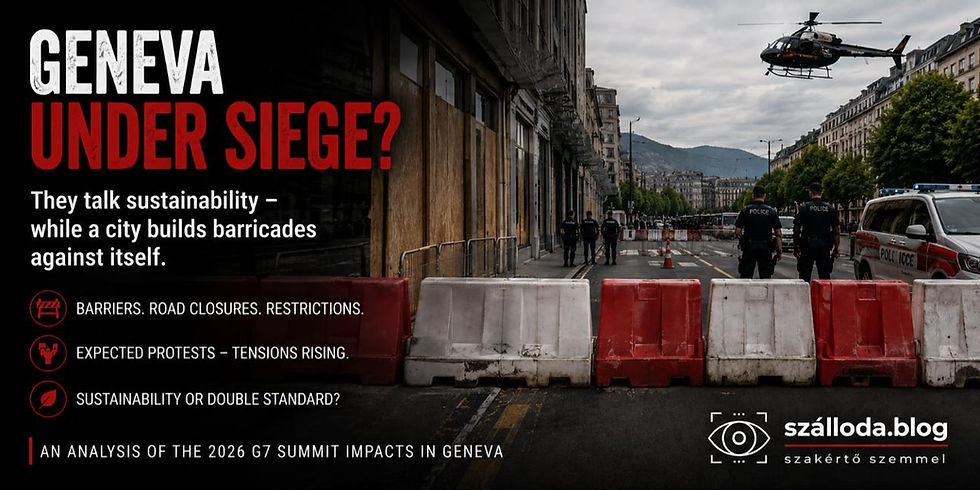
It may seem symbolic that on the weekend of the immigration referendum, Geneva does not present the usual image of openness, predictability and international cooperation, but rather closed border crossings, a military and police presence, boarded up shops and expected mass protests.
Although France is hosting the G7 summit in Évian-les-Bains from 15 to 17 June, a significant part of the organisation and logistics will be handled by Switzerland. A significant number of delegations will arrive at Geneva airport, and Switzerland has therefore introduced extraordinary security measures. The Federal Council has classified the event as an extraordinary event and decided that the Confederation will cover 80% of the security costs for the cantons of Geneva, Vaud and Valais.
However, this did not eliminate, and in fact escalated, political tension. There was serious outrage in Switzerland that there was still no agreement with the French side on the sharing of costs on the Swiss side. According to Swissinfo , although operational cooperation with France is working well, there is no agreement on the issue of cost sharing.
Le Monde put the diplomatic tension in a more pointed light: the upcoming G7 is putting a serious strain on Franco-Swiss relations, the paper said. The article quoted Mauro Poggia, a politician from the Geneva Citizens' Movement, as describing the situation as "a celebration for France, a nightmare for Switzerland." Geneva State Councilor Carole-Anne Kast stressed that it was unacceptable for the democratic debate to be shifted to Swiss territory, while Geneva and Switzerland were neither organizers nor participants in the summit. In a letter to Emmanuel Macron, the President of the Swiss Federal Council, Guy Parmelin, expressed his serious dissatisfaction with the organization, the costs and the risk of expected unrest, which further worsened the political tension between the two countries.
The level of security preparedness is remarkable. According to Reuters, Geneva is preparing for about 50,000 protesters for the anti-G7 demonstration. On the Swiss side, 4,000 soldiers are being mobilized and thousands of police are being transferred from other cantons, while France is expected to deploy 8,000 police for the Evian summit nearby. Geneva authorities are preparing to close or monitor 27 French-Swiss border crossings and have boarded up almost all shops in the city to prevent any potential damage, with many remaining closed until the end of the meeting, as commuters cannot cross the border.

This political timing makes the situation particularly sensitive. Rationally, the G7 and the immigration referendum have no direct connection. The G7 is not about immigration in Switzerland, and the referendum is not about the Évian summit. But in politics, it is not just facts that count, but also images, impressions and emotions.
What does an undecided voter see this weekend? Border closures, increased police alert, soldiers, boarded up and closed shops, anarchist protesters, serious disruptions to public transport, employees sent to work from home and the lack of commuters from the French side. A city loses some of its usual functionality for a few days.
It is easy to see how this sight could subconsciously reinforce the emotional arguments that supporters of the referendum are building on: overburdened infrastructure, overcrowding, fear, pressure on public services, a loss of control. This could be true even if the G7 emergency is not a consequence of immigration.
On the other hand, the example of Geneva shows how fragile Switzerland's international position would be without foreign labor, cross-border mobility, and international cooperation. If Geneva were to truly close itself off to the outside world, not only would protesters or delegations be unable to enter, but also the workers, professionals, doctors, researchers, caterers, hotel workers, and service providers who ensure the city's daily operations.
Another sensitive issue is whether demonstrations and traffic restrictions could affect Geneva’s turnout in the referendum. Many people in Switzerland vote by mail or in advance, so traffic problems on any given day are unlikely to be decisive. However, in a close referendum, it could still be politically interesting if demonstrations, closures or reduced transport options make it more difficult for even a few voters to get to the polling station or simply decide to stay home.
The G7 weekend is therefore not just a security or diplomatic event, but also a political mirror for Switzerland. It shows how difficult it is to remain open, international, safe, livable and sovereign at the same time in a country that is economically strongly connected to the outside world but is increasingly questioning the price of this politically.
The outcome of the referendum will likely not be decided by the G7. But the coincidence of the two events has created a rare political moment. While world leaders are debating the future of globalization in Évian, Swiss voters will decide this weekend how long one of Europe’s most successful globalized countries will remain open.
Few timings could be more symbolic.
The result of the vote could be a message to Europe.

About the author
Tamás Pakuts is a tourism, hotel, aviation and mobility expert with nearly 35 years of international professional experience. During his career, he has held management, consulting, training and project development positions in many countries in Europe and Asia at airlines, airports, hotels, cruise lines, tourism organizations and international development projects. He currently lives in Geneva, from where he analyzes current processes in tourism, transport, hospitality and mobility. As the founder of Szálloda.blog, he helps readers understand trends and connections with independent professional analyses, opinion pieces and industry commentaries.
The original text is in Hungarian, the translation is generated with the assistance of AI.

Comments