


Do Not Ban Airbnb — Regulate It Properly: Fifteen Proposals for Hungary


Short-term apartment letting is not inherently tourism's enemy. An uncontrolled, unlicensed apartment competing with hotels in the same market under different rules, however, is no longer merely a 'shared home' but a regulatory loophole. Cities from Singapore and New York to Paris and Munich are searching for answers. Some have effectively prohibited it; others impose limits on rental nights, condominium approval or special permits, while some maintain dedicated enforcement teams targeting illegal apartments. Hungary should learn from these examples rather than copy them blindly.
Airbnb's original idea was reasonable. Owners occasionally let their own home or a room, while guests received more personal, often cheaper accommodation than a hotel. That genuinely was home-sharing. The model has since become an industry: investors acquired entire apartment portfolios, residential buildings were converted into dispersed apartment hotels, yet many legal classifications still pretend someone is offering their sofa for a few weeks a year.
At least four different activities now hide under the same label: an occasional home-sharer letting their home while away; a host offering a room in their own residence; a second or subsequent apartment purchased specifically for tourism; and a professional operator managing dozens of units with reception, revenue management, housekeeping, maintenance and distribution systems. Anyone attempting to regulate these four models through the single word 'Airbnb' has lost the plot from the outset.
The Platform Is Not the Accommodation
Airbnb is a sales platform, not an accommodation type, just as Booking.com is not a hotel, Expedia is not a travel agency and Google Hotels is not a classification authority. Regulation should examine the underlying activity, not the app's name.
An owner renting their own home for twenty nights a year is not equivalent to a business operating twenty apartments. The latter is no less professional merely because no hotel name appears on the building and the guest collects a key card from a lockbox.
The real question is not whether we like Airbnb. It is what we consider housing, what we regard as a tourism service, and when we require the same accountability we take for granted at a hotel.

Singapore: A Home Cannot Be a Hotel in Disguise
At one end of the spectrum is Singapore. Offering accommodation in private residential property for fewer than three consecutive months is unlawful. Daily or weekly tourist rentals are therefore effectively prohibited, whether offered through Airbnb, another platform or directly.
The rationale is clear: residential property is intended primarily for long-term housing, while continual guest turnover affects safety, privacy and the character of a residential community. Authorities may work with condominium management and security providers, and residents can report unlawful activity directly. Singapore's Urban Redevelopment Authority explains the rules.
That is a hard-line solution, neither necessary nor desirable as a nationwide Hungarian model. It nevertheless demonstrates that a state can decide a home must not automatically become a hotel simply because finding paying guests online is easy.

New York: The Host Should Actually Be a Host
In New York, renting an entire apartment for fewer than thirty days is generally prohibited. Short-term stays may be hosted where the host remains in the same apartment, accommodates no more than two paying guests at once and grants access to exits and shared rooms.
Hosts must register with the mayor's Office of Special Enforcement; platforms cannot process bookings for unregistered accommodation. This goes beyond letting advertisers type any sequence of numbers into a form. Platforms have duties and accountability too. New York City's official guidance explains the conditions.
New York has effectively brought the model back towards its original meaning: when somebody advertises home-sharing, it should genuinely be their home, preferably with the host present. A twenty-apartment operation without staff no longer fits the romantic notion of a 'host'.

Amsterdam: Thirty Nights, Four Guests and Advance Notification
In Amsterdam only a host's principal residence may be rented to tourists. A permit is required, every rental must be notified in advance, no more than four guests may stay at once, and the general annual cap is thirty nights. A fifteen-night limit may apply in parts of the city centre and De Pijp.
Permits are time-limited, advertisements must display the registration number and infringements can attract fines of thousands of euros. Amsterdam's city guidance distinguishes occasional home-sharing from commercial operation.
One of the system's most important elements is prior notification. Authorities need not reconstruct rental nights years later from tax returns; in principle they know before visitors arrive. The rule can therefore be enforced rather than remaining a wish published on a website.
Paris: Ninety Days and a Campaign Against Lockboxes
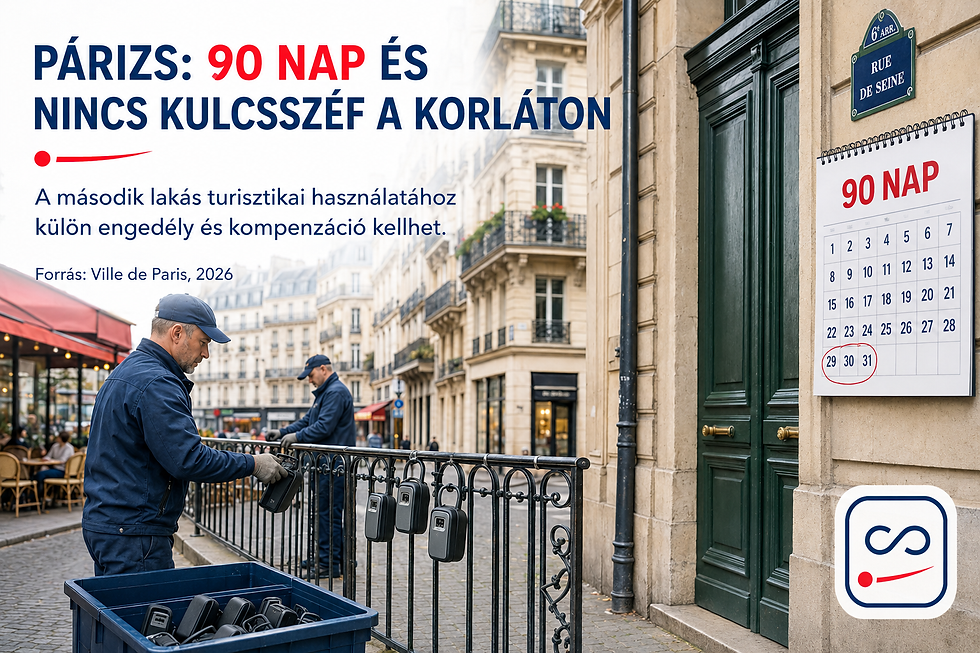
In Paris, a primary residence may be let for tourism for up to ninety days annually, and registration numbers must be shown. Second homes face much stricter rules, including change-of-use permits and often 'compensation': another property previously used for non-residential purposes must be converted into housing to offset the dwelling removed from the residential market.
In 2025 the city also prohibited lockboxes fixed to public street furniture. At first glance this looks like an eccentric detail, but it has symbolic force: a lockbox attached to a railing, lamppost or street fixture has become a visible symbol of impersonal apartment operations without reception or local contact. Paris publishes its rules and penalties.
Fines for unlawfully letting a second home in Paris can reach €100,000, with additional daily coercive penalties calculated by area. This is no longer a culture in which an automatic warning email is the worst consequence of breaking the rules.

Catalonia and Barcelona: Pulling the Emergency Brake on a Housing Crisis
Catalonia tightened rules in 262 municipalities experiencing housing problems, high concentrations of tourist apartments or both. New tourist apartments in those places require prior planning permission. Permits last five years and can be renewed; municipalities may allow no more than ten tourist apartments per one hundred residents.
Existing establishments are not automatically granted rights in perpetuity: they too must seek renewed permits within a transitional period or cease operating. The Catalan government says the changes may affect more than 95,000 existing tourist apartments, with details on its business portal.
Barcelona's political objective is more radical: not to renew licences for roughly ten thousand existing tourist apartments after 2028. Implementation remains contested legally and practically. It should be described as a political direction, not an accomplished fact.
The Catalan model's strongest lesson is not the precise cap. It is that identical rules may be inappropriate for a city centre facing a housing crisis and a depopulating rural municipality short of tourism capacity.
London: The Law Alone Is Not Enough
In London, a residential property can generally be let short term for up to ninety nights in a calendar year without separate planning permission. The paper rule is clear, but enforcement has been fragmented, borough capacities vary and access to platform data has not long provided consistent system-wide oversight capable of enforcing the cap across listings.
London shows that an annual limit is not effective regulation without automatic data, platform accountability and a competent enforcement body. A rule does not work merely because it looks impressive in council guidance.
Berlin: Renting a Room Is Different from Renting the Whole Apartment
Berlin regulates short lets under its prohibition on misuse of residential property. Letting part of a principal residence is generally easier where more than half of the home remains in residential use. Renting an entire dwelling or second home is subject to stricter conditions and time limits, generally around ninety days annually for a second residence used for tourism.
This is more useful than merely counting nights. Letting one room removes less housing from the local market than devoting an entire property to tourists year-round. Berlin's Service Portal explains permits and restrictions.

Munich: The 'Airbnb Police' Are Not an Urban Legend
In Munich, using residential property for tourist stays for more than eight weeks a year may constitute prohibited misuse and require permission. Rules may be more permissive where less than half the dwelling is used for another purpose and the remainder retains genuine residential use.
Fines for unlawful changes of use can reach €500,000 per infringement. The city has a dedicated residential-property protection unit that investigates reports, collects data and handles cases on site. German media and everyday speech sometimes call it the 'Airbnb police', although it is not a conventional police force. These are specialised municipal inspectors whose job is to investigate unlawful tourist-apartment use.
Munich publishes the relevant rules on its official municipal site. Its message is simple: serious regulation requires people, data, legal powers and sanctions.
Vienna's Apartment Operators Are Not Safe from Inspectors Either
In Vienna, building and land-use rules restrict residential properties' tourist use, and the city established a nine-person expert team to uncover illegal apartments. They do not merely browse online listings: they compare data, inspect properties and investigate actual building use.
During a targeted operation in 2025, Vienna's building police identified two illegal hotels and filed complaints in 34 cases. The city's announcement demonstrates the difference between making rules and enforcing them.
The expression 'illegal hotel' is particularly apt. Operating multiple dwellings as one system, with continuous guest turnover and commercial intent, is economically an accommodation business. A 'private' sticker on an apartment door does not alter that.
Japan: 180 Days and 3.3 Square Metres per Guest
Japan's national private-lodging rules permit operation for up to 180 days annually, with additional local restrictions possible. Providers must report operating days and guest numbers regularly and provide at least 3.3 square metres of floor area per guest.
This may sound unusual, but follows a principle hotels take for granted: maximum occupancy depends on actual room size and safe use, not an owner's imagination. Japan's tourism authorities explain the rules in English.
Portugal: Easy Entry, Real Responsibility
Portugal's traditionally more permissive approach is built around Alojamento Local. Operation requires registration, while municipalities may declare restricted zones where housing pressure exists. Providers must also hold liability insurance.
That is an important middle ground. Authorisation can be fast and digital without making ongoing operation consequence-free. Being business-friendly is not the same as abandoning oversight.
Hungary Has Data, but Not Yet Order
Hungary is not starting from zero technologically. Accommodation must be registered, connected to NTAK, use approved management software, submit daily data, record guests and undergo accommodation classification. Since 2020, online listings must show the NTAK registration number and accommodation type. NTAK says the local municipal clerk verifies registration and daily reporting.
In Budapest, between 1 January 2025 and 31 December 2026, new private or other accommodation cannot register in NTAK and municipalities cannot issue new registration certificates for those categories. That is a moratorium, not a permanent regulatory model. It buys time but does not answer what happens next.
Through NTAK, Hungary may in principle hold more operational accommodation data than many Western European countries. The weak link is not necessarily missing information, but the connections between data, platforms, municipal registers, condominium rules and actual inspections.
If a listing identifier cannot be validated automatically, if one dwelling can appear under multiple adverts and exposing unlawful operation depends mainly on persistent neighbours, the system may be digital without being effective.

Booking.com: When You Search for a Hotel and the Algorithm Recommends an Apartment
Booking.com's problem is not selling apartments. It is that the platform often places hotels, guesthouses, apartments, private flats and sometimes vaguely named accommodation in the same competitive search space.
A guest searches for a hotel and receives apartments. The results may imply that products are directly comparable, although reception presence, cleaning frequency, safety, complaints handling, accessibility, staff availability and official classification may all differ.
Booking.com has technical mechanisms for requesting licence details from providers. But requesting a number and validating its official status in real time are two different things. Displaying a number does not establish that a licence exists, belongs to that property, authorises that activity and remains valid.
Quality classification raises the same issue. For apartments, holiday homes and villas Booking.com may display a one-to-five 'Quality Rating'. It is neither official hotel stars nor necessarily the result of on-site inspection. According to Booking.com's own explanation, machine learning calculates it from more than four hundred factors, including facilities, property layout, uploaded photographs, guest reviews and booking history.
A yellow square therefore does not mean an independent inspector entered, checked the room, tested escape routes and smoke detectors, counted power outlets or looked under the bed. It generally reflects how an algorithm classified the property from available data. That may be useful commercial information, but presenting it as official or independent quality verification would mislead.
Nor is search ranking independent expert classification. Relevance and anticipated customer preferences may be combined with commercial factors, partner programmes, commission arrangements and promotions. Customers may not realise this when they see a 'recommended' property at the top.
Hungary's Competition Authority (GVH) found Booking.com particularly important in the domestic accommodation-distribution market. Around two thirds of surveyed providers used it, and nearly ninety percent reported being able to reach many guests through it. That is market infrastructure, not merely one more sales channel. An infrastructure-scale business should not retain the responsibilities of a classified-ad newspaper. GVH's report provides details.
Platforms cannot simultaneously claim they can process searches, prices, commissions, reviews and guest behaviour every second as global technology companies, yet treat verification of accommodation licences as an impossible administrative burden. If algorithms can estimate quality from four hundred factors, connecting to an official database should hardly be science fiction.

BookBudapest Shows How to Discuss Revenue Transparently with Owners

There is also a positive Hungarian example. BookBudapest's owner page does not merely promise high revenue; it tries to explain the actual economics of using a Budapest apartment for tourists. Owners can enter district, property size, rooms, guest capacity, condominium fees, utilities, internet and other expenses. Its calculator accounts for platform commissions, management charges, tourist tax and other cost items.
According to the company's information, its management fee is 25% of the sum actually received by the operator, after the platform commission for intermediary bookings. Direct bookings carry separate sales costs. Owners get access to SabeeApp, can follow bookings and receive itemised statements. The service includes guest communication, dynamic pricing, cleaning, maintenance coordination, invoicing and NTAK support.
It is particularly fair that expected financial returns are not confused with legal permission to operate. A revenue projection does not establish whether tourist letting is permitted in the relevant district or condominium.
BookBudapest reports average occupancy of 95.6% over 2024–2025, more than 3,100 confirmed bookings and guests from 95 countries. These are company-reported figures.
Honest apartment management begins not by promising owners the highest revenue, but by explaining in advance who will deduct what amount, on which legal basis, from their earnings.
Its calculator is available through the original link and provides genuinely useful public information to owners and investors in a market full of impressive revenue promises.

What Should Hungary Do?
Hungary should respond neither with a national ban nor unlimited tolerance. The tourism and housing realities of a Balaton or eastern Hungarian town are different from those of Budapest's inner districts. Regulation should reflect those differences.
These fifteen proposals would protect residents, encourage fair competition and preserve room for compliant providers.
No. | Proposal | Summary |
1. | Four Operating Categories | Distinguish occasional home-sharing, room letting, investment apartments and professional multi-unit operations. |
2. | National Framework, Local Rules | The state sets baseline requirements; municipalities adapt them to local housing and tourism conditions. |
3. | Differentiated Night Limits | Occasional letting of one's own home, a second home and commercial operation should not face the same annual cap. |
4. | Meaningful Condominium Approval | New permits should require qualified condominium support, preventing residential buildings becoming apart-hotels against residents' wishes. |
5. | Proportionate Taxation | Occasional private hosts and businesses operating multiple apartments should not be taxed under the same preferential logic. |
6. | Mandatory Net Revenue Calculator | Owners should see commissions, taxes, operating costs and their actual net proceeds before committing. |
7. | One Property, One Verifiable Identifier | No platform should publish listings without a valid accommodation registration number. |
8. | Real-Time Platform Verification | Platforms must not merely collect licence numbers but verify them automatically against official data. |
9. | Insurance and Safety Minimums | Require liability insurance, smoke and carbon-monoxide detectors, evacuation information and minimum capacity standards. |
10. | Accessible Local Contact | Each property needs someone who can respond quickly to complaints, incidents or breakdowns. |
11. | Periodically Reviewed Permits | Permits must not be perpetual or automatically transferable and must be revocable after repeated violations. |
12. | Housing-Market Emergency Brake | Areas facing housing crises may cap new permits or annual rented nights. |
13. | Development Incentives | Where accommodation is scarce and housing pressure absent, easier licensing should support growth. |
14. | Dedicated Enforcement Unit | Specialised municipal teams like those in Munich or Vienna should inspect listings, licences and properties. |
15. | Real Platform Accountability | Platforms should clearly distinguish hotels from apartments, verify authorisations and bear responsibility for illegal listings. |
These fifteen points are not a programme to prohibit Airbnb. On the contrary, they would create conditions under which short-term apartment rentals can operate legally, transparently and fairly alongside hotels.
Businesses obeying the rules should enjoy predictability. Those trading without permits, converting residential buildings into apartment hotels or advertising on uncontrolled platforms should face more than an automated warning email.

Taxation Deserves Its Own Article
Taxation of short-term letting is deliberately outside this analysis, not because it is trivial, but because it deserves separate treatment. Hungary's private accommodation, professional apartment operators and hotels should be compared internationally on VAT, flat-rate tax, tourism-development contributions, local tourist taxes, business and property taxes, labour costs and VAT on commissions charged by foreign platforms.
The question is not whether one private guest room should face precisely the same taxation as a hundred-room hotel. Obviously not. It is how long a professional network of twenty to fifty apartments can be treated on the same logic as somebody occasionally renting a guest room.
The next article should address this with numbers.
Not a Ban, but Regulation That Works
Short-term rental can be a useful and innovative part of tourism. It creates capacity for events, supports regions that would not sustain a hotel and serves needs traditional accommodation may not cover. But home-sharing must be distinguished clearly from commercial accommodation provision.
It is unfair to assume every apartment owner evades tax, every tourist behaves badly or every short let causes a housing crisis. Equally, it is unfair for a professional accommodation business operated from apartments to compete beside a hotel in the same Booking.com listing while permitting, inspections, quality assurance, local presence and accountability may differ.
Hungary already has the technical foundations: NTAK, digital reporting, accommodation classification, local registers and emerging European platform-data rules. What is missing is integration, consistent enforcement and a political decision about the cities and tourism we actually want. Where profit is automatic, responsibility must not remain voluntary.
About the Author

Tamás Pakuts has worked internationally in aviation and tourism for nearly 35 years and has firsthand hotel and hospitality experience extending over more than 25 years.
He has served as an executive, developer and consultant for airlines, airports, hotels, hotel groups and cruise companies. His work has involved direct operating responsibility, crisis management, organisational turnarounds, developing new business models and delivering measurable results.
His consulting value comes from understanding strategic relationships together with operational reality. He quickly identifies where businesses lose money, time, guests or employees and how workable changes can build lasting competitive advantages.
He does not sell ready-made recipes or impressive presentations, but experience-based, executable solutions. He works with owners and executives seeking better decisions, improved operations and genuine transformation, not simply advice.
Together with an international team of specialists, he supports hospitality, tourism and aviation businesses across several countries in strategy, operational audits, crisis response, leadership development and internationally relevant new projects.
If your business faces a critical decision, transformation or development, it is worth talking before challenges become more costly and opportunities are lost.
Sources Used and Recommended
AI tools (ChatGPT and Claude) supported my research and development of visual concepts for this article.
This article was translated from the original Hungarian using artificial intelligence. The original language is Hungarian.



Comments