


EES Emergency Brake Expires: Will Europe's Digital Borders Disrupt Travel?


Twenty-five seconds became ninety. Five-hour queues have already occurred, and missed connections have doubled. On 6 September, one of the most important transitional exemptions in Europe's new digital border-control system expired. We are now about to discover its impact on airports, road border crossings and international rail — because if the system cannot cope with the workload, the consequences will affect not only travellers but tourism and ultimately the European economy.
Europe spent years preparing to replace passport stamps with digital border control. The Entry/Exit System, or EES, records entry and exit by third-country nationals visiting the Schengen Area for short stays at its external borders, processes biometric information and automatically tracks when a traveller exceeds the permitted period of stay.
On paper this is modernisation. In practice, it raises a much less comfortable question: what happens if a digital border performs more accurate checks but allows travellers through much more slowly?
One minute lost by a single traveller is almost invisible. But when hundreds or thousands of travellers lose a minute in the same hour, the result can be airport queues, missed connections, delayed trains, backed-up coaches and disruption rippling across an entire transport network.

First a Gradual Rollout, Then Full Operations: Two Distinct Stages
Two different transitional stages need to be distinguished. The first was the gradual introduction between 12 October 2025 and 10 April 2026, when participating countries progressively connected their border crossings and passenger flows to EES. During the earliest phase, the system could still operate without all biometric functions.
On 10 April 2026, this gradual rollout ended and EES became fully operational at the relevant external Schengen borders. From that point, all relevant data for third-country nationals arriving for short stays had to be registered in the system. Sources: European Commission, 'The Entry/Exit System Will Become Fully Operational on 10 April 2026', and EUR-Lex, Regulation (EU) 2025/1534.
Not all temporary relief disappeared on 10 April, however. EU rules retained a separate safety valve for the first months of full operations. Where exceptionally severe queues arose at a border crossing, the collection of some biometric information could temporarily be partly suspended so passengers could move through faster.
That special transitional provision expired on 6 September 2026. From 7 September, EES did not suddenly become fully operational — it had already reached that stage in April — but one of its most important congestion-management exemptions was removed. Source: Regulation (EU) 2025/1534, Article 7.
That is what makes the present question particularly interesting: how will the system handle full traffic loads once one of its main operational emergency brakes has disappeared?
Passport Checks Rise from 25 Seconds to 90: Trivial for One Passenger, Potentially Chaotic for an Airport
The International Air Transport Association (IATA) represents more than 370 airlines responsible for roughly 85% of worldwide air traffic. When IATA identifies an operational problem, its warning reflects the experience of a large share of the global aviation industry. Source: IATA, About Us.
According to data cited by IATA, a traditional passport check previously took approximately 20–25 seconds, compared with about 90 seconds under EES. For one passenger, that is just over a minute of extra time. But airports do not process one person at a time. Source: Euronews on IATA's longer processing-time figures.
A long-haul aircraft may arrive with 250–350 passengers, and several intercontinental flights may land within the same time window, all using the same border officers, kiosks and automated gates. The extra 65 seconds per person becomes a capacity problem that can quickly translate into hours of waiting.
More flights continue to arrive and connecting aircraft still aim to depart on time. The summer showed that this is no longer a theoretical model.

Five-Hour Queues — and This Warning Is Not from One Frustrated Passenger
On 1 July, three organisations jointly wrote to Ursula von der Leyen. Together, they represent almost the entire operational side of European aviation.
Airports Council International Europe (ACI EUROPE) is a leading professional body for European airports, representing more than 600 airports across 55 countries whose members handle over 95% of European commercial air traffic. Source: ACI EUROPE, About Us.
Airlines for Europe (A4E), the Brussels-based association representing leading European carriers, has 16 airline groups accounting for over 80% of European air traffic. IATA was the third signatory. Source: Airlines for Europe, Who We Are.
Thus when ACI EUROPE, A4E and IATA raise an operational concern in one letter, airports, European airlines and much of global aviation are speaking together.
According to their letter of 1 July, waiting times for border checks rose as high as five hours during some peak periods after EES was fully deployed. The organisations described serious disruption and increasing operational pressure on border guards, airports and airlines. Source: ACI EUROPE, A4E and IATA, joint open letter to Ursula von der Leyen, 1 July 2026.
The problem is not limited to giant hubs such as Frankfurt, Paris or Amsterdam. The organisations also specifically highlighted smaller airports serving major leisure destinations. Border administration can therefore directly disrupt destinations where summer traffic is already heavily concentrated.
'EES Is Giving Us Sleepless Nights'
In June, Stefan Schulte, chief executive of Frankfurt Airport operator Fraport and president of ACI EUROPE, said EES was keeping him and many other European airport CEOs awake at night. At the ACI EUROPE congress in Prague, he warned that passengers were already queuing for hours during peak periods while airports were handling increasingly large traffic waves. Source: ACI EUROPE, Stefan Schulte's EES warning, 23 June 2026.
Schulte's warning reaches beyond waiting times. ACI EUROPE believes Europe's reputation as an efficient, welcoming destination could be damaged if arriving passengers regularly spend hours in queues. That is no longer a minor technical inconvenience. It is a guest experience — and an unpleasant one.
Frankfurt: 60 Minutes Become 120, While Missed Connections Double
Financial Times and Qsensor figures showed Frankfurt's average border-control waiting time in July rising to 120 minutes from 60 a year earlier. In Munich it increased from 31 minutes to as much as 60, while maximum waits in Amsterdam rose from 80 to 120 minutes. Source: Euronews reporting FT/Qsensor data for Frankfurt, Munich and Amsterdam.
According to an early-September Financial Times analysis, missed flight connections also doubled, with some airlines experiencing much larger increases. Source: Financial Times, 'Missed Flight Connections Double Under EU Smart Border System'.
This is critical because hubs such as Frankfurt, Munich, Amsterdam and Paris exist to enable connections. They are not merely arrival airports, but scheduled transfer points where someone arriving from New York, Toronto or Tokyo must reach a flight departing for Budapest, Vienna, Prague or Rome within a particular time window.
When that window shrinks, the harm extends beyond the airport itself to the accessibility of every destination that relies on the hub.

What Happens to Minimum Connecting Times?
The major European hub airports and airlines have not announced a general increase in minimum connecting times specifically because of EES. A minimum connecting time is the shortest interval between flights that a booking system still regards as a legally valid connection.
In early September, Global Work & Travel co-founder and CEO Jurgen Himmelmann advised travellers not to base itineraries on the minimum transfer time, because a connection acceptable on paper can quickly become risky when border checks consume another hour or more. Source: Euronews, Himmelmann's advice on connecting times.
If border processing takes persistently longer, there are two solutions: more capacity or larger connection buffers. The latter can mean fewer bookable flight combinations, longer overall journey times and weaker hub connectivity.
Thus a few dozen extra seconds at the border can become a network-planning issue whose final cost is visible on the booking screen.
Tourists Do Not Want to Become Border-Administration Experts
Imagine an American visitor travelling from New York to Budapest via Frankfurt. Their first entry point into Schengen is Frankfurt, where they must undergo external border checks while their onward flight to Budapest still departs on schedule.
If the traveller loses ninety minutes there, the remaining itinerary can unravel: a missed flight, rebooked ticket, lost transfer, later hotel arrival, missed dinner reservation or conference session, or even trouble catching a departing river cruise ship.
That is why we cover the relationship between tourism and mobility so extensively on szalloda.blog. In an earlier analysis, we began with the idea that travellers do not experience separate companies, industries and lines of responsibility. They experience one journey, which either works or does not. Our earlier article on tourism and mobility explores this connection further.
Guests will not remember that the EES database correctly stored their information. They will remember queuing for two hours, missing their plane and reaching the hotel at midnight instead of seven in the evening.
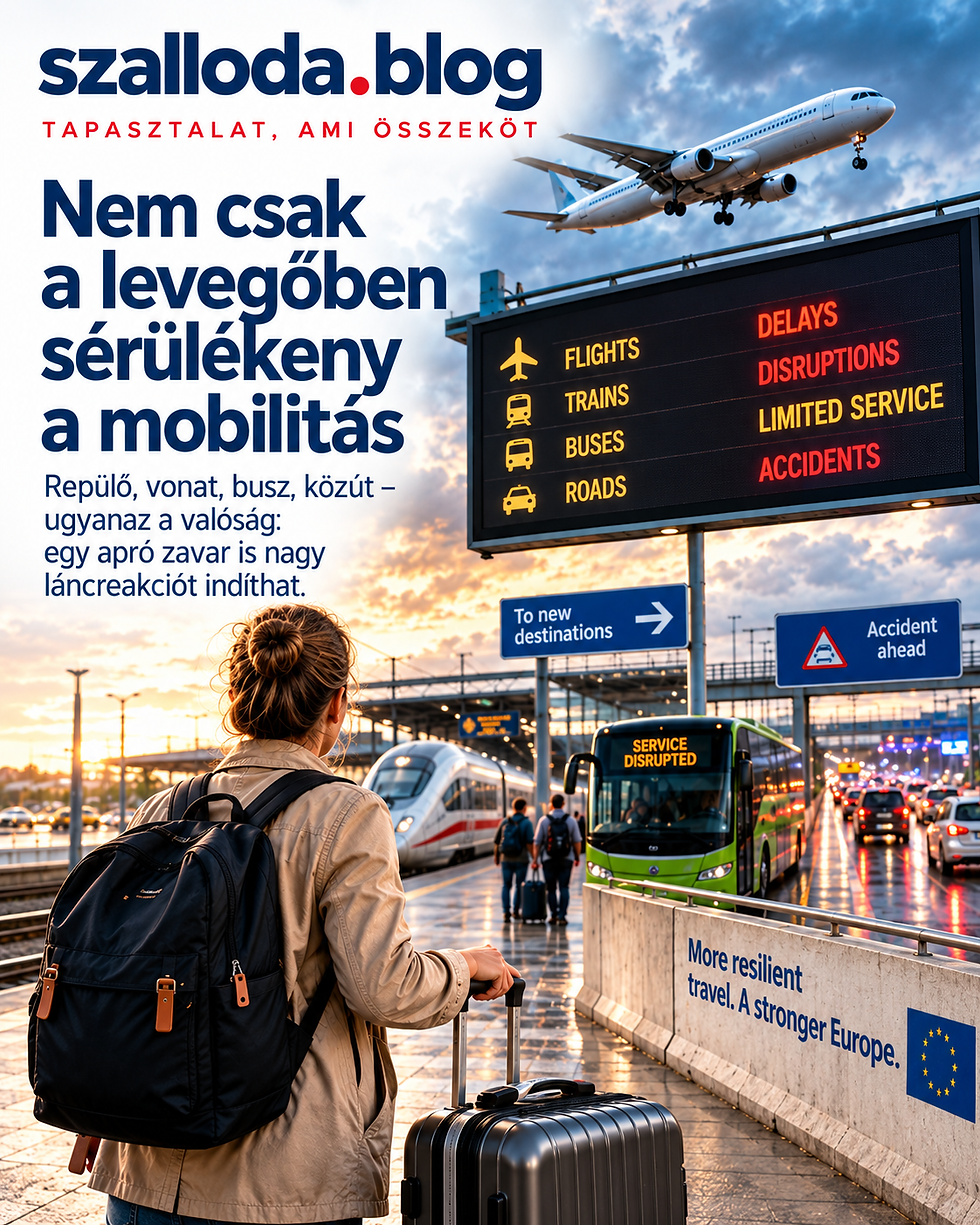
Not Just Aviation: Roads and Railways May Become More Vulnerable Too
EES operates at external Schengen land and sea borders as well, so the same capacity problem can arise at road crossings. In April, the International Road Transport Union (IRU) warned that practical implementation was uneven and said it was monitoring border delays and disruptions to operators. Source: IRU, 'EES Goes Live, Testing Readiness at EU Borders'.
In coach tourism, an extra half-hour or hour directly affects driving and rest periods, hotel arrival, a guide's working hours, meals and the next stop on the itinerary. At multiple borders, delays may accumulate.
Dover illustrates how the technological transition remains unfinished in some places. According to current information from the port, EES was not yet operating with the full planned biometric procedure for car passengers, and the dedicated Western Docks infrastructure could not be used as originally intended. Source: Port of Dover, EES FAQ.
Rail is not excluded. On 1 September 2026, Eurostar's travel updates reported delays at Paris Gare du Nord, Brussels-Midi/Zuid and Amsterdam Centraal attributed to 'EU border control procedures'. Source: Eurostar, Travel Updates.
If passengers on a four-hour rail journey must arrive at the station another half-hour or hour earlier, door-to-door competitiveness deteriorates much as it would if the train itself were slower.

Meanwhile, Europe Wants International Tourism to Grow
Eurostat figures released on 1 September show 1.321 billion tourist accommodation nights in the EU during the first six months of 2026, 1.7% more than the previous year. Nights by foreign visitors rose 2.5%, domestic demand 0.9%, and non-resident guests accounted for 48.9% of all nights. Source: Eurostat, 'EU Tourism Nights Up by 1.7% in First Half of 2026'.
The international category includes visitors from other EU member states as well, but the figures still show Europe's tourism industry's substantial dependence on cross-border mobility.
When entry into the continent becomes slower or harder to plan, the impact does not end at the terminal exit. Airports, airlines, rail, coaches, tour operators, hotels, restaurants, attractions and cruise companies all depend on different stages of the same visitor expenditure.
Europe is competing for high-spending long-haul markets, yet one fundamental process for entering the continent risks becoming slower and less predictable. This is now a question of destination competitiveness.
Inconvenience Can Easily Undermine the Desire to Travel
EES alone will not decide whether someone visits Europe. But rising airfares, geopolitical uncertainty, higher room rates, new travel authorisation, longer airport queues, larger connection buffers and the risk of missing a flight all accumulate for the same passenger.
Consumers ultimately do not analyse regulations: they compare total travel time, price and convenience. If the same European journey becomes longer, costlier and less predictable, it becomes easier to choose another destination, direct flights, a shorter journey or fewer trips.
European aviation is not currently expanding through an especially dynamic route network either. According to IATA's May analysis, Europe's air-route network grew by only 1% net in 2025, while EU air connectivity and the associated tourism support more than 9.2 million jobs and around €760 billion in GDP. Source: IATA, 'EU Air Connectivity Flatlined Under High Costs and Onerous Regulation', 21 May 2026.
In tourism, time is a cost just like an airline ticket. Another hour at the border can mean longer coach operating time, reorganised transfers, later check-in, missed activities or an extra hotel night after a lost flight connection.
If larger buffers become built into timetables and transfer rules, the same Budapest, Split or Ljubljana effectively moves farther from New York, Toronto or Tokyo — not in kilometres but in time.
Digital Systems, Analogue Capacity Shortages
One of the most important EES lessons concerns the old mistake of assuming digitalisation automatically creates efficiency. A kiosk does not create more square metres in an airport terminal, a biometric gate cannot replace missing border officers, and an algorithm cannot move unlimited numbers of passengers through the same bottleneck.
ACI EUROPE, A4E and IATA list the same requirements: adequate staffing, stable IT systems, working self-service kiosks, automated border controls and usable preregistration. Source: their joint EES letter.
The technology is in place; now operations must catch up. The coming weeks will show whether Europe can treat the digital border as seriously as a capacity-management and customer-service challenge as it has treated security and IT.

And ETIAS Is Still to Come
Following EES, the European Travel Information and Authorisation System (ETIAS) is planned for launch in the final quarter of 2026 under the EU's timetable current when this article was written. Source: European Union, official ETIAS information.
Affected visa-exempt third-country nationals will need to apply for electronic authorisation before travel, at a fee of €20, subject to specified exemptions. Source: European Union, ETIAS application and fees.
Before that next digital step, it is especially important not to dismiss EES operational failures as mere teething troubles. Modernisation succeeds when the traveller notices it less, not when people have to add yet another buffer to their itinerary.
Now Comes the Real Test
The most telling figure over the coming weeks will not be how many millions of entries and biometric records EES captured successfully. More important will be what happens to waiting times at Frankfurt, Munich, Amsterdam, Paris and Mediterranean holiday airports; whether missed connections rise further; what occurs at Dover and other external borders; and whether airlines begin adding larger connecting-time buffers.
If travel time rises permanently for flights, trains and particular road routes, EES ceases to be merely a border-administration project. It becomes a mobility, tourism, competitiveness and ultimately economic issue.
Travellers do not care which ministry, IT system, border authority, airport or airline caused the problem. They bought one journey and will remember only one thing about it: did it work or not?
Europe spends enormous sums persuading the world's tourists to visit. The real question is therefore no longer whether the database works, but how long it takes to admit visitors once they finally arrive.

Sources and Further Reading:
The legal, regulatory, industry and international information in this article reflects the position as of 6 September 2026. AI tools, including ChatGPT and Claude, assisted with collecting, comparing and organising the material. Final editing, interpretation and conclusions reflect the editorial position of szalloda.blog. AI applications were also used to produce some illustrations and infographic elements.
This article was translated from the original Hungarian using artificial intelligence. The original language is Hungarian.



Comments