
.png)

Geneva under siege? They talk about sustainability while a city builds defences against itself

Updated: Jun 13
Closed streets, boarded-up shop windows, extraordinary security measures and hundreds of temporary workers. Are the economic and diplomatic benefits of the G7 summit really proportional to the social, environmental and economic costs borne by the local community?

The 2026 G7 summit will take place from 15 to 17 June in Évian-les-Bains, France, on the shores of Lake Geneva. The arrival of delegations and world leaders, however, will begin on 14 June, while security measures connected to the event have already been in force since 11 June. Restrictions, road closures and increased security controls affect the entire Geneva metropolitan area, including the Swiss-French border region. Due to the chosen location, a significant proportion of participants and delegations will use Geneva Airport, meaning that the actual impact of the event extends far beyond the borders of Évian.
The security preparations are not only visible in public spaces. Numerous international organisations, multinational corporations and private companies are encouraging their employees to work from home during the summit. Several government offices and public service centres are operating with limited opening hours or have temporarily closed, while certain public transport routes have been placed on a reduced schedule. For the tens of thousands of commuters travelling daily from France into Geneva, crossing the border has also become more difficult, with longer waiting times and less predictable travel conditions.

The advisory issued by the United States Embassy provides an accurate picture of both the reasons for and the nature of the expected restrictions. Read it here
The most visible change, however, is the transformation of the cityscape itself. In many parts of the city centre, pedestrians are greeted by boarded-up shop windows. By 11 and 12 June, temporary protective structures and an increased police presence were already clearly visible. Numerous shops and service providers announced reduced opening hours for the summit period as a precautionary measure, while others chose not to open at all.

Authorities are paying particular attention to 14 June, the main arrival day for delegations and heads of state. Several organisations opposing the G7 have announced demonstrations throughout the region, while security services are also preparing for spontaneous anarchist actions and acts of vandalism.
Naturally, nobody disputes that a meeting of world leaders requires extraordinary security measures. The real question is where the boundary lies between necessary protection and restricting the normal functioning of a city.
The economic balance is not necessarily as straightforward as it may first appear. Aviation, airport services, the security industry, and certain hotels and restaurants undoubtedly benefit from the event. Private jets, government aircraft, delegations and members of the international press are arriving in the region, generating substantial additional traffic and revenue.
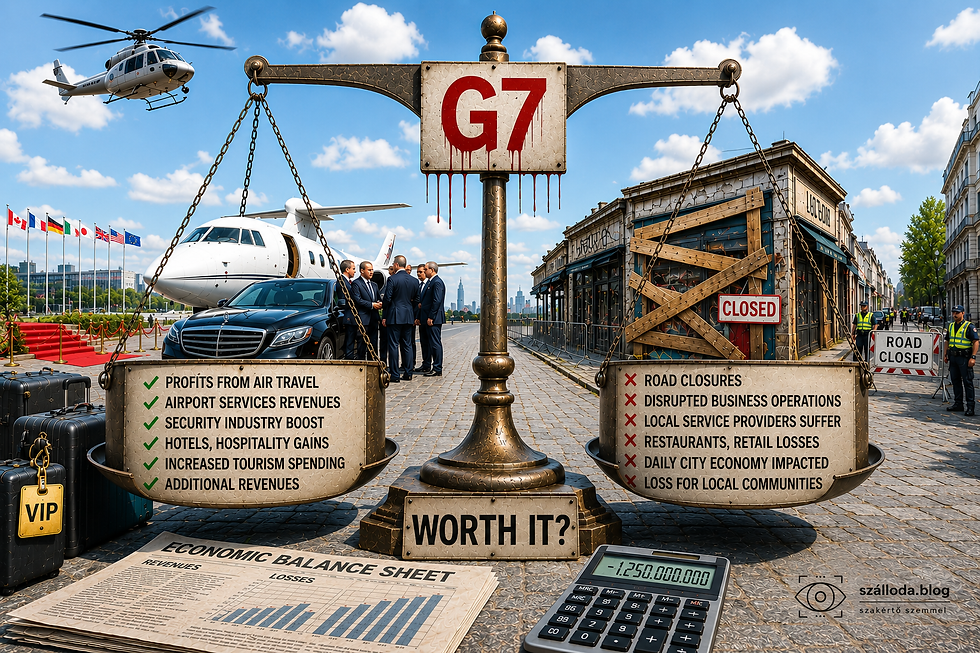
At the same time, it is worth asking whether these additional revenues truly offset the losses suffered by retailers, local service providers, restaurants and the wider urban economy as a result of the restrictions. A boarded-up shop window is not merely a security measure; it is also a symbol that the owner cannot expect normal business operations during those days.
The situation also raises important environmental questions. Hundreds of temporary workers have arrived in the region to build protective walls and security structures in record time, only for them to be dismantled a few days later. Hundreds of trucks are transporting construction materials, while temporary infrastructure appears and disappears almost overnight.
While political leaders will be discussing climate protection, the responsible use of resources and sustainable economic development, the event itself and the measures associated with it appear to demonstrate precisely the opposite. How many forests are sacrificed because of this event? How many truck kilometres are required to transport the protective structures and timber? What is the carbon footprint of moving and supporting a security apparatus consisting of thousands of people?

Sustainability is not exclusively an environmental issue. Equally important are quality of life, the sense of security, freedom of movement, the functioning of public services and the extent to which residents can still feel that the city belongs to them.
During the G7, Geneva temporarily loses some of these qualities. Road closures, transport restrictions, reduced services and disrupted daily routines create an atmosphere far removed from the open and international city that Geneva represents throughout the rest of the year.
When assessing the competitiveness of cities, infrastructure and financial advantages are no longer the only factors that matter. Today, predictability, accessibility and quality of life carry even greater weight. These are precisely the values that normally lead international organisations, corporations and private individuals to choose Geneva.
Yet during these days, Geneva presents the opposite image. One of the world's most liveable, safest and most international cities is temporarily building defences against itself while G7 leaders discuss economic stability, sustainability and social resilience. One of the world's most important economic and political centres is, for all practical purposes, grinding to a halt.
The extent of the damage therefore cannot be measured solely by the number of broken shop windows or direct financial losses. The costs also include fear and uncertainty, as well as lost tourists, postponed business trips, closed shops and the psychological burden imposed on local residents by living through this extraordinary, albeit temporary, situation.
The participants of the G7 summit will leave the Lake Geneva region on 17 June, and most of the protective structures will likely disappear within a matter of days. The consequences and the questions raised, however, will remain with us long after the roadblocks and restrictions have been removed.
Do we still need meetings like these in the 21st century if they can only be organised at such a cost? And when will we finally begin to incorporate a simple but fundamental principle into the concept of sustainability: that a city must remain liveable for the people who live there every day?


About the Author
Tamás Pakuts is an international tourism, hospitality, aviation, and mobility expert with nearly 35 years of professional experience. Throughout his career, he has held executive leadership, consulting, training, and project development positions across numerous countries in Europe and Asia, working with airlines, airports, hotels, cruise companies, tourism organizations, and international development projects.
Currently based in Geneva, Switzerland, he provides independent analysis of developments and trends in tourism, transportation, hospitality, and mobility. As the founder of Szálloda.blog, he helps readers understand industry trends, challenges, and opportunities through expert analysis, opinion pieces, and professional commentary.


Comments