


HUF 5.5 Billion for Hungary's Regional Airports: Enough to Survive, Too Little to Restart?

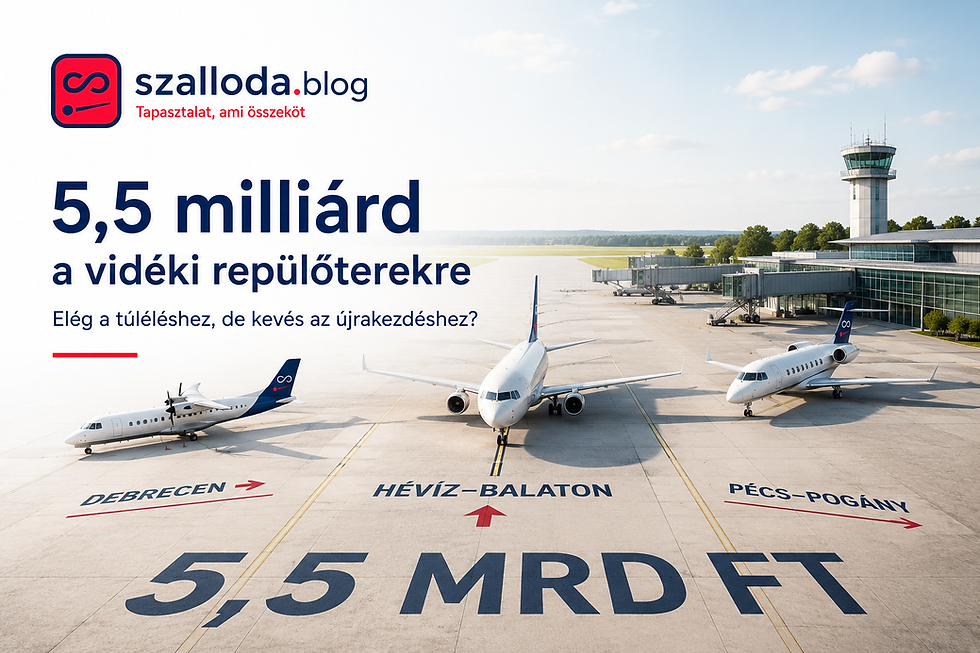
The Hungarian government has allocated an additional HUF 5.5 billion to keep Debrecen, Hévíz–Balaton and Pécs–Pogány airports operating in 2026. The decision appears necessary: without support, all three might have been at risk. But the money is primarily a lifeline, not an airport-development programme. We must therefore ask not just whether it was necessary, but what it should finance, how far it will stretch and what happens afterwards.
On 7 August, the government announced HUF 5.5 billion in additional funds for temporarily operating Debrecen, Sármellék's Hévíz–Balaton and Pécs–Pogány airports. The government briefing warned that without assistance the operating companies could become insolvent, airports might shut down and approximately 250 jobs could be threatened. The minister for transport and investment was also tasked with auditing the three airport operators and preparing a comprehensive sustainable operating model. That last element matters at least as much as the funding itself.
Hungary's regional-airport problem has never been simply a shortage of money. State bodies, municipalities and other public stakeholders have spent substantial sums at Debrecen, Sármellék and Pécs on infrastructure, operations and route development. Yet the same fundamental question keeps returning: what role should these airports have in Hungary's transport, economy and tourism, and what is maintaining that role worth?
What Can HUF 5.5 Billion Really Achieve?
HUF 5.5 billion may sound substantial, but three international airports operate on another scale. Hévíz–Balaton Airport recently completed an infrastructure programme worth HUF 3 billion, with HUF 2.77 billion for infrastructure, approximately HUF 122 million for equipment and the rest for administrative and regulatory costs. The terminal, taxiway, lighting and ILS/DME navigation system were upgraded, and more than 1,200 pavement defects were repaired on the runway. One development programme at a single airport thus cost more than half the present rescue package.
Debrecen's scale is even more revealing. An earlier aviation strategy envisaged a HUF 33 billion programme to target one million annual passengers, profitable operations and stronger service to regional industry. The plans involved a runway, terminal, tower, navigation equipment and road infrastructure. Much remained unrealised, but the figure illustrates the difference between keeping an airport open and genuinely repositioning it.
Operating costs are considerable too. In 2024, Debrecen Airport recorded revenue of HUF 2.4 billion and a loss of around HUF 2.6 billion. Sármellék, meanwhile, reported turnover of HUF 518 million and after-tax profit of HUF 15 million. Even those figures show that the three airports' financial positions cannot be described with one shared formula.
Treating HUF 5.5 billion as development funding would therefore mislead. It may be enough for the government's stated short-term purpose, but precise conclusions require the allocation between airports, current liabilities, actual annual operating costs and revenue positions. The broad conclusion is already clear: that sum may keep three airports alive for a time. It cannot also reposition all three, overhaul their infrastructure and build sustainable international networks.

What Should the Money Be Spent On?
The worst outcome would be simply dividing HUF 5.5 billion between the companies, paying the most urgent bills and discovering months later that we face precisely the same financing gap next year. The immediate priority must be liquidity and safe airport operations, but each public forint should also buy time to create a sustainable longer-term system.
The first task is operational stability. Flight safety, rescue and firefighting readiness, security, runway and taxiway maintenance, power, insurance, IT and communications, regulatory compliance and properly trained staff are not optional costs. Many must be paid even when no scheduled passenger aircraft arrives that day. That is why the cost structure of a low-traffic airport is inherently difficult.
Support must not merely defer maintenance into the next crisis. When cash shortages force an airport to postpone equipment replacement, use ageing systems or reduce preventive maintenance, hundreds of millions saved today can become billions in investment needs a few years later. The audit should identify hidden technical and capital backlogs at each property.
The next task is improving commercial and route-development capability. That does not mean indiscriminately subsidising airlines from operating grants. It means professional catchment-area studies, passenger-flow data, corporate-demand surveys, tourism-market analysis and serious route development that presents airlines with commercially grounded offers, not generic slides. Too many regional routes in Hungary have been launched by finding an airline first and then looking for passengers.
Success need not mean each airport announcing as many new destinations as possible. A suitably frequent hub connection through Munich, Frankfurt, Istanbul or another network gateway can create access to hundreds of onward destinations and be worth more to a region than five point-to-point flights once or twice a week. Route counts, like passenger totals, can be poor KPIs unless measured against connectivity and genuine regional economic value.
Finally, measurable performance and transparency should be conditions of support. If public money maintains airports, their annual operating costs, own revenues, passenger traffic, commercial income, government and municipal contributions and expected economic, tourism or mobility outcomes should be reported openly. Subsidy per passenger cannot be the only measure because an airport's regional economic effects are broader. But neither is it acceptable to finance billions in losses year after year without first defining success.

Debrecen Does Not Need What Sármellék or Pécs Needs
The three airports serve different markets, catchment areas, infrastructure, economies and tourism opportunities. We should not try to create three miniature Budapest Airports, but three models built around demonstrable regional needs.
Debrecen already has a genuine international aviation market. Its economic development, industrial investments, university, healthcare role and larger eastern Hungarian catchment may justify stable international services. The priority is not another spectacular announcement, but stabilising the existing network, providing suitable frequencies, improving access to major European and global networks and considering how cargo, business aviation and other activities can diversify revenue away from passengers alone.
Hévíz–Balaton requires a very different commercial logic. Its future should be linked more closely to Hévíz, Lake Balaton, Zalakaros, Keszthely and inbound tourism across western Hungary, not merely the July–August holiday peak. Health tourism, wellness, German-speaking markets, older higher-spending visitors, tour-operator partnerships and longer-season charter programmes may fit more naturally than forcing the airport into a conventional low-cost regional model. After HUF 3 billion in infrastructure work, it needs markets and passengers more than more concrete.
Pécs–Pogány faces even more fundamental decisions. After Universal Air withdrew in 2025, a Munich connection restarted in March 2026 under skyhub PAD with a DAT ATR 72-600. The twice-weekly service stopped again after little more than two months. According to Pécs municipality, operational difficulties at the German coordinating partner caused suspension from 10 June. Within a few years, a sustainable scheduled link between Pécs and a major European hub had therefore failed for a second time.
That does not prove Pécs needs no airport or can never support an international route. It does mean current arrangements must be reassessed. If business, university and tourism demand makes a hub connection strategically important, the case should be tested with adequate frequency, network integration, multiyear financing and potentially a lawful public-service obligation or regional support model. If provable demand is insufficient, business aviation, charters, flight training, specialised aviation and other functions deserve honest examination. The most expensive model is maintaining full international-airport infrastructure without knowing exactly what task it should perform.

We Asked Pécs–Pogány, Hévíz–Balaton and Debrecen Airports in a Spirit of Cooperation. They Found Common Ground in Silence.
For us, the question of Hungary's regional airports did not begin with this HUF 5.5 billion allocation. We had contacted all three more than once, not with a few broad press questions but with detailed professional enquiries.
First, we prepared a comprehensive 48-point questionnaire covering current operations, economics, infrastructure, route development, tourism links, general aviation, training and public-service roles, government and municipal involvement, and longer-term strategy.
We then sent a further fifteen questions tailored to the three airports for our analysis of Hungarian regional aviation. We asked whether they saw potential for domestic or regional services, which routes were commercially relevant, how business, tourism, universities and healthcare might benefit, how they assessed road and rail access, and whether links using 30–70-seat regional aircraft could be realistic.
We specifically asked about possible public-service obligation (PSO) routes where commercial operation might be unsustainable but regional benefits could justify support. We asked whether the main value lay in domestic connections or feeder services to major networks, and which hubs — Budapest, Munich, Vienna, Frankfurt or Warsaw — might be viable, including infrastructure, operational and regulatory prerequisites.
The questionnaires also covered poor-weather operations, permanent fuel supply, necessary investment, experience from earlier scheduled routes, partnerships with airports, cities, universities, tourism bodies and businesses, and any traffic data, strategies or development plans the airports could share for objective analysis.
These were not questions such as 'What do you generally think about regional aviation?' They were concrete operational questions directly relevant to the airports, in two separate questionnaires totalling sixty-three points.
Both the original 48-question general questionnaire and the fifteen targeted regional-aviation questions are attached to this article unchanged, so readers can judge whether it was reasonable to expect professional answers from airport management.
Our approach was constructive: no meaningful discussion of regional aviation can take place without the professional views of three airports serving different markets. Yet all three showed surprising unity: they reportedly consulted one another and then chose silence instead of substantive replies.
The HUF 5.5 billion public intervention gives that silence different significance. The same airports are now being maintained with public funds, and the government has ordered an audit and a sustainable model. In effect, the state is now asking questions we asked before: what each airport is for, what traffic is realistic, what investment is needed, which financing is justified and how to integrate each airport into working regional transport and tourism.
A company or executive declining a press enquiry is not by itself evidence of professional incompetence. But when management of three substantial publicly owned infrastructure businesses, now again publicly funded, declines to answer two detailed professional requests, questions of governance and accountability are legitimate. Do the ownership and management structures provide the professional responsibility and public transparency appropriate to assets of this scale?

An Airport Alone Is Not Tourism Development
Tourism must not be considered separately from transport. Sármellék makes no sense without Hévíz and Balaton; Pécs without Villány, Harkány, Siklós and southern Transdanubia; Debrecen without Hajdúszoboszló, Hortobágy, Nyíregyháza and the broader eastern Hungarian region.
For an arriving guest, the product is not the runway but the entire journey. How do they travel from terminal to hotel? Is reliable public transport or transfer available? Can they discover regional attractions and book suitable hotels and activities? Are marketable packages offered in their home country that make them want to fly to Pécs, Hévíz or Debrecen?
MTÜ must have a central role. Promoting destinations served by existing flights is not enough; research, demand data and targeted route development should establish which source markets, visitor segments, seasons and connections can generate genuinely new traffic to the regions. Demand does not automatically appear when a flight goes on sale. Airlines, destinations and distribution networks must build it together.
A permanent operational task force should bring MTÜ together with the transport ministry, foreign affairs and trade ministry, relevant airports and regions, and key business and tourism stakeholders. Its job should not be another broad strategy paper, but concrete markets, carriers, routes and measurable outcomes. Where is proven business or tourism demand for Debrecen? Which German, Austrian, Swiss or other European source markets can support a longer season at Hévíz and Balaton? What could justify Pécs flights, and how might its catchment extend beyond Baranya? These questions need evidence and coordinated airline sales proposals.
Hungary's Foreign Economic Network Could Contribute Much More.
Embassies, commercial attachés and overseas tourism contacts often know local tour operators, companies, associations and partners capable of building demand for routes. The transport ministry should coordinate airports, aviation law, route development and potential PSO models. MTÜ should ensure that at the other end of each flight lies an internationally marketable destination.
This also requires moving beyond the Budapest-centred assumption that inbound tourism and international air travel almost always pass through Ferihegy. Budapest remains Hungary's main gateway. But balancing regional tourism requires deliberately investigating sustainable direct international access to destinations outside the capital. Foreign visitors arriving in Sármellék, Debrecen or Pécs are more likely to spend a significant share of their money outside Budapest than those arriving first in the capital and later being persuaded to travel on.
MTÜ therefore cannot regard regional airports as a marginal transport issue. If Hungary wants more foreign guests, longer stays and higher spending outside Budapest, direct international accessibility must be one of the instruments. Achieving that requires research, market development, interministerial coordination, professional route development and multiyear consistency — not a new route celebrated today and quietly removed from the timetable months later.
The transport ministry, MTÜ, foreign affairs, airports, airlines, tour operators, hotels, municipalities, universities and leading regional businesses should therefore sit at the same table. Separate strategies and campaigns are inadequate. Airports must be infrastructure within a larger regional economic and tourism model, where the goal is sustainable passenger flows rather than the announcement of one flight.

The Most Important Job of HUF 5.5 Billion: Buying Time
I therefore consider the government decision necessary and defensible. Closing a functioning airport, losing specialised employees and capabilities, allowing licences and services to lapse and rebuilding them years later can cost more than temporarily maintaining operations. But keeping something alive is not the same as justifying indefinite financing of its current form.
The most important outcome of HUF 5.5 billion may be the time it purchases. If that time produces three differentiated and accountable business models, multiyear financing plans, realistic traffic targets, route-development strategies and roles aligned with regional economic and tourism priorities, the grant may prove a necessary transitional investment. If in 2027 the only question is once again how many billions are needed to plug the companies' losses, the problem will simply have been postponed.
Audit findings should therefore be public to the greatest extent compatible with legitimate commercial and safety interests. Professionals and taxpayers deserve to know why airports are funded, what tasks and outcomes are expected, over which period and at what cost. Only then can justified infrastructure financing be distinguished from perpetual deficit support.
HUF 5.5 billion may be enough to avoid shutting the gates today, but cannot solve regional aviation's deeper problems. That requires clear choices, competence, accountability and a different strategy for each airport, not another rescue package.
This Is Not Our First Examination of Hungarian Aviation
Over recent months Szalloda.blog has approached Hungarian aviation from several angles. In 'Hungary's Regional Airports: Gateways to Regional Opportunity', we argued that an airport's value cannot be inferred from terminal passenger counts alone. Accessibility, regional economic connections, tourism potential and a sustainable long-term function matter more.
We examined Pécs–Pogány's repeated attempts to build routes, Universal Air's withdrawal and the skyhub PAD/DAT Munich service, with its network opportunities and limitations. We also considered Osijek Airport's proximity and cross-border competition, often ignored to Pécs's detriment. The central question was whether a route could be market-supported or needed a transparent, predefined, long-term regional support model.
In 'The Quiet Decline of Regional Aviation' and our analysis of European low-cost capacity expansion, we explored the shrinking role of smaller regional aircraft and feeder services as the market pursued bigger aircraft and more seats. The conclusion was that connectivity and its quality, rather than sheer seat or passenger volume, determine mobility's value.
Our Rail & Fly article considered how rail and aviation might form a genuine travel chain instead of two adjacent tickets. That requires integrated booking, protected transfers, baggage and passenger-handling arrangements and better links between regional towns and airports.
We have examined EU261 passenger rights and reform, airline responsibility for delays and cancellations, compensation systems, and why refunds can be so difficult after booking a digital ticket was easy. We also asked how major international events stress-test the air and urban transport system, and what reserve capacity regional airports could offer.
Related Earlier Articles
Our earlier analyses of Hungarian aviation, regional flights, airports and associated mobility issues in one place:
Hungary's Regional Airports — Gateways to Regional Opportunity: Different functions, catchments and future prospects for Debrecen, Hévíz–Balaton and Pécs–Pogány. Read the article.
Pécs–Pogány Airport: Another Failure or an Inherently Flawed Strategy? Lessons of Universal Air, skyhub PAD/DAT, Munich, competing regional airports and supported models. Read the article.
The Quiet Decline of Regional Aviation: Why small regional aircraft and feeder routes declined across Europe and why connectivity matters more than passenger totals. Read the article.
The Aggressiveness of Low-Cost Airlines: Europe Walked into Its Own Capacity Trap — Low-cost growth, overcapacity and regional aviation. Read the article.
Rail & Fly: Genuine Intermodality or a Greenwashed Ticket Bundle? Building an integrated rail-and-air journey and connecting regional towns. Read the article.
The Champions League Final: When One Football Match Becomes a Whole City's Test — Aviation, airports, city mobility and reserve capacity at major events. In the Aviation section.
EU261 Reform: Passengers Win, Airlines Want to Pass on the Bill — EU air passenger rights, rebooking, compensation and airline accountability. Read the article.
Customer Service or a System Designed to Prevent Payouts? What happens when an airline must pay its customer rather than collect payment. Read the article.
Szalloda.blog's complete Aviation section, with all related articles. Browse Aviation.
The present HUF 5.5 billion grant is thus not an isolated headline but another important chapter in the same problem. Hungary must eventually decide whether it wants functional regional aviation and, if so, what it expects it to achieve. Keeping three airports open is not enough: an operating terminal is not transport policy, a runway is not regional economic development and one subsidised flight is not a network.
The funding now buys time for answers. We should use that time to establish a workable Hungarian regional aviation system, not simply defer the next funding crisis.
About the Author

Tamás Pakuts is an international tourism, hospitality, aviation and mobility expert with nearly 35 years' professional experience in Europe and Asia, including more than 25 years in management roles spanning hotels, hospitality and tourism development.
His career includes executive, operational, consulting, teaching and expert roles with airlines, airports, hotels, cruise companies, tourism organisations and international development projects. His distinctive experience combines aviation, hospitality, destination development, transport, organisational transformation and executive coaching.
As hotel executive and consultant, he has led successful repositioning, organisational change, expansion and revenue-optimisation initiatives. Several businesses previously facing severe operational or commercial challenges achieved record occupancy and strong financial outcomes under his leadership. In some cases occupancy grew from below 25% to above 90%, while profitability and service quality remained sustainable.
He created the REVo Dynamic Revenue Optimization Method, among Central Europe's early dynamic hotel-pricing and revenue-management approaches, before dynamic pricing became widely established. REVo-based pricing and sales supported occupancy gains, stronger market positioning and improved business results for several hotels.
Hotels and hospitality businesses he managed won national and international awards in quality, guest satisfaction, operating excellence, wellness and innovation.
Beyond hotels, he contributed to gastronomy and culinary tourism as an adviser to Hungary's national culinary team, drawing on his experience in service quality, training and strategic development.
His aviation work has covered airline management, airline marketing, airport development, route development and consulting. His knowledge of aviation law and advocacy helped secure changes to the bilateral Hungarian–Swiss air services agreement enabling designation of additional operators alongside the national carriers. He founded one of Europe's early virtual airlines and for years operated an air bridge linking Kazakhstan's oil and gas fields with the wider world.
He worked on airport feasibility studies, airline business development and transport projects linked to tourism, gaining direct understanding of accessibility, connectivity and competitiveness.
At the opening of Debrecen Airport to civilian traffic, he provided professional ground-handling expertise, and also played active roles in initiating international operations at Atyrau Airport in Kazakhstan and Cheboksary Airport in the Russian Federation.
His experience includes leadership roles aboard river and ocean cruise vessels, managing multicultural teams, complex hotel operations, guest experience, leadership development and crisis response internationally.
He is also a certified executive coach, trainer, DISC expert and organisational development adviser. Over the years, he has delivered thousands of coaching, consulting and training programmes for executives and service professionals.
He believes successful tourism development is inseparable from transport networks, infrastructure, access, local communities, sustainability and the complete visitor experience.
That philosophy is the basis of Szalloda.blog, an independent professional platform exploring relationships among tourism, hospitality, air and rail travel, mobility, destination development and economic policy.
He currently works internationally as consultant, trainer and specialist across Europe and Asia while independently publishing on the future of tourism, transport, hospitality and regional competitiveness.
This article was translated from the original Hungarian using artificial intelligence. The original language is Hungarian.


Comments