.png)


Hungary’s public transport system is one of the country’s greatest yet still untapped tourism and economic assets


Tourists do not see industries — they see experiences
One of the greatest structural problems of Hungarian tourism development may not actually be tourism itself. Rather, it is the fact that we still fail to think in integrated systems, continuing to treat the following areas separately:
hotels,
transportation,
railways,
airports,
river and maritime transport,
active tourism,
conference tourism,
wine tourism,
and even city marketing.
Yet visitors do not experience these as separate sectors.
For tourists, there is only one reality: how simple, comfortable, visually appealing, predictable, and experience-driven the entire journey feels from beginning to end.
The tourism experience does not begin at the hotel. It begins with the very first search, the first timetable, the first transfer, and the very first impression. Even when phrased diplomatically, Hungary still has enormous — and only partially utilized — potential in this area.

While a significant share of tourism development projects in recent years has focused on hotel investments, premium and luxury projects, spectacular attractions, and large-scale real estate developments, far less attention has been paid to how accessible and user-friendly the country itself actually is from a tourism perspective.
This is a strategic mistake, because in the long run competitiveness will not be determined by how many new wellness hotels are built along Lake Balaton, but rather by how easily, comfortably, and experience-driven tourists can move around the country and its regions — while also supporting a more responsible and sustainable relationship with the environment.
Despite the recognition of these challenges at a strategic level, the system itself has still not been built accordingly
What makes this particularly interesting is that Hungary’s tourism-related strategic documents clearly identify the problem — yet fail to address it in practice.

The National Active Tourism Strategy 2030, for example, explicitly states that improving environmentally friendly access to entry points and tourist attractions is essential. It specifically refers to the coordination of timetables, the development of regional tourism transport systems, and the expansion of bicycle transport options.
The strategy also includes ideas related to the development of forest railways, narrow-gauge railways, and other small railway networks, as well as the stronger integration of railway stations with active tourism entry points and destinations.
The strategy even emphasizes that for tours starting and ending at different locations, proper return transport solutions should be ensured, and that tourism should be integrated far more closely into the public transportation system.
So, on paper, the recognition clearly exists. In reality, however, the overall picture remains very different — and still highly incomplete.
Once again, this is where the difference in mindset between the National Tourism Development Strategy 2030 and the National Active Tourism Strategy 2030 becomes particularly striking.
While the NTS2030 still primarily focuses on:
destinations,
attractions,
accommodation developments,
priority tourism regions,
and guest-night statistics,
the NATS2030 places far greater emphasis on transport integration, network-based mobility, and the role of public transportation within tourism.
This also means that Hungarian tourism strategy still tends to underestimate the importance of mobility within the domestic tourism market, despite the fact that domestic tourism could serve as a key factor in economic stability, an effective tool for extending the tourism season, a driver of regional economic development, and one of the foundations for the long-term viability of smaller regions and rural communities.
These aspects are even less visible in inbound tourism strategies, despite the fact that for international visitors the overall “usability” of a country is often just as important as the attractions themselves. A destination may be outstanding, but if getting there is difficult, transfers are complicated, integrated ticketing systems are missing, multilingual information is limited, or an entire region is practically inaccessible without a car, the overall tourism experience immediately becomes less competitive and less attractive.
In modern European tourism, mobility is no longer merely background infrastructure — it has increasingly become a tourism product in its own right.

Hungary remains a predominantly car-centric destination
Hungary’s tourism potential is exceptionally strong:
UNESCO World Heritage sites,
health and wellness tourism,
active tourism,
wine tourism,
lakes,
rivers,
national parks,
historic towns and cities,
gastronomy,
and cultural heritage.
Yet in many cases, private cars still remain the only truly practical option, largely due to the lack of properly optimized and well-integrated public transportation.
By contrast, Europe’s most competitive tourism regions are no longer built around car-based tourism. Instead, mobility itself has consciously become an integral part of the overall travel experience.
Modern travelers increasingly want to avoid driving, searching for parking spaces, and sitting in traffic jams. At the same time, sustainability and environmental awareness are becoming ever more important factors in their travel decisions.

Hévíz, Hollókő, Szilvásvárad, Tokaj, and Villány: outstanding destinations with difficult accessibility
Many Hungarian destinations with outstanding tourism value remain difficult, slow, or unpredictable to reach by public transportation — especially for international visitors, older travelers, or younger generations increasingly choosing to travel without cars.

Hévíz could easily rank among Europe’s leading and most internationally recognized wellness tourism destinations, yet its transport connections still fall far short of its global potential. The role of Hévíz–Balaton Airport remains limited, there is still no direct railway connection, and the nearest major rail station — Keszthely — is often not properly integrated with onward transport services. For an international visitor — or even for a traveler arriving from Budapest — the journey still involves too many transfers, too much uncertainty, and a significant loss of time.

Hollókő faces a very similar challenge, only on a different scale. The UNESCO World Heritage village is one of Hungary’s most iconic cultural attractions, yet it remains extremely difficult to access by public transportation. The lack of a railway connection, infrequent bus services, multiple transfers, and limited weekend schedules mean that the destination is still, in practice, heavily dependent on car-based tourism.

Villány and Siklós represent an even more striking contradiction. This is one of Hungary’s most important wine tourism regions, with exceptional additional strengths in wellness tourism, gastronomy, and cultural heritage. Yet despite this potential, the region’s accessibility by public transportation remains weak. Rail connections from Budapest are still slow even to Pécs, regional feeder systems remain underdeveloped, and transportation within the region itself is often practically nonexistent without a car due to poor schedules and inconsistent service quality.

In Western Europe, one of the fundamental principles of wine tourism is that visitors should not have to drive themselves. In Austria, Italy, and France, fully integrated wine tourism shuttle systems, regional railway connections, and organized mobility networks are already an established part of the tourism experience.

Eger and Tokaj are in a considerably better position from a railway perspective today than they were in the past, yet the limitations of the overall system are still clearly visible. Access to a main railway line alone is not enough. Tourists do not simply want to arrive at a train station — they want to reach wineries, thermal spas, scenic viewpoints, hiking trails, wine cellars, boutique hotels, guesthouses, and private accommodations.
The “last mile” problem — the challenge of connecting visitors from transport hubs to actual tourism experiences — remains largely unresolved in Hungary.

Szilvásvárad is perhaps one of the best examples of how a destination with extraordinary natural potential can still remain significantly underutilized. The combination of the Bükk National Park, the Szalajka Valley, the forest railway, active tourism, and ecotourism could form the basis of a modern and sustainable tourism model. In reality, however, timetables are often poorly aligned with peak tourism periods, feeder connections remain inconsistent, railway infrastructure is slow, and the entire system still functions more like a weekend excursion destination than a professionally organized tourism network. The railway line itself between Eger and Szilvásvárad was, in practical terms, already condemned to decline once before — and today it continues to operate in a prolonged state of stagnation rather than genuine development.
Public transportation is still not truly integrated into tourism today
The county and national travel passes are undoubtedly among the best policy decisions made in recent years. They have made mobility within Hungary significantly cheaper and far more accessible — and importantly, they are available not only to Hungarian citizens, but also to foreign visitors.
From a tourism perspective, however, the system still lacks real integration and consistency. For visitors, it often remains completely unclear:
where the pass is actually valid,
which cities include local public transportation access,
where it cannot be used,
which narrow-gauge and forest railways are integrated into the system,
which ferry or boat services are included,
and at what point the supposedly seamless travel experience simply breaks down.
Scheduled ferry and boat services on Lake Balaton, for example, still do not function as a genuinely integrated transportation system.
Meanwhile, scheduled public transport services on the Danube River in Budapest remain, from a tourism perspective, largely underutilized — or after a previously successful period, practically nonexistent today, with only the Soroksár ferry connection still remaining.
In many European cities, river transport forms an integral part of both urban mobility and the overall tourism experience.

Domestic river transport is also a significantly underutilized opportunity
Hungary’s natural conditions in this respect are exceptionally favorable:
the Danube River,
the Tisza River,
Lake Balaton,
Lake Tisza,
Lake Velence,
as well as numerous smaller waterways and potential port locations across the country.
Despite this, domestic passenger shipping in Hungary still functions primarily as a seasonal excursion product rather than as a genuine transportation system. Yet historically, the country once had remarkably strong foundations for exactly this kind of integrated water-based mobility.

During the Austro-Hungarian Monarchy and in the period between the two World Wars, navigation on the Danube River was an important part of both Hungarian transportation and tourism. Passenger steamship services on Lake Balaton also functioned as a genuine element of regional mobility rather than merely as a tourist attraction.
In the past, scheduled passenger boat services operated on the Danube River between Budapest and Mohács, including stops in Kalocsa, Paks, and Baja.
Even today, destinations such as Budapest, the Danube Bend, or Lake Balaton could realistically support:
regular regional passenger boat services,
integrated tourism-oriented water transport systems,
hop-on hop-off river services,
timetables coordinated with railway connections,
boat services combined with bicycle transport,
or even premium panoramic river routes designed as tourism experiences in their own right.
In Austria, navigation on the Danube River is far more closely integrated into both the tourism experience and regional mobility systems. In the Netherlands and across Scandinavia, it is entirely natural for water transport to function as part of the urban and regional public transportation network.
Meanwhile, in Hungary, river transport has largely remained an underutilized opportunity rather than becoming an integrated element of modern mobility and tourism development.
Panoramic railway lines are one of Hungary’s greatest — and still barely utilized — tourism assets
Hungary still makes very limited use of the tourism potential hidden within its panoramic railway routes, despite the fact that the country has several railway lines that could themselves become attractions in their own right.

The railway line through the Danube Bend between Budapest and Szob possesses truly exceptional qualities even by European standards. Few riverside railway routes on the continent combine UNESCO-level scenery, historic towns, mountainous landscapes, and panoramic river views in such a remarkable way. Yet despite these extraordinary assets, the line still functions primarily as transport infrastructure rather than as a premium tourism experience.
A very similar situation exists along the northern shore of Lake Balaton, where the combination of lakeside panoramas, wine regions, volcanic hills, and cultural heritage could form a truly unique tourism product.
Yet the region still lacks:
modern panoramic railway carriages,
a unified visual identity,
multilingual tourism communication,
strong gastronomic integration,
premium onboard services,
and the kind of international marketing strategy that could successfully position the route as a destination experience in itself.
Szilvásvárad, the Bükk Mountains, and the Zemplén Mountains region also possess railway routes and landscapes around which many other countries would already have built complete tourism brands.

In Austria, the Semmering Railway or the Arlberg Railway are far more than simple railway lines — the journey itself is considered part of the destination experience. In Switzerland, the Glacier Express and the Bernina Express have become internationally recognized tourism brands in their own right. Meanwhile, in Slovenia, the Bohinj Railway is consciously integrated into the country’s alpine and active tourism networks.
Meanwhile, Hungary still tends to approach railways and mobility primarily through a purely transportation-focused logic. Yet in modern tourism, the journey itself has increasingly become an experience product in its own right.
The tourism potential of narrow-gauge and forest railways also remains far from fully utilized

Although both national tourism strategy documents mention the development of narrow-gauge and forest railways, in many cases these lines still operate as isolated attractions rather than as integrated elements of a broader tourism system.
In reality, they could become part of:
ecotourism networks,
cycling infrastructure systems,
national park tourism,
hiking trail networks,
and regional mobility systems.
In Transylvania, Austria, and Slovakia, numerous successful examples already demonstrate how forest railways, narrow-gauge railways, and historic railway lines can be transformed into modern tourism experiences and strong regional tourism brands.
Hungary has practically lost its domestic air transport network
While Hungary has practically lost its genuine regional and domestic air transport network, several neighboring countries have clearly recognized the economic and tourism value of decentralized aviation systems.
In Croatia, alongside Zagreb, airports such as Split, Dubrovnik, Zadar, Pula, Rijeka, and Osijek each serve their own tourism and economic regions with substantial international connectivity.
Poland is perhaps an even more striking example. Alongside Warsaw, cities such as Kraków, Gdańsk, Wrocław, Poznań, and Katowice operate as independent regional economic centers with their own international air connections. Decentralized aviation has played a major role in ensuring that Poland’s economic development is not concentrated exclusively around the capital.
In Slovakia, Košice has also become an important regional aviation hub alongside Bratislava, particularly in terms of industrial and business connectivity, supported in part through state involvement and PSO-based approaches.
Hungary, by contrast, has remained heavily centered around Budapest. Yet cities such as Debrecen, Hévíz–Balaton Airport, Pécs, or even Szeged could potentially play meaningful regional roles within a more balanced national mobility network.
At first glance, routes such as Debrecen–Pécs, Debrecen–Győr, or Debrecen–Sármellék may sound unrealistic to many people. Yet across Europe, it is precisely these kinds of regional connections that help sustain decentralized economic and tourism systems.
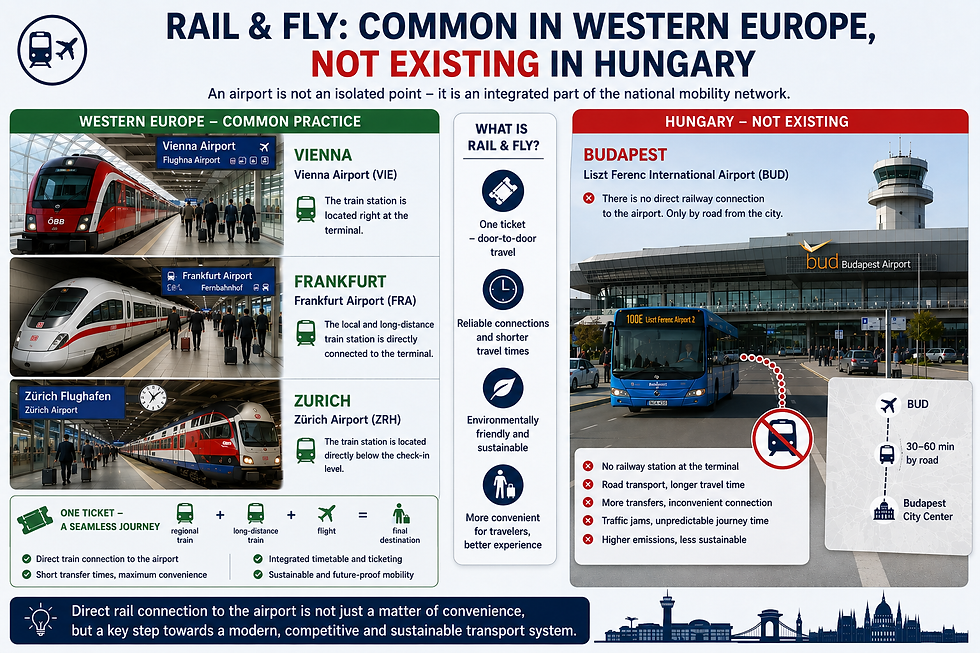
Rail & Fly: common practice in Western Europe, still missing in Hungary
This is where another concept enters the picture — one that has long become completely natural across Western Europe: the Rail & Fly system. In Germany, Austria, and Switzerland, most major airports already have direct railway connections. Airports are no longer treated as isolated transport hubs, but as fully integrated parts of the national mobility network.
In many cases, tourists and business travelers can reach their final destination using a single integrated ticket that combines:
regional rail services,
long-distance trains,
and air travel.
At airports such as Frankfurt Airport, Zurich Airport, or Vienna International Airport, the railway station has effectively become part of the terminal itself.
In Hungary, this mindset is still largely absent. Budapest Ferenc Liszt International Airport still lacks a direct railway connection — an increasingly noticeable weakness by European standards.
Even a well-organized nationwide airport express bus network could already represent a major step forward, especially if it were:
directly connected to the country’s main railway stations,
operated within an integrated ticketing system,
and designed to function as a regional feeder network.
Today, for travelers arriving from cities such as Debrecen, Győr, or Pécs, simply reaching the airport can already become a major logistical challenge.

Seaplane aviation also has historical roots in Hungary
Few people realize that seaplane aviation once had a significant historical presence in Hungary. Between the two World Wars, both Budapest and Lake Balaton formed part of the early European seaplane networks. The Danube River was not only a commercial shipping and passenger transport route, but also served as a natural infrastructure corridor for early aviation. At the time, seaplanes were not considered exotic tourist attractions, but rather modern and innovative transportation solutions.
Today, as experience-based mobility, premium tourism, short regional connections, and exclusive low-capacity transport concepts are gaining renewed importance, Hungary has fallen significantly behind in this area. Yet destinations such as Lake Balaton, the Danube River, the Tisza River, Lake Tisza, or even the Danube Bend could potentially support limited premium seaplane tourism experiences and regional connections.
In Croatia, Germany, Greece, Spain, and across the Scandinavia region, seaplane aviation still exists today as a functioning tourism and transportation product.
In Hungary’s case, this would not even represent a completely new concept — but rather the modern reinterpretation of a historical tradition. The country would also have access to the professional expertise and technical capabilities needed to support such initiatives.
Today, the real question is no longer whether we have something worth showcasing
Hungary’s tourism challenge is not a lack of attractions. The country still possesses enormous — and in many areas still underutilized — opportunities, along with more than sufficient tourism potential. The real question is whether Hungary is willing and able to learn from its neighbors, follow and adapt successful international examples, and finally catch up in terms of integrated tourism thinking, because the future of tourism is becoming less and less about a single hotel or attraction.
Today, competition increasingly revolves around mobility, simplicity, experience, sustainability, and integration — and around whether destinations are capable of functioning as interconnected networks rather than isolated tourism products.
The original article was written in Hungarian. The English translation was prepared with the assistance of AI.

About the author:
Tamás Pakuts has been actively involved in aviation and tourism for nearly four decades, and for more than 25 years also in the hotel and hospitality industry.
As both an executive and consultant, he has gained extensive insight into the operations of airlines, hotels, hotel chains, and cruise companies, while also successfully contributing to operational management, crisis management, and development projects across these sectors.
Today, together with his colleagues, he is active in numerous countries around the world as an expert, consultant, and trainer within the hospitality and aviation industries, currently working on several new international projects of notable professional significance.


Comments