.png)


Hungary's rural airports - The regional airport is the gateway to a region's opportunities


When a new scheduled flight takes off from one of Hungary's rural airports, Hungarian aviation is put back in the spotlight for a few days. There are celebrations, the press is there, interviews are done, and optimistic statements are made.
However, if the same flight is discontinued a few months or a few years later, the mood changes almost overnight. Public opinion is quick to pass judgment: the airport has failed again.
But I think we're looking for the reasons in the wrong place. A regional airport is much more than just a runway, a terminal, or a few scheduled flights.
A well-functioning airport connects with the world, helps businesses, facilitates the arrival of investors and supports tourism, just as it can host aircraft maintenance businesses, pilot training, cargo traffic, research and development or even sport aviation.
In other words, our airports represent a value that often only becomes truly visible when it is already missing.
Our airports are the engines of development
In recent months, we have covered Hungarian regional air transport several times. We wrote about the termination of the Pécs-Munich flight, the possibility of flights based on public service obligations, the situation of rural airports, and the role that air transport can play in the tourism competitiveness of a region.
However, during the conversations, I increasingly felt that we were falling into the same trap: we always talked about a flight or a specific airline, an airport, while the system itself was almost never discussed.
However, the real question is not how many flights depart from a given city, but what role a given airport can play in the development of its own region.
We shouldn't expect the same from every airport
In Hungary, we tend to measure all rural airports by the same standard. Let there be as many passengers, scheduled flights and as much traffic as possible.
However, this oversimplifies the issue, as an industrial center requires completely different air connections than a medical tourism region. A university city has different mobility needs than an automotive center, and a wellness destination is based on completely different travel habits than an export-oriented economic region.
We shouldn't expect the same from Debrecen, Hévíz–Balaton and Pécs–Pogány either. At first glance, all three are regional international airports. However, in reality, they can play three completely different roles in Hungary's economy and tourism.
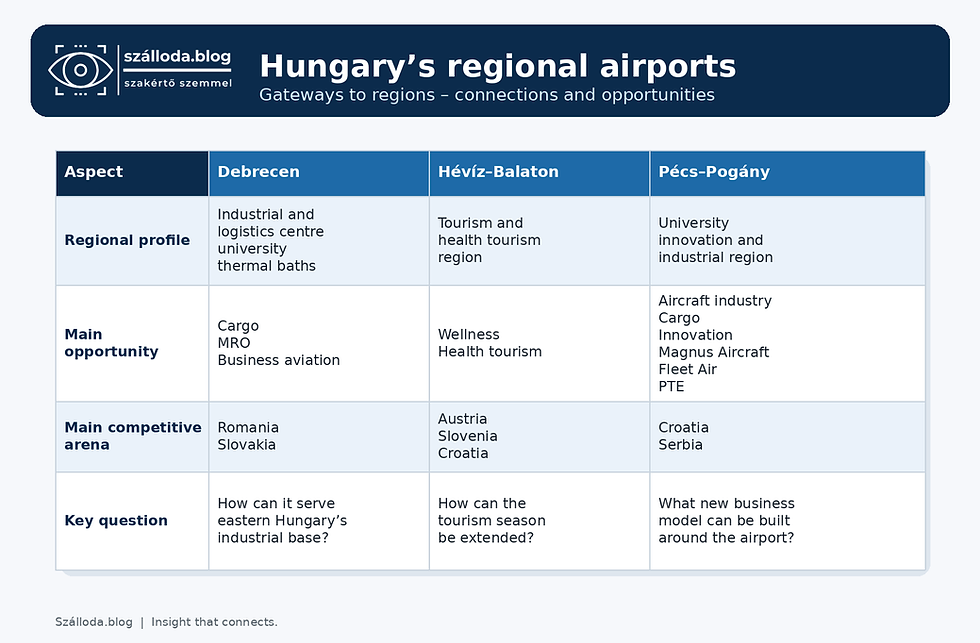
Even from this simple comparison, it is clear that the future of the three airports is not to be found in the same recipe.
The map of the catchment areas has been completely redrawn in the meantime.
In the past twenty years, the transport map of Central Europe has fundamentally changed, contributed by the expansion of the Schengen area, the development of the motorway network, online ticketing and the liberalisation of air transport, which have also created a completely new situation.
Today, for a passenger from Debrecen , Oradea, Cluj-Napoca or Košice may be a natural alternative, just as for a family from Pécs , Osijek or Zagreb, or even Belgrade is in many cases just as realistic a choice as Budapest. And those living in Western Transdanubia are now more likely to consider the offers of Vienna, Graz, Bratislava or Ljubljana than the Hungarian airports.
Airlines think exactly like this: not in terms of national borders, nor in terms of (city)counties, but in terms of so-called airport catchment areas . In other words, they examine how many potential passengers a given airport can reach, what kind of economic performance, what kind of corporate environment, and what kind of tourist demand it can achieve within a two- to three-hour drive/accessibility, and here national borders usually don't matter.
This approach fundamentally changes the picture of Hungarian regional airports, because in the 21st century, it is no longer primarily airports that compete with each other, but regions.

Three airports with completely different visions for the future
If we compare Debrecen, Hévíz–Balaton and Pécs–Pogány solely based on the annual number of passengers, we can easily reach wrong conclusions; in fact, all three airports serve different economic regions and needs.
Debrecen is the gateway to a dynamically developing industrial region. BMW, CATL and international investments in the region have given a new dimension to the role of the airport. The importance of cargo, aircraft maintenance (MRO) and business travel is expected to continue to grow. At the same time, Debrecen operates in an extremely competitive international environment. Oradea, Cluj-Napoca, Košice and Satu Mare are part of the same catchment area, while Wizz Air is present at several nearby airports , and numerous Romanian and international low-cost carriers are also available at the surrounding airports. Debrecen's future may therefore be determined at least as much by industrial development and its logistics role as by new scheduled flights, although the stable presence of Lufthansa with its Munich flight is encouraging, while cargo and MRO developments may even mean more stability in the long term than a new route.
Hévíz–Balaton plays on a completely different field. Here, the primary task of the airport is not to serve an industrial region, but to improve the international tourist accessibility of Balaton and Hévíz. Wellness and medical tourism, high-spending foreign guests, and extending the season are the most important challenges. The competitors are not Debrecen or Pécs, but Vienna, Graz, Bratislava, Ljubljana, Zagreb or even Maribor. The question here is not whether it can offer the same as these airports, but whether it can build on its own tourist specialties. The question is not whether Hévíz–Balaton can catch up with Vienna or Ljubljana, but how, building on its own strengths, it can become one of the important health tourism air gateways in Central Europe.
Pécs–Pogány is perhaps the most interesting example. Public discourse is almost exclusively asking: when will scheduled flights start again? However, this may not even be the most important question. Magnus Aircraft operates its aircraft factory and development center in Pécs, which is one of the aircraft development and production centers in Hungary, while Fleet Air also counts on the airport as a cargo and maintenance base in the long term. This is combined with the innovation background of the University of Pécs and the industrial development of the region. It is easy to see that the future of Pécs will not be determined solely by passenger transport, but by an emerging aerospace and innovation cluster . And Schengen has created a completely new situation here too: Osijek, Zagreb, and even Belgrade on certain routes have become part of the same competitive field.

A common response that is a message in itself
In preparing this article, we approached the management of the three airports with a detailed set of questions. We were curious to know how they see their own role, what improvements they need, what challenges they face, and what they expect from the coming years.
The three airports sent a joint response. Although they did not wish to respond in detail to any specific professional question, they were pleased to see that the domestic professional press is paying attention to the future of rural airports.
The joint response is noteworthy in itself. In addition to the local governments, the Hungarian state also plays a decisive ownership role in all three airports , through various organizations. In the case of Pécs-Pogány, this has been linked to the Ministry of Foreign Affairs and Trade in recent years, partly due to the air traffic related to the Paks investment. In the case of Debrecen and Hévíz–Balaton, the co-owner is a state company established by the former Ministry of National Economy.
According to several independent industry sources, this ownership structure may change in the coming weeks, with the transformation of the government structure following the change of government , which in itself may explain the caution in public statements.
However, it is worth noting that the joint response paid no attention to the positive developments that could determine the future of the three airports in the longer term. Debrecen's industrial and cargo capabilities, Hévíz's tourist potential, and Pécs's aerospace development are values that go beyond the issue of scheduled passenger transport.
We are not writing about airports.
This series of articles does not aim to decide which Hungarian airport is the most successful, but rather to show that behind every airport there is a region with its economy and opportunities, a social community, development ideas and a vision for the future. Therefore, we should not expect the same from Debrecen, Hévíz–Balaton and Pécs–Pogány.
The mission of airports always stems from the region to which they are the gateway.
In the coming months, we will therefore introduce additional regional, business, sports and general airports in Hungary, because the debate about the future of airports is actually not just about aviation, but about the future of Hungary's regions.
In the coming months, we will seek to answer whether these airports will be able to not only follow, but also shape the development of their own region, we will introduce additional airports and industry players and analyze their role and opportunities.

About the author
Tamás Pakuts has been working in the aviation, tourism and hotel industries for over three decades. He earned his Airline Manager degree in Geneva, studied airline marketing, passed a ground handling exam, and studied international law at the University of Leipzig, specializing in interstate aviation agreements and licensing procedures.
During his career, he represented numerous airlines in Hungary and neighboring countries. He founded TPG Airways & Travel , the first virtual airline in Central and Eastern Europe, which at the same time operated as one of the largest airline consolidators in Hungary.
It also provided professional assistance in the preparation, launch and reception of the first international flights at Debrecen Airport.
He was active in consulting in the CIS countries, helped establish Kazakhstan Airlines , and was instrumental in the internationalization of several airports. He was the Eastern European Director of Denim Air , and later the CEO and Accountable Manager of ABC Air .
He has prepared case studies for several airlines on the economic operation possibilities and potential destinations of rural airports in Georgia, Azerbaijan and Hungary.
As the founder of Szalloda.blog, he analyzes the connections between transportation, tourism and regional economic development.
The original language of the article is Hungarian, the English translation was generated by AI.
Image source: AI, szalloda.blog



Comments