


Not all “difficult guests” are difficult
- Pakuts Tamás
- Jul 17
- 10 min read

How to use the DISC model in the hotel industry, catering and transportation

A hotel room is not ready, a restaurant order is late, a flight is canceled, a train unexpectedly departs from a different track. Everyday situations. The service problem is the same for everyone involved, but the reactions can be completely different.
One guest demands an immediate decision and solution, the other talks at length, asks questions, and wants to tell everyone what happened to him, while the third waits seemingly patiently, but in the meantime becomes increasingly uncertain and the fourth asks for precise times, solutions, and detailed explanations.
Often, all four guests receive the same information: in the same tone, with the same level of detail, with the same solution proposal, yet while one leaves satisfied, the other leaves angrily, the third says nothing but never returns, and the fourth writes three more complaining emails because he thinks the answer he received was not accurate enough.
The problem in this case is not necessarily with the solution. It may simply be that we did not communicate in a way that the guest can most easily accept. The DISC model can help with this.
For us, this is not a personality label, but a communication map.
DISC is a behavioral and communication model that distinguishes four basic modes of operation:
D – Dominance: result, speed, control;
I – Influence: connection, experience, impact;
S – Steadiness: security, stability, cooperation;
C – Conscientiousness: accuracy, rules, details.
People do not, of course, fall into four rigid categories. Most of us have all four modes of functioning present in varying proportions. Our behavior is also influenced by situation, role, stress, and environment.
The value of DISC therefore does not lie in categorizing guests and employees based on colors or letters, but rather in recognizing that not everyone understands the same message in the same way and not everyone expects the same thing from a service situation.
Good service doesn't mean treating every guest the same. It means everyone receives the same quality in the most acceptable way for them.

Guest D: “What is the solution?”

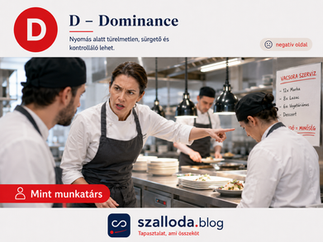
A guest with a more dominant function thinks quickly, makes quick decisions and usually has little patience for long explanations. They are not necessarily impolite, they are simply interested in the result.
If your room isn't ready yet, she doesn't want to know why housekeeping was late, how many housekeepers are sick, or how the cleaning process works. She wants to know when the room will be ready and what alternatives she'll have until then.
For him, effective communication is short, direct and solution-oriented:
"Your room will be ready in 25 minutes. Until then, I can offer you two options: we will provide a meeting room or immediately upgrade you to a higher category room."
For the D-style guest, it is important to:
speed;
the possibility of choice;
a sense of control;
clear responsibility;
the specific deadline.
What to avoid:
the long, elaborate explanation;
the uncertain wording;
phrases like “maybe,” “soon,” or “we’ll try”;
shifting responsibility to another department.
This is a good sentence for an airport flight cancellation:
"We can book you on two flights right now. The first one leaves earlier, the second one has more seats. Which one would you choose?"

The I-guest: “Are you listening to me?”
For the I, or influence, guest, service is not just a function, but also an experience and a relationship. They are happy to talk, ask questions, share their experiences, and often react strongly to the mood. They enthusiastically share a positive experience, but they can also communicate a negative situation spectacularly.
For him, an impersonal, purely technical answer easily proves insufficient.
If your restaurant order is running late, you may not just want to hear “ten more minutes.” You may also need to be acknowledged for your inconvenience.
"I'm so sorry you have to wait. The chef is already working on your order. In the meantime, let me buy you a drink and I'll let you know personally when it's ready."
For the I-style it is important:
personal attention;
the human voice;
the involvement;
the experience;
the recognition.
What to avoid:
cold, mechanical communication;
the answer that refers solely to the rules;
lack of eye contact;
the feeling that the guest is just a number.
In sales, experience often works most strongly with Type I:
“This is one of the chef's most spectacular dishes, which we finish at the table.”
You're not necessarily looking for the cheapest or fastest offer, but one that has a story, atmosphere, or social experience attached to it.
The S-guest: “Am I safe?”

A guest with S, or steadiness, generally appears more patient, calm, and adaptable.
That is why one of the most common service errors occurs in connection with it:
He didn't complain, so he was satisfied.
Maybe he's not happy. Maybe he just doesn't like confrontation.
The S-style seeks security, predictability, and calm connection. It has difficulty with sudden changes, especially when it is not clearly communicated what will happen.
A flight cancellation or a hotel transfer can mean not only logistical but also emotional uncertainty.
This is how it's worth communicating with him:
“I know this change is inconvenient. We will ensure your entire onward journey, your luggage will be automatically transferred, and you will be assisted by the same colleague throughout.”
For the S-style it is important:
tranquility;
predictability;
ongoing support;
the empathetic tone;
the feeling of not being left alone.
What to avoid:
the sudden change;
applying too much pressure;
aggressive upselling;
frequent change of contact person;
the uncertain process.
The S-guest often “votes” later rather than on the spot: they don’t return, they don’t recommend the service, or they silently choose another brand. That’s why active attention and follow-up are especially important for them.

Guest C: “What exactly does that mean?”
A conscientious guest seeks detailed, accurate and verifiable information. They are the ones who read the booking conditions, compare the invoice with the confirmation, check the flight ticket rules and notice the contradiction between the information provided by two staff members.
He's not necessarily distrustful. He simply makes decisions based on data, facts, and consistency. For him, answers like "soon," "probably," or "that's usually how it goes" easily generate further questions.
This is the appropriate communication for you in the event of a flight delay:
"According to current information, boarding will begin at 18:40 at gate B12. The delay is due to a technical inspection of the arriving aircraft. The next official announcement will be made at 18:10."
For C-style it is important:
accuracy;
the logical structure;
the rules;
documentability;
consistency.
What to avoid:
the vague promise;
the contradictory information;
unjustified exaggeration;
the inaccurate invoice;
the silence of the details.
In a restaurant, they often ask about ingredients, allergens, preparation method, or origin of ingredients. In a hotel, they are interested in room size, amenities, cancellation policies, and rates.
For Guest C, authenticity depends not on the quantity of smiles, but on the quality of information.
Same product, four different selling points
DISC can be used well in both sales and upselling.
It is not necessary to offer four different products. Often the same product needs to be presented from a different perspective.
For example, a premium hotel transfer can be sold in four ways:
D: “This is the fastest and most convenient way to get to the airport without waiting.”
I: “The driver will personally wait for you and can also recommend local activities during the trip.”
S: “We record the reservation in advance, the driver monitors the flight, so you don't have to worry about delays.”
C: “The transfer is a fixed price, the price includes waiting, luggage handling and all fees.”
Sales will be personalized by not only paying attention to what we offer, but also to the arguments we use to make it attractive.

The role of DISC throughout the entire guest journey
The model can be used not only in complaint situations.
Before booking
AD wants to make a decision quickly, so he needs a clear offer and easy booking.
It will convince you with inspiring images, stories and promises of experiences.
S is looking for a safe, reliable process and clear cancellation terms.
A detailed room description, exact prices and full terms and conditions are expected.
Upon arrival
AD doesn't want to stand in line.
I appreciate the personal welcome.
S expects a calm briefing and a predictable process.
AC checks that everything matches the confirmation.
During your stay
AD expects an immediate response.
I values connection and experience.
S stands for stable, consistent service.
AC stands for accuracy and error-free performance.
At check-out
Express check-out is important for AD.
I would be happy to exchange a few personal sentences.
S would appreciate it if you could help prepare for his next stay.
AC expects a flawless, detailed invoice.
The stakes are especially high in transportation.
DISC-based communication can be particularly useful in rail, road, water and air transport.
In these situations, it often appears simultaneously:
the time factor;
uncertainty;
the lack of information;
the crowd;
feeling of loss of control;
the risk of onward travel;
failure of a personal or business program.
For a flight cancellation, the same template message may be technically correct, but it may not be effective for all passengers:
AD wants an immediate alternative.
I want human attention and dialogue.
S stands for reassurance and ongoing support.
AC precise rules, dates and compensation conditions.
This approach can be used:
during airport check-in;
in gate communication;
on-board information;
in airline call centers;
in case of railway traffic disruptions;
in boat and bus services;
in premium lounges;
for transfer and taxi services.
Good operational communication doesn't just provide information. It reduces uncertainty and gives the passenger back some sense of control.



It's not just about the guests, it's also about the employees
DISC is at least as useful in collaboration between employees and managers.
In a hotel, restaurant, or transportation team, all four operating modes can create value.
D makes quick decisions, takes responsibility, and can function well in crisis situations.
I builds relationships, motivates, sells, and energizes the team .
S provides stability, collaboration, and consistent service.
C pays attention to quality, rules, safety and details.
The problem may not be the presence of any one style, but its excessive dominance:
A leadership team made up entirely of Type Ds is fast, but it can overlook important details and human aspects.
A highly I-centered team is enthusiastic and creative, but can be inconsistent.
An organization with a predominantly S-function is stable but difficult to change.
A highly C-dominant organism may become precise but slow and overregulated.
A balanced team is not necessarily conflict-free, but it is able to take several aspects into account at the same time.
It is not worth giving the same task out in the same way.
DISC can provide particularly practical help in leadership communication:
It is worth giving the D-employee a goal, decision-making rights, and room for maneuver.
It is worth involving the I-colleague, giving him a visible role, and providing regular feedback.
The S-worker may need clear support, preparation time, and a predictable process.
The C-employee must be given precise standards, data, lines of responsibility, and quality criteria.
The same leadership statement motivates one employee, makes another insecure, and contains too little information for the third. This does not mean that the leader has to take on four different personalities. It means that he or she must be able to adapt his or her communication to the situation and the person.
Conflicts between departments are often due to different ways of working.
Recurring conflicts may arise in the hotel industry:
sales and operations;
reception and housekeeping;
kitchen and restaurant service;
revenue management and sales;
between central office and local management.
AD asks, “Why isn’t it ready yet?”
AC replies: “Because we didn’t get accurate data.”
According to I, everything can be discussed.
Meanwhile, S tries to avoid the situation from turning into an open conflict.
In such cases, it is easy to assume professional incompetence or malice. However, it is often simply a matter of the people involved interpreting the same situation from different perspectives.
DISC does not automatically resolve conflict, but it can help you recognize what communication differences are causing it.
Where safety comes first, only with due caution
In aviation, shipping and other safety-critical areas, DISC is not a competency test and does not replace professional selection, psychological assessment or Crew Resource Management systems, but it can help you understand certain behavioral risks:
AD can make decisions quickly, but can suppress others with excessive dominance.
I can communicate well, but under stress, may give too much or not enough structured information.
S may be calm and cooperative, but may have a harder time confronting a superior.
AC follows the rules exactly, but in an uncertain situation may analyze further than necessary.
The model here can primarily be a tool for self-awareness and communication: how we react under pressure, how we give feedback, and how much we dare to report if we detect a danger or error.
What should it not be used for?
DISC becomes harmful when used for labeling or automatic selection.
It is not correct to say that:
a D-type is definitely a good leader;
an I-type is always a good salesperson;
an S-type is incapable of leading change;
a C-type is not suitable for guest contact.
There is no single DISC style that is appropriate for a given job. Professional knowledge, experience, emotional intelligence, values, motivation, and learning ability make the question of suitability much more complex.
DISC is not a diagnostic tool and should not be used to hire, promote or reject someone based solely on a profile. The handling of test results is also a privacy and ethical issue. Employee profiles should not be used for stigmatization, manipulation or unauthorized sharing.
You don't even have to write a letter on the guest's forehead.
It is not the job of the frontline employee to classify the guest into a DISC category after a few sentences.
It may be enough to ask yourself four simple questions:
Looking for a quick solution?
Do you want connection and attention?
Do you need security and reassurance?
Are you looking for precise information and details?
The point of practical application is not classification, but adaptation. Moreover, a guest may behave differently in different situations. Someone may be sociable and open at a restaurant dinner, but in the event of a canceled flight, they expect a particularly short, result-oriented communication. It is not necessary to decide “what type of person they are”. It is necessary to recognize what they need at a given moment.
Four ways to listen

A guest is not always dissatisfied because they received too little information. It could be because they received too much.
I'm not sure he wants more attention. Maybe he just wants a quick decision.
Other times, the solution is technically perfect, but it doesn't feel like real help because it lacks the human connection or sense of security.
The greatest value of DISC is therefore not that it divides people into four categories, but that it teaches you to listen in at least four ways.
The quality of service depends not only on what we do for the guest, but also on whether the guest truly experiences it as help.


Comments