


Not Lazy, Not Unmotivated — Still Underperforming. Could the Manager Be the Problem?

Why does the same management method fail with different employees? DISC in hotels, restaurants and transport
The hotel starts the day almost fully booked. Two employees are ill, three groups will arrive by noon, the conference room has a technical problem and every restaurant table is booked for dinner. The manager calls the morning briefing and announces firmly:
'Everyone needs to give their best today. There are many VIP guests; we cannot make mistakes and every problem must be solved immediately.'At first hearing this sounds clear. In reality it provides almost no useful management information.
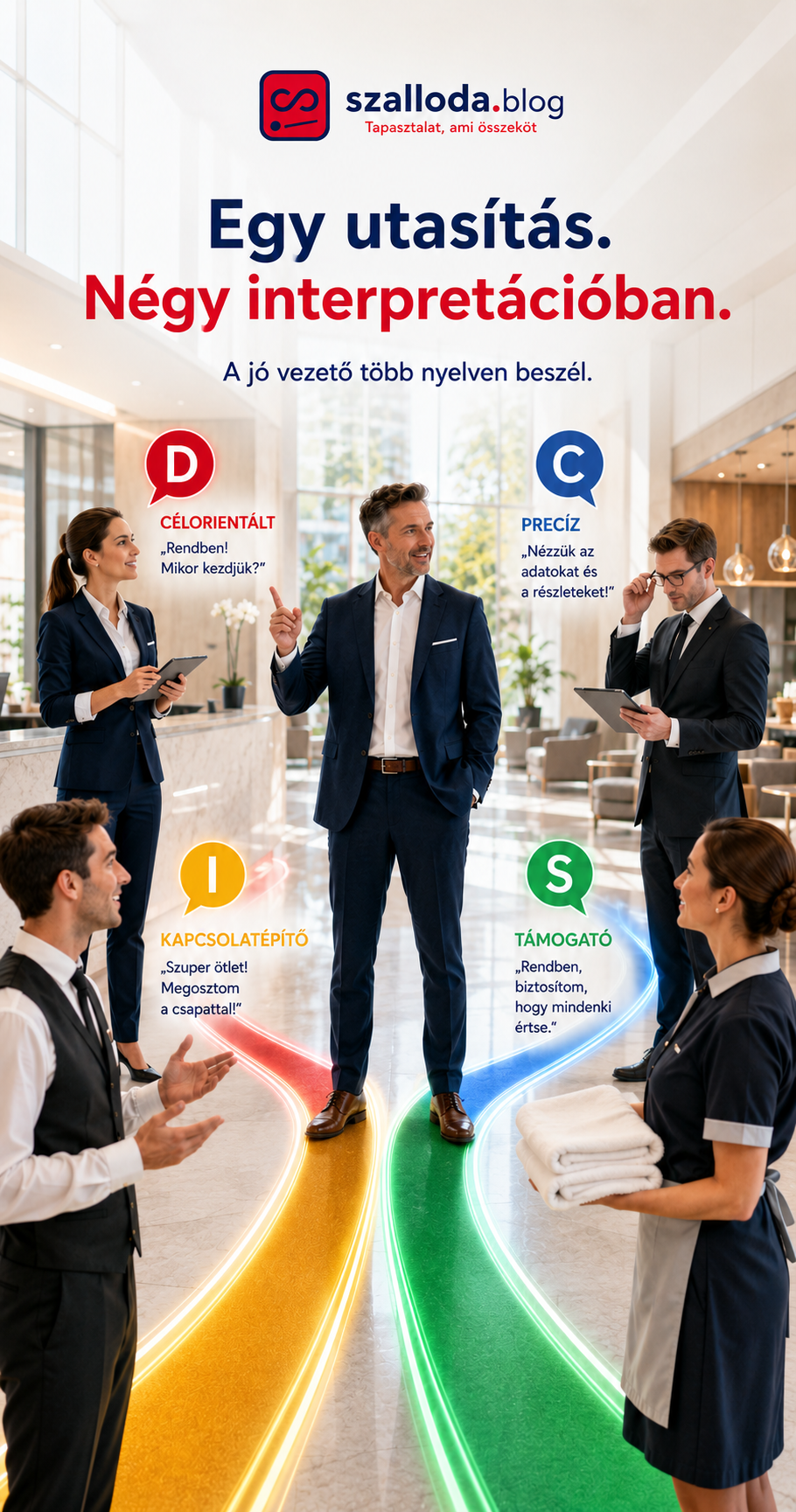
One colleague wants to know the most important objective, what decisions they may make independently and what result is expected. Another becomes enthusiastic, starts talking to guests and colleagues, but may not really understand their own task. A third feels insecure because responsibilities are unclear and they do not know whom to approach when things go wrong. A fourth wonders who the VIP guests are, which mistakes need special attention and exactly what 'immediately' means.
The manager believes the message was clear. The team has received four different kinds of uncertainty.
In our earlier article, 'Not Every Difficult Guest Is Difficult', we examined how the DISC model may help identify different communication preferences among guests, passengers and service users. Now turn the perspective around: what happens when an employee hears something different from what the manager intended?
Not every underperforming employee is lazy or unmotivated. Perhaps they have not been given a clear objective, genuine decision-making authority, enough information or feedback they can understand.
The Manager Speaks. But Does Everyone Understand the Same Thing?

DISC's historical roots are commonly traced to William Moulton Marston's 1928 book Emotions of Normal People, although the workplace DISC systems used today were developed later. The model's practical value is not dividing people into four boxes, but recognising behavioural and communication preferences. D tends to seek results, pace and control; I, relationships, influence and involvement; S, security, cooperation and predictability; and C, accuracy, logic and consistency.
DISC is used in leadership and team communication. In 2005, for example, Mary Kay Slowikowski described leadership and role-play scenarios in which recognising different behavioural styles could help collaboration. This does not prove that every online test sold under the DISC name has equal scientific merit. The reliability and validity of individual instruments require separate assessment. Findings about one particular DISC system cannot automatically be applied to every similar questionnaire.
More important still, no profile can lead a team for the manager. DISC does not determine whom to hire, promote or dismiss. It may help a leader express expectations not merely in words they themselves understand, but in a way employees can understand and carry out.
The D Employee: Genuine Responsibility or Simply More Pressure?

An employee with a dominant style tends to decide quickly, accepts confrontation and has limited patience for overexplained assignments. On a fully booked arrival day, during a flight cancellation, breakdown or unexpected staffing shortage, that speed and decisiveness can be extremely valuable.
Yet managers often put such colleagues in an impossible position: they give them responsibility without authority.
'You are responsible for ensuring there is no queue at reception, but you must clear every deviation with me first.'That is not delegation. It is accountability without the power to decide, and it can quickly frustrate an employee expected to be independent.
A more useful management instruction is specific:
'Before the noon arrival wave, we need to reduce average waiting time to under five minutes. You will lead the reorganisation, make decisions independently within our current resources, and we will review the outcome at 11:30.'This provides an objective, measure, deadline and decision-making scope. There is also a checkpoint, so independence does not turn into unlimited authority.
Under pressure, a D-style employee may become impatient, controlling or prone to interrupting others. Labelling them 'too dominant' will not help. Managers should identify the concrete behaviour and its consequences:
'You interrupted colleagues three times in the briefing, so two important operational details were not shared. We need your quick decisions, but first we have to hear each department's report.'The employee now knows what to change. They learn nothing from 'you are difficult to work with'.
The I Employee: Enthusiasm Is Not Yet Performance, but Can Become It

An I-style colleague connects with people easily, inspires and involves others and can energise a tired shift. This can be invaluable in guest relations, sales, events, training and introducing new services.
But managers can easily fall into one of two extremes: excusing everything because the colleague is popular with guests and peers, or noticing only that they talk a lot without always finishing tasks.
The answer is not to silence the I-style employee but to connect their relationship-building ability to a concrete result:
'I would like you to present the new breakfast concept to the team and collect colleagues' suggestions. By Friday, please give me a one-page summary of the three most important problems and possible solutions.'The role retains visibility, communication and participation, while introducing a defined deliverable and deadline.
One risk for employees who connect quickly with guests is promising something the organisation cannot deliver, simply to calm a difficult situation. Again, managerial feedback must be specific:
'You eased the guest's tension very quickly, and that visibly changed the tone of the conversation. However, you cannot promise a complimentary room-category upgrade without approval. Next time, begin by explaining the options you can definitely offer.'Research in hospitality suggests management language is not merely decoration added to leadership style. Rabiul and Yean found relationships between leadership styles, motivating language and employee engagement in hotels. Another hospitality study associated managers' oral communication with engagement, resilience and employees' commitment to high-quality guest service.
Recognition matters for I-style employees, but 'great job' is not enough. Precise feedback tells them which behaviour to repeat and where greater discipline is needed.
The S Employee: We Notice the Most Dependable Colleague's Problem Last

An S-style employee is often a team's quiet stabilising force. They may not speak the most at briefings or seek to lead every situation, but they are dependable, know the processes, care for colleagues and do their work even without applause or conspicuous recognition.
Hotels and restaurants rely heavily on precisely this consistency. Guest experience is created not only through extraordinary gestures but also because rooms are properly prepared every day, handovers are accurate, tables are clean, luggage reaches the right place and the next colleague receives the right information.
The managerial mistake begins when silence is treated as agreement and patience as unlimited capacity.
When a new PMS, shift pattern or procedure is introduced, an S-style colleague may not protest openly. Instead they may become uncertain, withdraw or continue with the old method because nobody has shown them safely how to succeed with the new system.
Rather than announcing 'everything changes on Monday; learn it by then', a predictable framework is far more effective:
'From Monday, we are changing the shift handover. Tomorrow we will go through the new process together, on Thursday we will run a trial shift, and for the first two weeks one designated colleague will answer all questions. At the end of the week we will review what works and what needs changing.'The change is not optional and standards are not lowered. But the employee understands what will happen, what is expected and where support can be found.
Public criticism can be particularly damaging for an S-style colleague. That does not mean avoiding accountability. Feedback should be private, specific and identify the next action:
'Information about VIP arrivals was missing from the last two shift handovers. I want to understand where the process broke down, then agree how we will check the handover list in future.'International hospitality management literature increasingly examines empowerment, participation and the organisational conditions for leadership support. A systematic review of empowering leadership stresses that the effects of autonomy must be interpreted within the actual workplace and organisational context.
The C Employee: Perhaps They Are the Only Person Who Noticed the Error

A C-style colleague seeks data, standards, logical procedures and verifiable expectations. In hotels, restaurants and aviation, those are often prerequisites for quality, safety and compliance, not annoying personality traits.
They notice a mismatch between booking and PMS data, a missing allergen label, inadequate maintenance documentation, stock discrepancies or an operational decision contrary to policy.
An impatient manager may respond:
'Stop overanalysing and just fix it.'Sometimes there really is no time for a full analysis. But the manager's task is not to mock precision. It is to define the necessary depth of review.
'Identify the three largest sources of loss in last month's minibar discrepancies, quantify the impact and prepare two possible solutions by noon on Friday. I do not need a full audit, but a decision paper.'The employee now knows what to examine, how deeply, by when and in what format.
'You are too slow' is equally unhelpful feedback for a C-style employee. A better alternative is:
'The report was accurate and reliable, but arrived two days late. Next month I want an 80% draft first, then we will reserve separate time for checking.'The employee hears not that their accuracy is a problem, but how to adapt it to the operational pace.
In Most Conflicts, Both Sides Believe They Are Being Professional

Reception wants to give guests their rooms quickly; housekeeping wants to release only inspected rooms. Sales wants to sell an event; operations wants to know precisely what must be delivered. Service wants food out faster; the kitchen needs accurately recorded orders. Airport customer service wants an immediate decision; security and operations will release only verified information.
To the fast colleague, the precise colleague is slow. To the precise one, the fast colleague is reckless. The communicative colleague sees the quiet one as uninterested. The person seeking stability sees the constantly innovating manager as unpredictable.
Conflict escalates when everyone treats their natural way of working as the only acceptable form of professionalism.
The manager's job is not to choose whether speed or precision, relationships or stability, matters more. Most service situations require all of them, simply not at the same moment or in the same proportions.
One study of empowering leadership used data from 294 employees to test how leadership empowerment related to engagement and extra-role behaviour. The effects were not automatically the same for everyone: individual characteristics and the managerial environment mattered. That is a warning against treating 'everyone should sort it out independently' as modern leadership when employees lack information, competence or real authority.
Delegation does not mean that the manager disappears. It means making the objective clear, granting the necessary authority and remaining accessible.
The Same Expectations, Different Communication

DISC-based leadership does not mean four sets of rules or four performance standards. Room-cleanliness standards, food-safety requirements, aviation safety rules and respect for guests apply equally to all.
What differs is how expectations are communicated clearly.
For D, make objectives, authority and outcomes clear. For I, explain the intended impact and tangible deliverable. For S, show the process, available support and predictable steps of change. For C, provide precise standards, data, deadlines and quality criteria.
This is not weakness or pandering to employees. It is management effectiveness.
Broad reviews of hospitality leadership literature have mapped hundreds of publications and identified transformational, servant and empowering leadership among the major research areas. Though conceptually distinct, these approaches share the recognition that leaders' effects depend on employees' perceived support, engagement and the organisational environment.
DISC Is Not an Excuse for Managers or Employees
It is unacceptable to say that somebody is a D type and therefore naturally shouts, an I type and therefore need not be accurate, an S type and therefore cannot lead change, or a C type and therefore always decides slowly.
A behavioural preference does not excuse anyone from performance requirements, respect, rules or responsibility.
Managers cannot excuse themselves by saying, 'I am simply direct', 'everyone must cope with pressure here', or 'anyone who does not understand the first time does not belong'. A manager's personal style is not an organisational standard.
A D-style leader may be fast and decisive, but can suppress colleagues. An I-style leader may inspire but communicate inconsistently. An S-style leader may be supportive but postpone difficult conflict. A C-style leader may be thorough and dependable but overregulate operations.
Managerial maturity is not denying one's natural style. It is recognising when that style helps the team and when it gets in the way.

Perhaps the Team Is Not the Problem After All
When a department underperforms, it is easy to describe staff as unmotivated, resistant or unsuitable. Sometimes there truly is a performance problem that communication training cannot resolve.
But sometimes the manager should ask some uncomfortable questions. Was the objective genuinely clear? Was it obvious who could decide? Did everyone understand the deadline the same way? Did staff receive feedback, or hear from management only when something failed? Did they have genuine latitude, or merely responsibility without authority? Did anyone ask what was unclear, or was 'yes' automatically treated as comprehension?
DISC is not magic and cannot save an organisation from poor processes, weak recruitment, understaffing or incompetent leaders.
It can, however, reveal how the same managerial statement energises one employee, confuses another, silences a third and prompts endless questions from a fourth.
Good leadership does not begin when the manager has said what they wanted to say. It begins when employees understand what is expected, can deliver it and know how their work contributes to the shared result.

A strong hotel, restaurant or transport team does not require everyone to think alike. Its strength comes when speed, relationships, stability and precision work not against each other, but for the same guest and the same outcome.
That requires a manager who does more than talk to the team: they must be able to make the same goal understandable in different ways.
Sources and Further Reading
Marston, William Moulton: Emotions of Normal People. Kegan Paul, Trench, Trubner & Co., 1928. The original theoretical work regarded as a historical precursor to DISC.
Slowikowski, Mary Kay: 'Using the DISC Behavioral Instrument to Guide Leadership and Communication.' AORN Journal, 82(5), 2005, 835–843. DOI: 10.1016/S0001-2092(06)60276-7.
Rabiul, Md Karim and Yean, Tan Fee: 'Leadership Styles, Motivating Language, and Work Engagement: An Empirical Investigation of the Hotel Industry.' International Journal of Hospitality Management, 92, 2021, 102712. DOI: 10.1016/j.ijhm.2020.102712.
Rabiul, Md Karim et al.: 'Fostering Quality Customer Service During Covid-19: The Role of Managers’ Oral Language, Employee Work Engagement, and Employee Resilience.' Journal of Hospitality and Tourism Management, 53, 2022, 50–60. DOI: 10.1016/j.jhtm.2022.09.002.
Rescalvo-Martin, Elisa et al.: 'Effects of Empowering Leadership Under Boundary Conditions in the Hospitality Industry.' International Journal of Hospitality Management, 105, 2022, 103269. DOI: 10.1016/j.ijhm.2022.103269.
Hoang, Giang, Wilson-Evered, Elisabeth, Lockstone-Binney, Leonie, and Luu, Tuan Trong: 'Empowering Leadership in Hospitality and Tourism Management: A Systematic Literature Review.' International Journal of Contemporary Hospitality Management, 33(12), 2021, 4182–4214. DOI: 10.1108/IJCHM-03-2021-0323.
Huertas-Valdivia, Irene, González-Torres, Thais, and Nájera-Sánchez, Juan-José: 'Contemporary Leadership in Hospitality: A Review and Research Agenda.' International Journal of Contemporary Hospitality Management, 34(6), 2022, 2399–2422. DOI: 10.1108/IJCHM-05-2021-0658.
Everything DiSC: official introduction to the model and the research supporting the particular assessment instrument. Validation claims concerning Everything DiSC should not be extended to every DISC-branded test.
About the Author

Tamás Pakuts has worked for almost 35 years across hotels, hospitality, cruising, aviation and transport services. As a hotel manager, general manager, trainer and executive coach, he has led and developed multicultural teams in boutique hotels, major resorts, international luxury brands, aviation businesses and ocean and river cruise ships.
Over his career, he has conducted more than 5,000 coaching and development conversations and more than 4,000 recruitment and management interviews. Leadership communication, feedback culture, conflict resolution, service orientation and DISC-based team development are central to his work.
He does not use DISC to label people or make employment-suitability judgments, but as a practical map that can help explain why the same managerial sentence motivates one colleague while confusing, discouraging or provoking resistance in another.
As founder of Szalloda.blog, he connects international experience, practical operations and the human factor — because good service depends not only on suitable processes but also on managers who communicate clearly and teams that work well together.
This article was translated from the original Hungarian using artificial intelligence. The original language is Hungarian.


Comments