.png)


One ticket, one day, an entire region

What can we learn from the interconnected tourism system of Lucerne and Rigi?

We took a scheduled boat from Lucerne to Vitznau, had lunch on board, transferred almost directly from the port to the Rigi Bahnen cogwheel train, and then returned from the top of the mountain by a different route. We descended on the other side of the Rigi, towards Arth-Goldau, from where the modern Voralpen-Express train of the Südostbahn took us back to Lucerne.
The ship itself was a tourist attraction in its own right: the Schiller , one of the iconic paddle steamers on Lake Lucerne. The ship, which was put into service in 1906 and is now 120 years old, is not a static industrial monument on display in a museum, but still carries passengers as part of scheduled transport. Its special value is the richly decorated Art Nouveau first-class salon, in which lemon wood, ebony and mother-of-pearl details evoke the elegance of the turn of the century. The carefully maintained historic vehicle also offers modern, well-functioning onboard catering. The preservation of the past here is not a nostalgic setting, but a living, usable and revenue-generating tourist asset. ( lakelucerne.ch )
Boat, onboard catering, historic mountain railway, Alpine excursion and modern regional train – all in one day, without a car, based on public transport. What’s more, the same SBB day ticket was valid for the scheduled boat, the Rigi Bahnen cogwheel train and the Arth-Goldau-Luzern railway section. We didn’t have to buy separate boat or mountain railway tickets and didn’t have to pay any extra fees.
This was not just a convenient excursion, but a practical example of how multiple transport companies, settlements, attractions and services can be organized into a single, easy-to-use tourism product.

Lucerne also has problems and it's not a lack of guests
Lucerne is a huge success in terms of tourism. The city recorded more than 1.41 million hotel guest nights in 2025, an increase of 6.4 percent compared to the previous year. Hotel occupancy rates rose to 74 percent and RevPAR increased by around 14 percent. The average length of stay, however, was only 1.8 days. ( business.luzern.com )
The figures thus reveal a dual situation: Lucerne is a strong brand in the Swiss domestic and international tourism markets , capable of attracting a large number of guests and generating significant hotel revenue. At the same time, many visitors only come for a short time, and a significant proportion of tourists are concentrated in a few iconic city centre locations: Kapellbrücke, Schwanenplatz, the old town, the Lion Monument and the lakeside are located in a relatively small area, so the tourist load is easily concentrated in time and space.
The city's own tourism strategy until 2030 also addresses over-concentration, tour buses, the effects of short-term housing and the public's acceptance of tourism. According to the document, further growth in long-distance and day-trip tourism in particular could exacerbate acceptance problems, and therefore a conscious management of visitor flows is needed. ( stadtluzern.ch )
So Lucerne doesn't simply need more visitors. The real question is how to:
encourage guests to stay longer;
reduce congestion at some city centre points;
to spread consumption over a larger area;
to transform one-day visitors into at least full-day, and preferably multi-day, guests;
to bring the economic benefits of tourism to more actors in the region.
In this context, Rigi is not just a beautiful mountain near Lucerne. It is a means of regional tourist flow.
The city does not lose, but shares the guest with the region
Many destinations fear that if they divert tourists to other towns or the surrounding area, they will lose out on their spending.
The example of Lucerne shows the opposite: the city functions as a starting point. It is here that the international rail connection, a significant part of the accommodation capacity, the cultural and commercial offer and the best-known tourist brand of the region are located. At the same time, the lake, the boating, the Rigi and the smaller towns add a full-day program that the city center of Lucerne could not provide on its own.
In the morning, the guest departs from Lucerne, spends the day with the boat company, local and mountain service providers, restaurants and other regional players, and returns to their city hotel in the evening.
The regional excursion thus does not weaken Lucerne's tourism, but rather increases the city's value as a place to stay. It creates another reason for guests to come not just for a few hours, but for at least two or three days.
The first lesson, then, is that a successful city does not need to keep all tourists in its center all day long. Well-organized neighborhood offerings can both reduce concentration and increase the value of the stay.
Public transport has become a ready-made tourism product

The Lucerne–Vitznau–Rigi–Arth-Goldau–Luzern route is not simply a series of successive transport sections. Each section offers a different experience. The boat gradually takes you from the urban environment to the world of the lake and mountains. In Vitznau, there is no long transfer or uncertain orientation, but a direct connection to the rack railway. The line from Vitznau opened in 1871 as Europe's first mountain railway, making it one of the oldest rack railways in the world still in operation. The historical authenticity of the route is clearly demonstrated by the fact that on some sections the trains still run on racks from 1871. ( rigi.ch )

From the mountaintop towards Arth-Goldau, we see a new landscape, so the return trip is not a repeat of the one we took there. From Arth-Goldau, the Voralpen-Express takes us back to Lucerne.
Each element of the cruise is attractive in its own right, but the real value is in the connection between them. The guest does not have to rent a car, find a parking space or book a separate transfer for each leg. Transfers become part of the program, not its risky points.
The second lesson: it is not enough to have a ship, a railway, a mountain, a lookout point or a hiking trail in an area. These must be used to create a predictable, timely tour and an attractive offer.
The mountaintop is not just a viewpoint
The transportation system alone would not be enough if the guest did not find any additional services on the mountaintop besides the panorama.
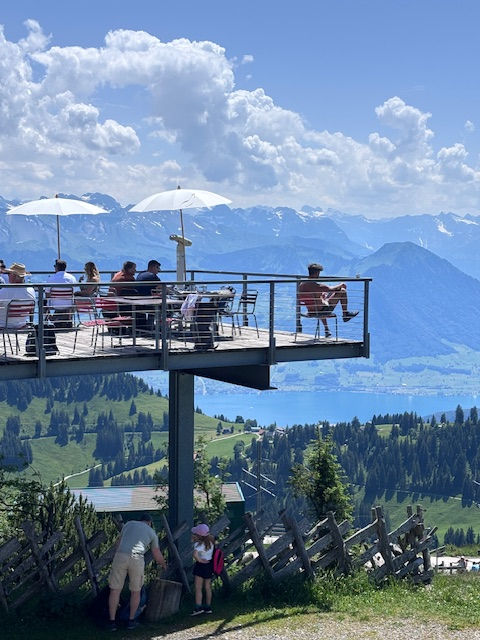
However, arrival at Rigin is not the end of the tourist product. There is a proper, normal hospitality service on the mountain, so the visitor does not just arrive at a viewpoint for a few minutes. He can sit down, eat, relax, and choose from a variety of programs. This increases the time spent on the mountain, improves the sense of comfort, and creates additional local consumption in addition to transportation revenue.

The permanent exhibition Lok 7 can also be visited free of charge on Rigi Kulm. The historic locomotive, in its original environment, presents the pioneering era of Europe's first mountain railway with lights, film footage and audio. The railway heritage is thus not only perceived during the train ride, but also becomes cultural content that can be interpreted independently. ( rigi.ch )

Rigi also doesn't rely solely on panoramic tourists arriving by train. The mountain has around 120 kilometres of summer and 35 kilometres of winter hiking trails, from barrier-free walks to longer and more difficult mountain routes. The various stations in the transport network allow visitors to combine the train ride with a shorter walk, a full-day tour or a program with several stops. ( rigi.ch )

This is important because the same infrastructure can serve multiple target groups and different lengths of stay. A different product is available to those who come just for the panorama, to families, to visitors interested in railways, to hikers, to winter hikers, or to those who want to eat and stay longer on the mountain.
The further lesson: good transport connections alone do not make an attraction complete. Adequate hospitality, cultural content, programs, and various time-consuming activities are also needed at the point of arrival.
The single ticket is not a discount, but a strategic tool
With the SBB day ticket we used, valid for the GA network, we were able to travel on the Rigi Bahnen cogwheel trains without paying extra. According to the official information of Rigi Bahnen, the SBB day ticket and the Saver Day Pass, among others, provide a full, 100% discount on the company's main services, without having to exchange tickets separately. ( rigi.ch )

The same day ticket is also valid for scheduled boat trips on Lake Lucerne. The boat company accepts, among others, the Saver Day Pass, the Half Fare Card day ticket, the Swiss Travel Pass and the Lucerne Travel Pass. ( help.lakelucerne.ch ) This is significant because corporate boundaries disappear for the guest. He does not need to know that one section is operated by the SGV shipping company, another by Rigi Bahnen and the third by SOB. He does not need to compare separate fares, use multiple sales platforms or make a new decision before each transfer.
A single transport product opens up the lake, the mountain and the regional rail network.
This system also influences visitor behavior. If the boat and the mountain railway are already part of the day ticket, the guest is more likely to choose the full cruise. They visit more locations, spend more in a wider area and do not need a car.
Another lesson: the integrated ticket is not just a price discount. It is one of the most effective tools for guest flow, sustainable mobility and regional revenue generation.
Hospitality appeared exactly where it was needed
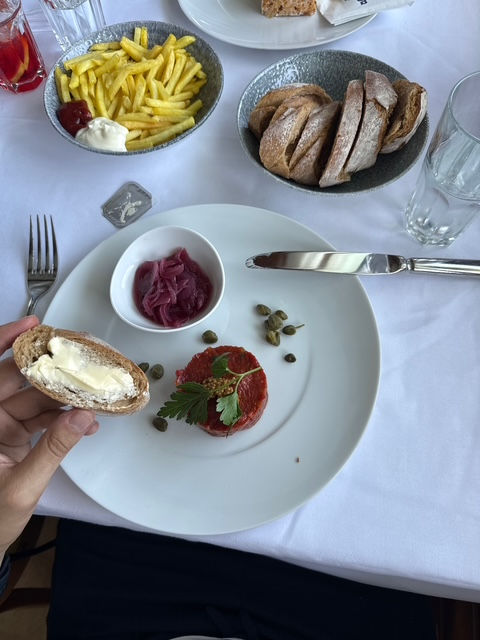
We had lunch on the boat to Vitznau. The service was fast, the food was good quality, and the price level was no higher than what we would have experienced in a city restaurant in Lucerne. We didn't have to organize a separate meal before departure and we didn't waste time in Vitznau looking for a restaurant.
While we were having lunch, we were already moving towards the next program. This is also remarkable from a business perspective. The sailing time was not an empty wait, but a comfortable guest experience and at the same time a catering revenue. This did not require an excessive premium price, a complicated gastronomic concept or a long menu, but reliable quality, adequate speed and a fair price-value ratio.
Hospitality did not appear as a separate program, but rather fit precisely into the guest's schedule.
The umpteenth lesson: consumption options must be planned not only for locations, but also for the guest's journey and available time.
One possible alternative to the Rigi Luzern problem
Of course, the Rigi excursion alone will not solve all of Lucerne's tourism challenges or eliminate downtown congestion, it will not automatically guarantee longer stays, and it will not replace tourist buses, short-term rental of apartments, or regulation of public space. However, it clearly shows how large visitor numbers can be better distributed.
Instead of trying to keep guests away from the city center with prohibitions, they offer them an attractive, easily accessible alternative. Visitors voluntarily leave the busiest parts of Lucerne for a few hours, because the lake and the mountain together promise a stronger experience.
Lucerne's tourism sustainability goals officially include encouraging environmentally friendly mobility, mitigating seasonal demand peaks, strengthening the regional economy, and maintaining a balance between the interests of guests, residents, and the environment. ( luzern.com )
The 2025 results already show the strength of the autumn and winter months: the number of guest nights in Lucerne increased by 6.1 percent in October and 14.2 percent in December. The tourism organization has also developed data-driven visitor management and a new “Tourism Cockpit” system. ( business.luzern.com )
The example to follow is not that Luzern does not have problems, but that it also recognizes, measures and manages the side effects of success.
What could we apply from this in Hungary?
Many regions in Hungary have the basic elements that could be used to create similar tours that can be explored without a car.
In the Danube Bend, Budapest, shipping, HÉV, railway, Szentendre, Visegrád and Esztergom could be connected. At Lake Balaton, railway, boat, bicycle, wine regions, mountains and hinterland settlements could form unified guest routes. Miskolc and Lillafüred, Pécs and Mecsek, Eger and Bükk would also be suitable for the development of transport and tourism circular products.
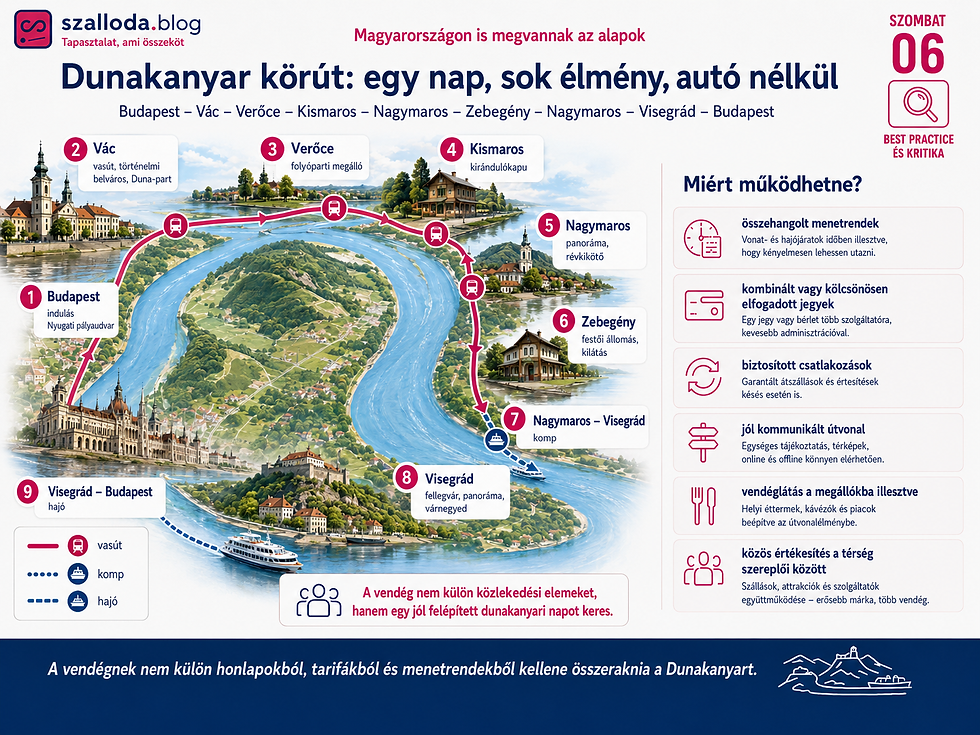
This does not necessarily require building new attractions, but rather organizing the existing elements into a system:
with coordinated schedules;
with uniform or mutually accepted characteristics;
with transfers provided;
well-communicated, with pre-tested routes;
with catering integrated into transport;
with joint sales across municipal borders.
Existing historical means of transport and industrial monuments should not be exclusively preserved either. They could be transformed into living products that move, tell stories, offer programs, and generate income in the process. At destinations, attractions alone are not enough: visitors with different needs must also be provided with hospitality, shorter and longer programs, cultural content, and onward travel options.
In most Hungarian regions, the main problem is not the partial or complete lack of experience elements, but rather that the guest has to piece them together from different websites, tariffs, schedules, and service provider rules.
According to the example of Lucerne and Rigi, this is not the guest's responsibility.

We didn't get tickets, we got a whole day
The cruise involved at least three transport companies, several settlements, different infrastructures and different service providers.
As guests, we barely noticed anything from this.
We traveled with a day ticket, had lunch on the boat, transferred to the historic cogwheel train in Vitznau, descended the other side of the mountain, and then returned to Lucerne by modern train.
This is true destination management.
It is not when each player advertises their own service separately, but when they create a single logical, purchasable and memorable experience for the guest.
Tourists are not looking for a cruise, a cogwheel train, or a regional train, but a day well spent and full of experiences.
And Lucerne and Rigi give him exactly that.


Comments