
.png)

Paper straws are not yet a sustainability strategy

Local, seasonal, sustainable – or should we just call it that?

If we enter a modern restaurant or café today, we might easily get the feeling that sustainability has already arrived in Hungarian hospitality.
We get paper straws for our lemonade. The sugar is served in biodegradable bags. There’s a sign on the wall that says “Support Local,” and the menu proudly lists the names of some local producers. The terms “farm to table,” “zero waste,” “slow food,” and “green dining” are all buzzing on social media.
All of this is undoubtedly a good direction. However, it does not in itself mean sustainability, because while the guest drinks the lemonade with a paper straw, the kitchen may be throwing away several kilograms of completely fresh and edible food every day. The tomatoes on the menu may have traveled thousands of kilometers in January, the breakfast buffet is completely refilled ten minutes before closing, the refrigeration equipment consumes an unreasonable amount of energy, suppliers are paid months later, and employees work with a turnover rate that is neither professionally nor humanly sustainable in the long term.
Sustainability is not a single measure, nor is it a new packaging material, and it should not remain just a fashionable phrase without real content.
Sustainability is an operating culture that is reflected in purchasing, menu planning, energy use, waste management, employee appreciation, and economic decisions, as well as in the details visible to the guest.
Has Hungarian hospitality really become more sustainable, or in many cases does it just want to appear more sustainable?
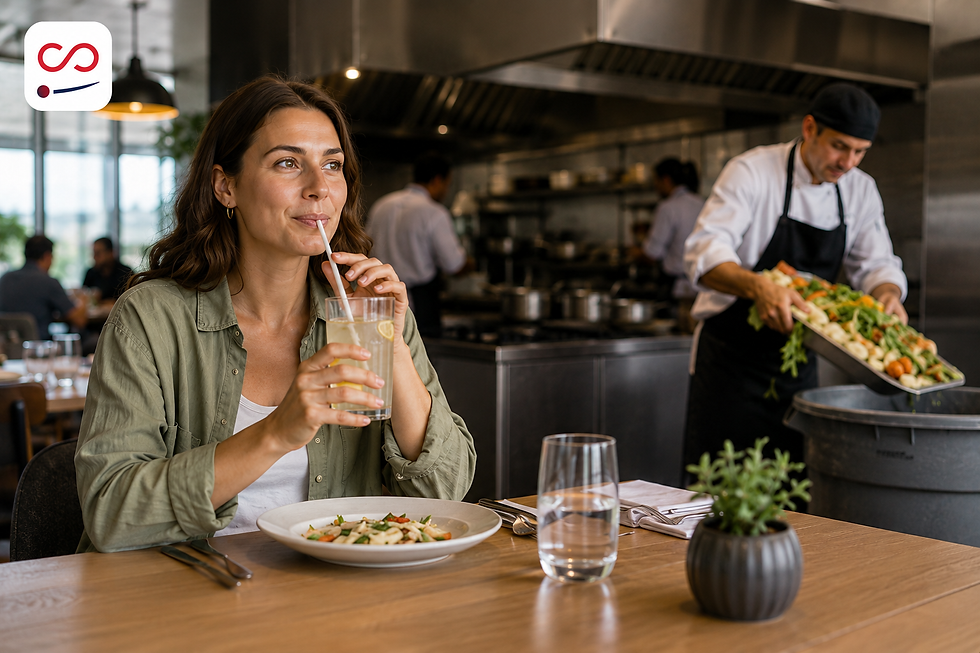
The guest sees what we want to show
Communicating sustainability is now almost an expectation. Guests appreciate a paper straw, a reusable glass, a cloth napkin, or the name of a local cheesemaker or winemaker on the menu. These are important gestures and can really help reduce environmental impact.
But the guest doesn't see the back of the kitchen, how much ingredients spoil in the warehouse, how many portions of food end up in the trash every night. They don't see whether the "compostable" packaging ends up in the same mixed waste bin as everything else, or the inventory losses that come with maintaining a long, year-round menu.
Real sustainability is much less visible and starts not in the dining room but in the warehouse. And not on Instagram, but in the purchasing tables, in the planning. And it's not about the paper straw, it's about the phone call when the chef calls the producer and asks:
" What's really fresh right now?"

Greenwashing – when the color green is just decoration
Along with the popularity of sustainability, another phenomenon has emerged: greenwashing , or green marketing. In this case, a business tries to create an environmentally conscious image of itself while barely changing the real environmental impact of its operations: it could be a paper straw, a “100% natural” label, or just a green leaf on the menu or a few good-sounding sentences on the website added by a skilled graphic designer.
The control questions related to sustainability are quite different:
Does the restaurant measure food waste?
Are they aware of the amount of energy they use?
Do you know what the proportion of seasonal ingredients is?
Is their supply chain traceable?
Do they have specific plans to reduce water, energy or waste?
If there are no answers to these questions, then sustainability can easily become a marketing tool and that paper straw will really remain just a paper straw.

Local – but truly sustainable?
There are few phrases in the hospitality industry that we hear as often as local ingredients . We see it on many restaurant menus or websites, often as one of the most important proofs of sustainability. However, the situation is much more nuanced than that. Local procurement in itself does not mean sustainable operations. Its undoubted advantages are that the supply chain can be shorter, the environmental impact of transportation can be reduced, the local economy can be strengthened, and a much more direct relationship can be established between the producer and the catering establishment.
But "local" in itself is not a guarantee of either quality or sustainability.
It doesn't matter what methods the raw material was produced with. It doesn't matter whether it is truly seasonal, how often and by what vehicle it is transported, how much packaging it comes in, and ultimately what proportion the restaurant uses without loss.
Likewise, it is not important whether a "local producer" on a menu is a real partner or just a well-communicated marketing element.
Sustainable hospitality does not start with the name of a single supplier, but with long-term collaborations.
With relationships in which the chef knows the owner, the owner knows the restaurant's needs, they plan the season together, think about quantities together, and mutually adapt to each other.
This trust means much more than a few kilometers shorter delivery route.
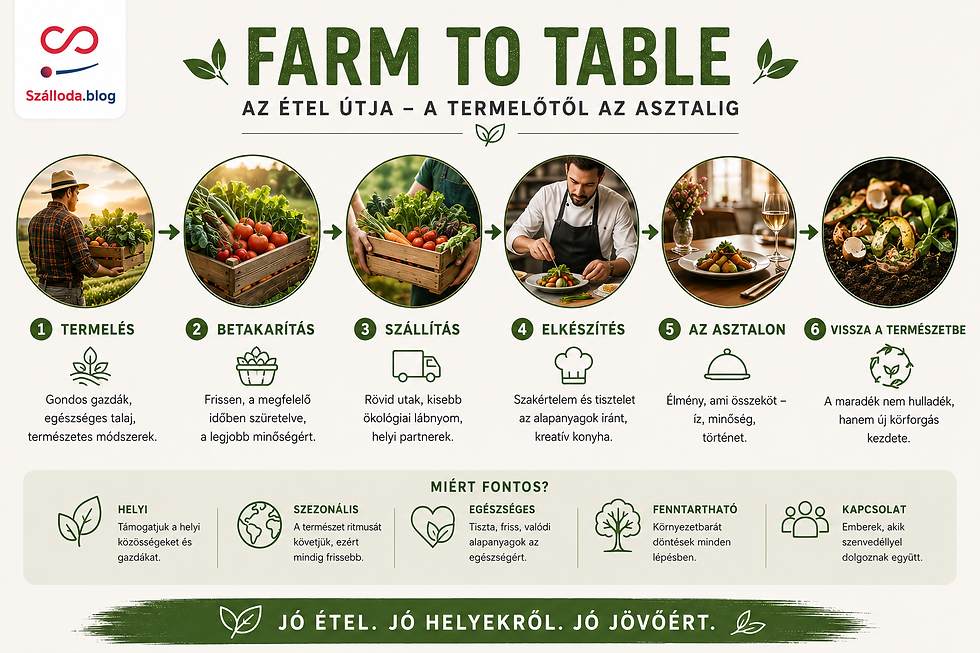
Farm to table – when the producer is a real partner
The phrase farm to table is now familiar to almost everyone. However, in many places it appears more as a marketing term than as a real operating model. Its essence is extremely simple: the essential question is not where the chef buys the tomatoes, but whether he thinks along with the producer.
In a true farm-to-table approach, the menu does not precede nature; on the contrary, nature dictates the rhythm of the menu. The chef does not want local tomatoes in January, but creates from what the season offers in the best quality. And the producer knows what the restaurant will need, so he can plan, invest and develop more predictably.
This relationship simultaneously means economic stability, lower environmental impact, less food waste, and more authentic gastronomy.

One of the most beautiful examples of Hungarian gastronomy was Malackrumpli in Tihany. Tamás Járosi and Luzsa Jacek jointly created a restaurant that was years ahead of its time. Farm-to-table was not a fashionable slogan for them, but the basis of everyday operations. Seasonal ingredients, carefully built producer relationships, a short supply chain and respect for the ingredients determined their thinking. The menu did not start from what they wanted to cook, but from what nature offers and what their partners can provide in the best quality.
After the tragic death of Tamás Járosi, the story of Malackrumpli came to an end, but the approach they represented lives on today. Not only in the professionals who worked with them, but in all those who believe that sustainable hospitality begins with trust between producer and chef.
Luzsa Jacek , who currently runs Ruttner House in Veszprém , Pizza Rosa and Three Monkeys in Balatonalmád , says:
"Unfortunately, we can't really talk about sustainability these days. We don't have a competitive agriculture or food industry. Everyone, without exception, sells "garbage" from the EU and outside the EU.
I try to get the best possible, but the hospitality industry at that time was in an era where many of us, with a lot of hope and a lot of work, were trying to break out of simplicity, and thus it was not the market that dictated, but nature. This has completely faded away today, and chefs socialized on Western trends are “dazzling” investors and guests with greater or lesser success.
The wave back then was all about renewal, about rethinking the good old things. Now there's nothing to renew, nothing to rethink. There's just copy & paste in terms of trends. Everyone cooks pretty much the same thing, using the same circles of suppliers.
Maybe there will be a change, maybe there is another bullet in the magazine, and if so, and there are brave people, I trust that this is not a lost cause.
The generations that come after us simply don't need this, and as long as we live, this has potential only for so long. Because maybe we could still reduce it if there was something and if there was someone to do it with.
I don't think I need to detail the taxes and other burdens that are currently holding SMEs back :) With the same numbers, lower taxes and products that can be sold at a higher price level, a similar unit operating to the west of us would pocket exactly two and a half times as much, rightfully so and, what is important: snow-white."

The most expensive raw material is what we throw away
Many restaurant owners still view food waste as a natural part of their business. Yet every kilogram of food thrown away has already traveled the same path as the one that was ultimately consumed by the guest:
They produced it.
They were harvested.
They packed it.
They were delivered.
They took it over.
It was cooled.
They were stored.
They prepared it.
And finally... they threw it away. And with it, they threw away the labor of the producer, the cost of transportation, the water, energy, working hours used, and of course, a portion of the company's profits.
Perhaps one of the most important metrics of true sustainability is not how many paper straws are used in a month, but how much food ends up in landfill.

The buffet paradox
Perhaps nowhere do guest experience and sustainability come together more than in hotel breakfasts. Guests want to see plenty and hotels don't want to disappoint. In many places, it is still considered normal to have a fully stocked buffet waiting for guests in the last half hour of breakfast: fresh pastries, refilled fruit bowls, full dishes. It looks good, but it often costs too much.
A sustainable buffet does not mean reducing the selection, but rather smarter organization, smaller plates, more frequent refills, more accurate forecasting, and data-driven kitchen preparations.
Who has the courage to communicate to our guests: freshness is more important than unnecessary abundance?
True luxury is not having the same amount of scrambled eggs in the warmer when the buffet closes, but having the same quality at seven in the morning and at half past nine.
The most important report from the kitchen
Interestingly, most restaurants know exactly how much revenue they made each day and how many guests they served. However, far fewer can say how many kilograms of food went into the trash that day, even though this is an equally important indicator for the managers and owners of a sustainable place.
Every kilogram of raw material thrown away is a cost that no one paid for.
If a restaurant or hotel is truly serious about sustainability, the amount of food waste should be included in the daily management report just like revenue, number of guests, or average consumption.
We cannot improve what we do not measure.
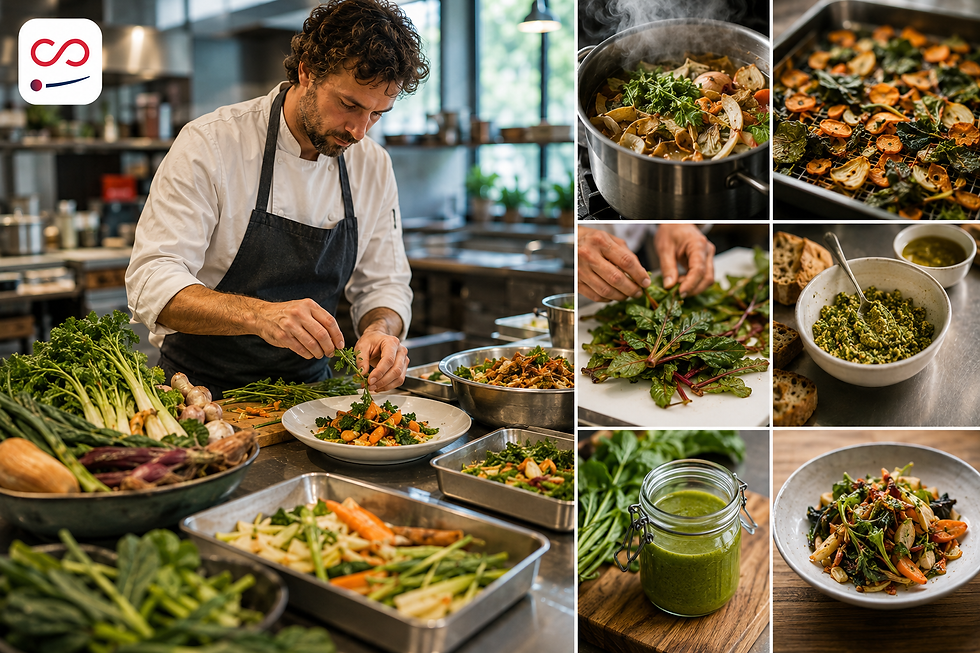
Waste is not always waste
One of the most important tasks of modern kitchens is no longer just cooking, but also planning the entire life cycle of the raw material.
Soup bases can be made from what would have previously gone in the trash. Bread crumbs or dessert can be made from bread. Vegetable peels can be made into stock. Less visible parts of meat can be used to make excellent stews or stuffings. Of course, this is not always possible and food safety always takes priority.
However, the approach remains the same: the first question we should ask is not what to throw away, but what else can be used for valuable purposes.
Because the most sustainable raw material is one in which every usable part is used with respect.

Many roads lead to the same place.
I understood what it means to run a sustainable restaurant when I was in Saigon many years ago and a small restaurant stood out from the many good others because it was part of the lunch and evening "show", where producers brought in fresh vegetables, fruits, and meat from around the city at the beginning of the meals and presented them to the guests, because good things don't just end on the plate and on our taste buds, but they certainly don't start there, but with the producers.
Fortunately, there are now more and more restaurants operating in Hungary that prove that sustainability cannot be achieved according to a single recipe.
There is no universal model. There is no one-size-fits-all solution. However, there are some common ideas that can be found in the operation of almost all truly conscious hospitality establishments:
A production partner in the strictest sense of the word.
The raw material is valuable.
Seasonality is not an obstacle, but an inspiration.
Waste is not a natural part of operation, but a loss that is worth and can be reduced.
For example, Villa Kabala in Szigliget , in the Balaton Uplands, shows how one can shape one's own garden, local producers and gastronomy into a unified concept. The place is also much more than that: it is also a workshop, where András Szabó has joined forces with Ádám Pohner ( Gajdó & Iszkor , Miskolc and Mályinka) to provide internships and training within the framework of the Culinary Institute of Bükk & Balaton for professionals who like awareness and those who would like to embark on a journey in gastronomy with this approach.
Graefl Major proves that on the outskirts of Poroszló , agriculture, hospitality and accommodation are not separate worlds, but can be a mutually reinforcing system, as dreamed up by Györgyi Szerencsés and Péter Szepesi. They do not have a menu, because the chef, Ádám Gyűjtő, always cooks from fresh ingredients. The opening hours are the time of the order.
The Budapest SALT draws attention to the fact that fermentation, preservation and traditional technologies are not a step backwards, but rather one of the most exciting directions of modern gastronomy, and Szilárd Töth and Máté Boldizsár are bringing traditions, small gardens and their own production into the city centre, with specially selected and paired drinks.
Natura Hill (Zebegény) and Pajta (Őriszentpéter) both prove that it is possible to build international-standard gastronomy in the countryside while keeping the local landscape, local ingredients, and local community at the center of the story.
It is worth noting that these places are very different, of different sizes, do not cater to the same clientele, and are not at the same price level. However, what they have in common is that none of them try to make sustainability a marketing tool.
Sustainability is not a campaign for them, but an operational culture.

Sustainability is not just about the environment
However, there is one area that is surprisingly little talked about when we talk about sustainable hospitality: people.
A restaurant can be energy-efficient, based on zero-kilometer ingredients and selective waste collection.
But can it really be called sustainable if your entire staff is replaced every year, employees work unpredictable shifts, suppliers are paid months later? If employees are given more and more tasks while there is less and less time for training them?
The three pillars of sustainability – environmental, economic and social – cannot be separated in the hospitality industry. A business that focuses on only one will pay the price in the long run on the other two.
Hospitality has always been about people:
About the producer.
About the chef.
About the server.
About the sink.
About the guest.
If we take any of them out of balance, the system will not remain sustainable. Perhaps this is where the real difference between green marketing and sustainable hospitality begins: while one talks about objects, the other talks about people.
Ten questions every restaurateur should ask themselves
Before ordering more eco-friendly packaging or replacing plastic straws with paper ones, it's worth stopping for a moment and honestly considering a few questions:
Do we know how much food goes into the trash every day?
Do we measure plate leftovers and kitchen waste?
Do we really work with seasonal ingredients, or do we just call them that?
Do we know our most important producers personally?
Do we know how much energy and water our kitchen uses?
Is there a raw material that we could still use more of?
Do our employees receive regular training on sustainable operations?
Do our suppliers view us as partners or just customers?
Do our employees envision their long-term future with us?
And finally: does our actions reflect what we communicate about ourselves?
If the answer to even a few of these questions is uncertain, then the paper straw is probably not what you miss the most.

Sustainability is ultimately about trust
The trust of guests.
Producers' confidence.
The trust of employees.
And last but not least, our own conscience.
Sustainability doesn't become authentic by drawing a green leaf on the menu or replacing plastic straws. It becomes authentic by treating the producer with the same respect as the guest.
We treat raw materials with the same responsibility as we treat financial results, and we take care of our employees as much as we do our reputation.
A paper straw may be a small, useful step, but it is not a strategy in itself. True sustainability begins where hospitality finds its roots:
To the producer.
For the seasons.
For the raw material.
And finally to each other.
If we succeed in achieving this, we will not only build more sustainable hospitality, but also better, higher quality hospitality.


Comments