


Silence Was the Crisis Response: Five Months, No Tourism State Secretariat, No Answers

Tamás Pakuts | 6 October 2026
On 11 May, István Kapitány promised a separate tourism state secretariat. On 6 October, there is no tourism state secretary, no named deputy state secretary and no strategy. Meanwhile a summer passed in which the forint, the Danube, Lake Velence and Lake Balaton all raised serious alarms. The government, the Ministry for the Economy and Energy (GEM) and the Hungarian Tourism Agency (MTÜ) responded substantively to none of these emergencies. Nor to the industry's public warnings, the hospitality sector's 34-point package, inbound operators' crisis proposals or Szalloda.blog's questions.
Before writing the article, Szalloda.blog contacted the Prime Minister's Office, the minister heading GEM, the state secretary for economic development, MTÜ and Visit Hungary leadership, and members of Parliament's tourism subcommittee.
We asked them to help assess the new government's first 150 days of responsibility for tourism policy: what they regarded as achievements or failures, which decisions they were proud of, and where work remained.
Not one of those approached gave a substantive response.
That unanimous silence itself became part of the assessment. It is difficult not to see silence as the balance sheet of those 150 days. Regrettably.
There is also a welcome update dated 7 October 2026 at the end of this article.
The TISZA government took office on 12 May. Tourism has still not been given a proper political home. It has a minister whose diary prioritises energy, industry and investor confidence; a state secretary for economic development, Ágnes Fábián, who barely speaks publicly about the sector; and agency leaders whom the minister announced in the first person, drawn from familiar circles.
That is not governance. Zoltán Guller was removed. The ties to the former NER system were left intact, and where a familiar figure departed, others were brought back.
Guller Left. The Same Circle Stayed Around the Table.
Guller's work was criticised for years, often with reason. His communications obscured specifics, replacing substance with publicity breakfasts. TISZA promised to dismantle that practice. By October his name was no longer attached to the position; much of the method remained, only with even weaker communication.
On 3 July, Kapitány recalled Guller from his position; on 21 July he appointed Olivér Csendes to lead MTÜ. Csendes had been Visit Hungary's CEO until February, within the same institutional group. In August, Andrea Róna took over Kisfaludy grant administration, Andrea Tóth EXPO 2027 and Botond Boros Visit Hungary. Róna's documented career and business connections extend from the Quaestor group and Csaba Tarsoly through the Demján sphere and Hunguest and Mészáros-linked interests to a company takeover involving the Rahimkulov family. The conflict-of-interest documents are not public.
The personnel changes overseen by Kapitány are therefore anything but a systemic break. Connections with the previous system have not been dismantled; old figures remained or were replaced by other familiar names.
Communication now falls below the standard of the Guller years, which we had criticised extensively and with reason. Rather than surpassing that period, the new system has so far delivered even less. At least Guller sent a message, even when it was merely numbers without substance. Now there are closed background conversations distributed through MTI, with no strategy published on an official website.
The same projected image: a historic opportunity, a horizon to 2036, eleven intervention areas.
The same obscurity: seventy organisations without a list, 4,100 responses without the full questionnaire or methodology, and 3,400 reviewed contracts without public findings.
The same lack of specifics, only in fewer words.
On World Tourism Day, they did not even greet the profession.
They did not respond to the summer emergencies.
Under Guller, this would have been a scandal. It has now become the new normal.

What the Ministry Still Has Not Assessed
Tourism is directly associated with roughly 14% of Hungary's economic output — approximately every seventh forint. On 5 October, MTÜ used a narrower definition: accommodation and hospitality represent 7% of GDP, exceeding 14% when twenty related sectors are included. Our broader estimate including ancillary services currently reaches 21%, although this is our own estimate rather than a directly comparable official figure. Tourism's economic effects run through an even wider chain of buses, ships, guides, spas, attractions, airports, municipal revenue and local providers. This is not ceremonial decoration. Whoever looks only at the seven-percent figure misses much of the story.
Around 400,000 employees and their families are affected — a constituency of roughly a million people when households are included. Hospitality is among the country's major employers. That is critical economic weight, not a sideline in an energy minister's diary. In our view TISZA has not appreciated this over five months; otherwise tourism would not be left in the shadow of an economic-development secretariat without a named deputy state secretary.

The Promise Took One Sentence. Its Withdrawal Became an Institution.
Before the parliamentary Committee on the Economy and Energy on 11 May 2026, Kapitány said a separate tourism state secretariat would be created so that the industry could again be managed strategically. This was no casual remark in a corridor: MTI, Infostart, Origo and Turizmus.com all reported it.
On 13 May, the official gazette assigned tourism, hospitality, tour operations and country branding to the minister for the economy and energy, except religious tourism, which remained with the culture portfolio. That established ministerial responsibility, not a separate state secretariat.
On 24 May, four GEM state secretaries appeared in the official gazette: Ágnes Margit Fábián for economic development, Áron Somerville Porcher for parliamentary affairs, András Tótth for energy and Judit Zolnay for foreign economic relations. There was no tourism state secretary, and none subsequently appeared on the list. Kapitány wrote that day that the list was not final. Zolnay's name briefly emerged in connection with tourism, but she ultimately received foreign economic relations.
On 28 May, the vice-president of the Hungarian Hotel Association informed members at its Kecskemét meeting that tourism had been assigned to Ágnes Fábián and that a deputy state secretary rather than a dedicated state secretary was expected. No named deputy tourism state secretary has since appeared.
The promise did not merely run late. It shrank first to the prospect of a deputy state secretariat and then into silence.
Fábián formally oversees tourism, yet has hardly any identifiable public programme, independent statement or initiative concerning the sector. Kapitány announces appointments himself. Professionals do not know whom to contact.

We Asked. They Promised to Respond in Writing. No Answer Came.
On 15 June, Szalloda.blog sent twenty-five questions to the Prime Minister's Office, GEM, and the ministries responsible for transport and regional development. The list later grew to thirty-five: administration, structure, strategy, accountability, consultation, mobility, regions and labour. These were concrete questions, not slogans.
The state secretariat for economic development promised a written answer. Months later it had still not arrived.
On 16 August we submitted a freedom-of-information request about the selection of tourism leaders. The deadline was 31 August. Neither a substantive reply nor an extension arrived. After our reminder on 1 September, the ministry sent an extension retrospectively. In our assessment, the response was dismissive and lacked substantive information.
We also sent GEM specific proposals concerning lost Danube river-cruise calls and the resulting income losses for guides, coaches, inbound operators and related businesses. They received no response.
When nobody asks, there is nothing to explain. When the profession asks, first there is silence, then a request for time. Those suffering losses are not even offered that: the losses simply continue.
The Summer Whose Consequences Nobody Managed
According to KSH, almost 2.6 million guests spent 6.9 million nights in Hungarian tourist accommodation in August 2026. Guest numbers were 7.3% below the previous year and guest nights 5.8% lower. Seasonally adjusted, visitor numbers were down 11%. International visitors fell 13% in August, with foreign demand down 15% in Budapest and 14% at Lake Balaton; domestic guests at Balaton declined 3.6%. Over January–August, total guests fell 0.9% and foreign guests 2.9%.
June advance bookings still appeared strong. SabeeApp reported summer pre-bookings 31.5% above the 2025 baseline nationally and 65.5% higher in Budapest. But advance bookings did not become actual guests. On 5 October, MTÜ identified a forint around 10% stronger against the euro during summer as a reason for the downturn. It did not identify a corresponding need for intervention.
Accommodation revenue nevertheless rose in nominal terms from HUF 794 billion to HUF 809 billion. That reflects prices, not automatically success. Average spending per visit is €851 across the EU but only about €600–640 in Hungary, according to the comparisons discussed here. Summer occupancy at Balaton is around 60%, falling to roughly 20–24% in January.

A strong forint makes Hungary more expensive to foreign guests without making forint-denominated costs disappear. In June, Hungarian Hotel Association president Tamás Flesch said hotel budgets had assumed EUR/HUF rates of 390–400 early in the year, against 350–356 by summer: a difference of HUF 40–50 per euro in planned earnings while costs remained in forints. In late July, the hospitality guild's president László Kovács reported a 15–20% decline in Balaton restaurant trade, with some companies down 20–30% in the first half and a similar pattern in Budapest. There was no targeted relief on public charges, temporary marketing or group-inbound support.
Lake Balaton has become less predictable than the weather. In August, foreign guests were down 14% and domestic guests 3.6%. As early as June, reports noted that some local foodservice businesses would not open at all because of market trends, growing staff shortages and wage expectations. During the weeks of downturn, no meaningful new package for extending the season, improving access or building bookable offers was launched.
Lake Velence is not a metaphor. In August, water at the Gárdony beach was too shallow for compulsory bathing-water samples, leading to a bathing ban for the year. The gauge at Agárd registered ten centimetres on 9 September and four on the morning of 5 October, compared with 69 centimetres a year earlier. The national water authority reported almost one square kilometre less surface area over twelve months. In a September survey of 47 local businesses, 76% reported lower revenue than in 2019, 39% losses exceeding 40%, and 18% losses exceeding 80%; 52% regarded the lake's condition as the principal cause. Guest nights have dropped from more than 160,000 in 2019 to fewer than 100,000, including about 20,000 associated with EFOTT, which will move elsewhere next year. In early October more than fifty local stakeholders met at Pázmánd under the title 'Life Beyond the Lake'. No emergency tourism support package had been offered by GEM or MTÜ. When we asked MTÜ and local municipalities, they did not wish to respond.

Low water also disrupted Danube river cruises. At one MABEUSZ member company, 106 of 192 scheduled ship arrivals had been cancelled since mid-July — more than 55% of planned calls. In the American market, 20–30% of river-cruise customers reportedly cancelled, while a further 10–15% travelled directly to Vienna. Budapest had lost some 30–45% of former passenger activity; industry participants reported losses approaching 70% across parts of the wider service chain. Ships were taking accommodation, city programmes, coach transfers and guiding fees elsewhere. Inbound operators, guides and coach businesses often lost bookings at the last moment with no cancellation compensation.
Pécs–Pogány, Hévíz–Balaton, Debrecen and other regional airports will not recover on a small one-off funding package; that is only temporary relief. Without an aviation strategy, inbound tourism outside the capital lacks a foundation. Coordinated planning by foreign affairs, transport and tourism institutions is conspicuously absent. Budapest Airport is meanwhile approaching capacity constraints, and fuel costs have led some carriers to consider suspending winter routes or reducing frequencies. Advertising new source markets such as Canada, the Netherlands and Sweden while regional gateways remain shut, public-service air links are absent and overseas tourism offices have not been rebuilt is another marketing statement difficult to measure.

Robinson Tours is a separate concern. The Bulgarian-registered travel operator with Hungarian ownership links, operating primarily in the Hungarian market, was removed from the authority's register only after its collapse. Travellers could not easily tell which state's arrangements protected their money. GEM offered no public assessment.
What the Profession Said, Requested and Received Instead
Industry participants did not remain silent over summer. The addressees — GEM, MTÜ and Visit Hungary — remained largely silent.
On 15 September, the Hungarian Incoming Tour Operators Association (MABEUSZ) spoke through MTI. Vice-president Lilla Lassú said the problems had been reported to MTÜ and discussions requested. The association sought an intersectoral government working group including MTÜ, Visit Hungary, water authorities, shipping, transport, Budapest, ports and trade groups. It sought a nationwide loss survey because nobody had a complete count of cancelled cruises, port calls, passengers and guest nights. It proposed a crisis protocol before the next season covering navigability information, alternative ports, capacity transfers, international communication and cost-sharing, along with examination of cancellation risks and targeted relief. It warned that if water remained low, ships could turn back in Vienna or Bratislava and Budapest could be reduced to a day coach excursion — or a risky stop omitted entirely. MAHART PassNave reports nearly 600,000 river-cruise visitors annually. These downstream losses did not even feature in the MTÜ background meeting of 5 October. At the date assessed there was no working group, survey, protocol or relief.
On 23 September, four associations initiated by MVI presented a 34-point proposal package: MSZÉSZ, MÉSZ, VIMOSZ and MVI. Key measures included removing the 120-day limit on simplified employment or extending it to 150–180 days, separate seasonal worker rules, twelve-hour shifts without additional premiums, tax-free housing support to promote mobility, three years of reduced employer contributions for returning Hungarian workers, and faster permits for skilled third-country labour.
They also proposed 5% VAT on all non-alcoholic drinks and food, whether consumed on site or taken away; exempting event catering from representation-related charges; and one coordinated short-term rental strategy instead of blanket district bans. By 6 October, neither GEM nor MTÜ had responded substantively. At the background meeting of 5 October, 'reducing administration' appeared as a future intervention area — but the 34 proposals were not addressed.

On 10 August, the ÉTREND Hungarian Chefs' Association published its 21-point Strategic Concept for the Renewal of Hungarian Tourism and Hospitality, drawn from years of business experience. Szalloda.blog covered it that day. GEM, MTÜ and Visit Hungary had not responded. The chefs' association was not among the first five associations invited to the table. Its 21 points remained untouched while the ministry spoke of seventy unnamed consultations.
In June the hotel association sounded the currency alarm. In July the hospitality guild reported falling trade at Balaton and in Budapest. In September Lake Velence operators held their own forum without a public tourism-policy counterpart. Szalloda.blog had been asking questions since 15 June and requesting data since 16 August, while proposing measures for Danube losses. The written response promised to us had not arrived.
Who Raised the Issue | When | Main Concern | Government, GEM or MTÜ Response |
Hungarian Hotel Association, Tamás Flesch | June 2026 | HUF 40–50 lost per euro versus hotel budgets, while costs remain in forints | No targeted currency or cost response |
15 June, followed by 35 questions; FOI request 16 August; Danube proposals | Governance, responsibility, strategy, appointments and the cruise-sector chain of losses | No promised written reply; FOI deadline expired, extension sent after reminder; no Danube-proposal response | |
Hungarian Hospitality Guild, László Kovács | July 2026 | Balaton foodservice down 15–20%; certain companies down 20–30% in H1, similar issues in Budapest | None |
Robinson Tours Customers | Summer 2026 | Collapse of a Bulgarian-registered operator catering to the Hungarian market | Removed from register after collapse; no public supervisory review or correction |
ÉTREND Hungarian Chefs' Association | 10 August 2026 | 21-point strategy to renew tourism and hospitality based on professional experience | No response; excluded from the first five-association meeting |
MABEUSZ, Lilla Lassú, MTI | 15 September 2026 | Over 55% of planned ship calls cancelled at one member; request for working group, damage assessment, emergency protocol and relief; industry reports losses approaching 70% in the chain | MTÜ was informed; no group, survey or protocol; not discussed on 5 October |
MSZÉSZ, MÉSZ, VIMOSZ, MVI | 23 September 2026 | 34-point competitiveness and employment package, 5% VAT on non-alcoholic items and coordinated short-term rental policy | No substantive response; administrative streamlining still a promise |
Lake Velence Businesses, 'Life Beyond the Lake' | September–October 2026 | 76% report revenue down versus 2019; bathing ban; lake gauge at 4 cm | Water-management forum; no emergency tourism package |
Five Organisations, Then Seventy Without Names
The first consultation included the five familiar associations: MSZÉSZ, VIMOSZ, MaReSz, MUISZ and MABEUSZ. These are important representative bodies, but collectively do not cover all Hungarian tourism, even if they may sometimes imply otherwise. MVI and MÉSZ, two signatories of the 34-point package, were not included. Rural micro-accommodation, guides, spas, attractions, active tourism, cruise operators, coaches and regional airports had no direct seat at the first table.
Through the leaders, major members and commercial connections of some of these organisations, we see much of the same corporate and relationship network that regularly attended government meetings under Orbán and Guller from 2018 onward. One might just as well have consulted Sándor Csányi, István Garancsi or László Szíjj directly, in our editorial judgment: significant parts of the interest structure converge. Changing the minister did not automatically replace the privileged circle of negotiators.
At a closed background meeting on 5 October, Olivér Csendes said more than seventy professional organisations had been consulted; Világgazdaság reported sixty. No list was provided. One organisation publicly confirmed participation: MKFE in the transport working group on 24 September.
Questions also remain about the survey totals. An earlier NTAK survey reported responses from 2,725 businesses, while the 5 October briefing mentioned 4,100 service-provider responses. These may combine different surveys. But the public cannot see how the figures relate, which questions were asked, the sampling or methodology. Transparency is a slogan unless practised.
Dialogue does not become representative simply by inviting old acquaintances and later rounding the number to seventy at a press briefing.
What Was Announced on 5 October — and What Was Missing
Information about the background briefing was distributed by MTI. Olivér Csendes, Botond Boros and Zoltán Horváth attended. There was no corresponding statement on an official website, downloadable strategy or government decree.
The headlines were: a draft strategy by year-end and scenarios to 2036; eleven areas of intervention; a sample review of roughly 3,400 contracts from 21,000 Kisfaludy projects with an external law firm, without identifying that firm or publishing its findings; preference for loans over non-repayable grants; no foreign tourism offices; a draft law concerning NTAK data with a December deadline; new source markets in Canada, the Netherlands and Sweden; regional destination management perhaps three years away; and meaningful EU tourism funds only after 2028.
On 5 September, Kapitány promised on Facebook 800 businesses HUF 10 million each, half loans and half non-repayable support, for a total HUF 4 billion plus HUF 4 billion under the Ganz Ábrahám name. Almost 80% of applications came from the regions. It was a narrow inherited scheme under a new title, not a response to Lake Velence, Danube shipping, Balaton, the 34 points or the currency problem.
The Name Changed. The Connections Did Not.
The appointments are partly known. Anyone who criticised Guller's communications has little justification for accepting the same circles and opacity now, with even fewer usable details. The ministry did not publish the conflict-of-interest checks that should be expected, and it remains unknown whether such checks were conducted. Transparent appointment procedures would protect appointees as much as critics. Their absence recalls the previous personnel logic: names can change, connections remain, and the public is kept at arm's length.
On World Tourism Day, 27 September, professionals organised programmes across Hungary. By 30 September, we found no public greeting from the leaders of the government, GEM or MTÜ addressed to the industry. Visit Hungary promoted almost one hundred events. Events could be organised and promoted; emergencies received no equivalent response.
Promises Kept, Promises Broken
The limited achievements: a sample review of Kisfaludy funding began, covering roughly 3,400 contracts among 21,000 projects, with an external law firm but without publishing findings. Professional consultation took place, first with five organisations and later at least with MKFE. At the 5 October meeting, leaders publicly acknowledged for the first time that spending and capacity utilisation, not just volume, are bottlenecks. On 5 September a limited HUF 4+4 billion funding window was opened under the Ganz Ábrahám title.
Commitments not yet fulfilled: the separate tourism state secretariat promised on 11 May; an identifiable deputy tourism state secretary mentioned in late May; the written answers promised in June to 25, later 35 questions; a strategy still promised for year-end; summer crisis management; the working group, loss survey and emergency protocol requested by MABEUSZ; the 34-point employment package; ÉTREND's 21 points; a tourism emergency package for Lake Velence; assistance for Balaton's season; an aviation strategy; measurable country-brand work; a named consultation list; EU tourism funding expected only after 2028; and a World Tourism Day message to the profession.
Five months may be too little to write a strategy running to 2036. It is not too little for someone in government to ask about a drying lake, a cancelled cruise ship or an empty week at Balaton.
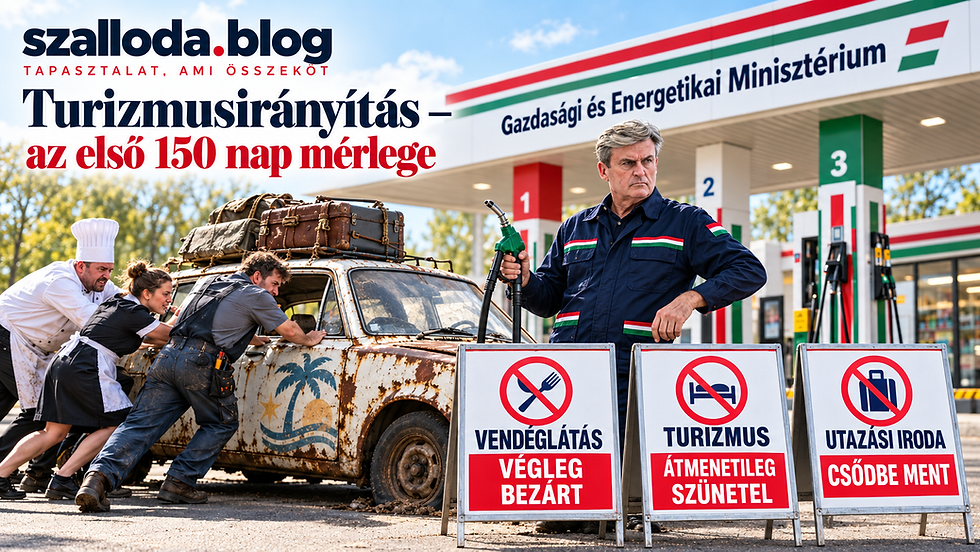
Tourism is not a network of petrol stations or an open door for the previous government's interest groups.
Four hundred thousand employees, a constituency of around one million with their families, and a system associated with roughly 14% of economic performance. It cannot be governed by one minister speaking in the first person or by consulting only those who sat at the former government's table while ignoring letters documenting losses.
Removing Guller was simple and highly visible. Breaking established connections and communicating more clearly than during his years has proved harder. In our editorial assessment, those responsible for TISZA's tourism strategy have so far performed worse than the practice they criticised, not better.
Tourism, hospitality and related services need at least a dedicated state secretariat with skilled professional staff, but more fundamentally an institutional home led with greater care and openness. Destinations, water resources, cruise ships, airports and rural regions evidently do not fit comfortably in a ministerial portfolio weighted more towards energy than tourism.
Until that is acknowledged and a capable, attentive authority is clearly assigned, the 'historic opportunity' described on 5 October remains words. Summer has already gone.
Winter approaches, with the risk of further restaurant closures, hotel failures and travel-agency problems. Predicting difficulties hardly requires clairvoyance.
The questions submitted on 15 June, the 34-point package and the Danube proposals remain open. We will publish any response received from the ministry.
UPDATE | Perhaps 150 Days Were Needed for a Change of Approach
7 October 2026
After publication, István Asztalos, representing the ÉTREND Hungarian Chefs' Association, reported participating in a professional meeting at MTÜ in which, in his words, something more meaningful than simply hearing one another finally took place: a substantive dialogue developed.
The conversation covered taxation, employment, training and regulation in hospitality, along with NTAK reporting, the tourism development contribution, service charges, 5% VAT on food, strengthening regional destinations and tourism income remaining in local communities. Asztalos especially emphasised that this time he sensed a genuine willingness to listen professionally at MTÜ.
That is not yet a strategy, decision or crisis response. But it is a signal.
Perhaps tourism administration needed 150 days before conversation began replacing communication. If so, this may be the first indication of a better direction.
The next question is not whether professionals are heard, but what happens to what they say.
AI transparency: Artificial intelligence assisted with research, editing, language and visual production. A human editor checked and approved the facts, data, sources, conclusions and final text. Some illustrations were AI-generated editorial illustrations, not documentary photographs.
This article was translated from the original Hungarian using artificial intelligence. The original language is Hungarian.


Comments