
.png)

The aggressiveness of low-cost carriers – Europe has walked into a capacity trap of its own making

While airlines keep expanding capacity, regional aviation, connectivity, and in many cases the long-term sustainability of tourism itself are increasingly at risk.

Over the past few weeks, several professional debates have emerged around the weakened position of easyJet. According to some industry experts, the airline’s difficulties signal the beginning of the end for the low-cost model itself, while others argue that the entire European low-cost sector has entered a period of crisis. The reality, however, is considerably more complex than either of these interpretations suggests.
In my view, it is not the low-cost model that is in crisis. Rather, Europe has walked into a capacity trap of its own making.
The root of the problem is not the low-cost structure, online distribution, high aircraft utilisation, or the unbundling of services. Rather, it lies in the fact that, over the past two decades, a significant part of the aviation industry has treated growth as a strategy in itself. In this pursuit, governments and tourism stakeholders have often acted as willing partners, frequently without fully considering the long-term consequences.
When growth becomes an end in itself
From the early 2000s onwards, European aviation experienced a period of continuous expansion. New airports appeared on the map, while existing ones embarked on ambitious capacity expansion programmes. New routes were launched, and airlines placed orders for ever larger aircraft.
Market participants operated on the assumption that sufficiently low fares would always generate new demand, and for a long time this proved to be true. The accession of Central and Eastern European countries to the European Union, the free movement of labour, the rapid growth of city-break tourism, and the development of online booking platforms all fuelled expansion for many years.
The problem began when capacity expansion became an end in itself. Parts of the industry started to confuse growth with success, yet the two are not the same.
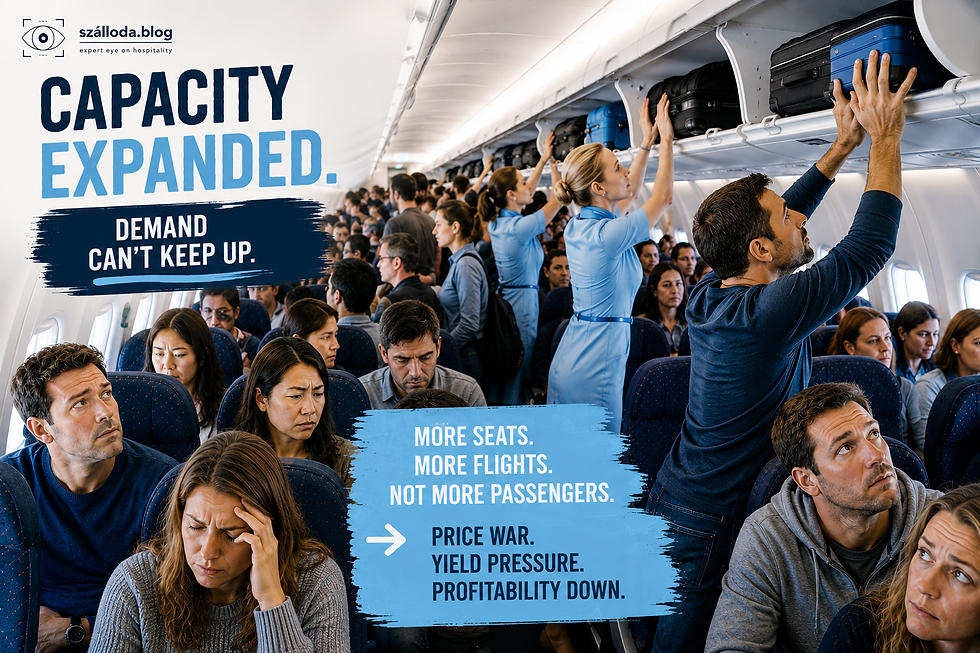
Today, it is increasingly evident across many European markets that capacity is growing faster than solvent demand. A significant share of newly added seats is not creating new passengers but merely redistributing existing demand among an ever-growing number of market participants. The inevitable result is intensified price competition, declining airline yields, and deteriorating profitability. Moreover, this challenge does not affect only low-cost carriers. Airlines across all business models are feeling the impact.
easyJet’s current financial performance and its implications may serve as a warning for modern European aviation

The debates surrounding easyJet provide a clear illustration of this phenomenon. The airline is undoubtedly under pressure: its share price has been underperforming, a portion of investors have become increasingly dissatisfied, and the European leisure travel market is growing ever more unpredictable.
None of this, however, suggests that easyJet’s market position, strategic importance, or long-term prospects are diminishing. Quite the contrary. The airline holds an exceptionally valuable portfolio of airport slots at London, Paris, Geneva, and other economically significant European airports with strong profit-generating potential. Its fleet consists of a modern and highly standardized family of Airbus aircraft.
easyJet Holidays has become one of the fastest-growing tour operating businesses in Europe.
It is therefore no coincidence that investor interest has emerged around the company. If a business were genuinely on the verge of becoming unviable, it is highly unlikely that it would attract strategic and financial investors of such calibre.
(Editor's note: Simultaneously with the publication of this article, we contacted easyJet's press office regarding the company's future prospects and the reports of investor interest that have recently appeared in the media. Should we receive a response, this article will be updated accordingly..)
What does the investment interest from Castlelake and MSC signal?
The investor interest surrounding easyJet in itself reveals a great deal about the company's true value. Two names have appeared most prominently in media reports: Castlelake and MSC. Both parties may be interested in the airline, albeit for entirely different reasons.
Castlelake: an aviation finance powerhouse

Castlelake is an American investment firm with a particularly strong presence in the transportation sector, especially within aviation. For many years, the company has been involved in aircraft financing, leasing, and the investment management of aviation-related assets.
For Castlelake, easyJet may not necessarily be attractive primarily as an airline. Rather, it represents an asset portfolio comprising a valuable Airbus fleet, a substantial portfolio of airport slots across Europe, a strong and well-established brand, and a significant market share.
For an investor of this kind, the value of easyJet cannot be measured solely by its current profitability, as the underlying assets themselves represent considerable value.
MSC: from shipping giant to integrated transportation and travel ecosystem

Even more intriguing is the emergence of MSC as a potential investor. Most people know MSC as one of the world's largest container shipping companies. However, in recent years the group has also become an increasingly significant player in tourism and passenger transportation. Today, MSC Cruises operates one of the world's largest cruise fleets, serving multiple market segments and categories. The group has also assumed a major role in the development and operation of port terminals.
MSC's business strategy is increasingly moving towards the creation of integrated travel chains, and within such a system easyJet could become a particularly valuable asset. Through a potential acquisition, MSC would gain access not only to a substantial European short-haul air network, but also to key airport positions, the easyJet Holidays package travel business, and tens of millions of European passengers.
Within the cruise industry, an airline capable of transporting passengers directly to cruise embarkation ports represents a particularly valuable strategic asset. For MSC, therefore, easyJet would not simply be an airline, but another important building block in a global travel ecosystem.
What is the market signal behind all this?
The backgrounds of the two potential investors clearly illustrate that the market does not necessarily interpret easyJet's challenges as a sign of structural collapse. Castlelake sees asset value, while MSC sees strategic synergies.
Both perspectives ultimately lead to the same conclusion: despite its current challenges, easyJet continues to represent significant value. That would be difficult to reconcile with the notion of a company genuinely standing on the brink of operational failure.
Not all low-cost airlines are created equal
It would therefore be a mistake to judge the entire low-cost sector on the basis of a single easyJet case.

Ryanair: the cost-focused carrier
Ryanair remains Europe's airline with the strongest cost position. In the 2025/26 financial year, the company generated more than €2.26 billion in net profit while carrying over 208 million passengers.
This is not the picture of a collapsing business model, but rather that of an exceptionally efficient company. Ryanair's success demonstrates that, with the right cost structure, the low-cost model can still perform extremely well. At the same time, it also highlights how the market is becoming increasingly concentrated around the strongest players.
Wizz Air: when growth becomes a vulnerability

Wizz Air's situation is considerably more complex. Pratt & Whitney engine issues, rapid fleet expansion, exposure to the Middle East and Eastern Europe, and geopolitical uncertainties have all placed pressure on the company simultaneously.
The airline's profit warnings and declining financial performance clearly demonstrate that rapid growth in itself does not provide protection. At the same time, the Wizz Air case is not evidence of a problem with the low-cost model. Rather, it illustrates how growth can make an operation increasingly vulnerable.
Jet2: when the airline ticket is only the beginning

Jet2 represents a particularly interesting counterexample. While many people still view it as a low-cost airline, it increasingly operates as an integrated travel company, selling not only airline tickets but also accommodation, package holidays, and complete vacation experiences.
The company's record financial results demonstrate that controlling the entire tourism value chain can provide a significant competitive advantage.
Volotea: proving that niche markets still matter

Volotea has chosen a different path. Rather than focusing on Europe's largest markets, the airline connects smaller and medium-sized cities with one another.
The company's results demonstrate that a niche strategy can still be viable in Europe. Not every destination needs ten daily Airbus A320 flights.
Vueling: operating under the IAG umbrella

Vueling belongs to a different category altogether. As part of the IAG Group, it does not operate as an independent player but as a member of one of the world's largest airline holding companies.
The backing provided by British Airways, Iberia, Aer Lingus, and other group carriers gives Vueling a level of stability that differs significantly from the traditional low-cost carrier model.

Overtourism starts long before visitors reach the city
When air capacity to a destination can be expanded without meaningful constraints, it is only a matter of time before visitor numbers reach levels that local infrastructure can no longer absorb. Barcelona, Venice, Dubrovnik, Amsterdam, and Santorini are all examples of destinations already struggling under the weight of mass tourism, with many residents finding their cities increasingly difficult to live in.
The consequences of excessive capacity expansion are reflected not only in the financial performance of airlines, but also throughout the tourism sector itself.
The problem is often blamed on tourists, yet the process frequently begins much earlier — in aviation itself, and even before that, in flawed tourism strategies and uncontrolled permitting and development processes.
Cheaper airfares attract even more visitors, forcing hotels into increasingly intense price competition. This, in turn, can lead to a decline in service standards as businesses strive to remain competitive and financially viable.
Meanwhile, local communities increasingly feel that their towns and cities no longer belong to them. Expanding capacity does not automatically equate to development and can ultimately produce the opposite effect.
At that point, excess capacity is no longer serving tourism development; it is simply inflating tourism.
The market is beginning to separate winners from losers in aviation
Today, investors are looking far beyond simple passenger numbers. They assess an airline's cost structure, route network, revenue mix, the extent to which it is integrated into the tourism and business ecosystem of the destinations it serves, as well as the flexibility of its operations and its ability to adapt to rapidly changing and often unforeseen challenges.
One of the most important lessons of the post-pandemic era is that the market has once again begun to differentiate between airlines. It is no longer enough to simply add more aircraft, launch more routes, and respond to every challenge or market situation with lower fares.
Those that excel in these areas continue to have a strong future ahead of them. Those that have built their strategy solely around capacity growth are facing increasingly significant challenges.
Conclusion
The winners of the next decade will most likely not be those offering the greatest number of seats, but those that best understand that the true value of mobility is determined not by the number of seats available, but by the quality of the connections it creates.
The debate surrounding easyJet is not really about easyJet, nor is it about the low-cost model itself. Rather, it reflects the fact that European aviation has reached a stage in its development where quantitative growth no longer necessarily translates into qualitative progress. The question today is no longer how to bring even more seats to the market, but what level of capacity is actually needed.
While Europe was celebrating the era of 200- to 240-seat aircraft, regional aviation quietly began to decline. Smaller airports, regional routes, and the connectivity that is vital to economic development have lost importance in many areas. Yet in the long run, this may once again become one of the most important issues facing European aviation.
In the next part of this series, we will examine how Europe lost part of its regional airport network, why rail has become both a competitor and a partner to aviation, and what lessons can be learned from the examples of Linz, Debrecen, Norway, and Switzerland.
This article was originally written in Hungarian. The English translation was prepared with the assistance of artificial intelligence.


Tamás Pakuts is an international tourism, hospitality, aviation, and mobility expert with nearly 35 years of professional experience across Europe and Asia, and more than 25 years of leadership experience in the hotel industry, hospitality, and tourism development.
Throughout his career, he has held executive, operational, consulting, training, and advisory positions with airlines, airports, hotels, cruise companies, tourism organizations, and international development projects. What makes his professional background unique is his ability to combine expertise in aviation, hospitality, destination development, transportation, organizational transformation, and executive coaching at a high level.
As a hotel executive and consultant, he has successfully led hotel repositioning projects, organizational transformation initiatives, expansion programs, and revenue optimization projects. Several hotels that had previously faced significant operational and commercial challenges achieved record occupancy levels and outstanding business results under his leadership. In some cases, occupancy rates increased from below 25% to well above 90%, while profitability and service quality remained sustainable.
He is the creator of the REVo Dynamic Revenue Optimization Method, one of the first dynamic hotel pricing and revenue optimization systems developed in Central Europe, long before dynamic pricing became a widely adopted industry practice. REVo-based pricing and sales strategies delivered substantial occupancy growth, stronger market positioning, and improved financial performance for numerous hotel businesses.
Under his leadership, hotels and hospitality businesses have received numerous national and international awards for quality, guest satisfaction, operational excellence, wellness services, and innovation.
Beyond the hotel sector, he has also been actively involved in the development of gastronomy and culinary tourism. As an advisor, he supported the work of the Hungarian National Culinary Team, contributing his expertise in hospitality, service quality, training, and strategic development.
Within aviation, his work has included airline management, aviation marketing, airport development projects, route development initiatives, and aviation consulting. The amendment of the Hungarian–Swiss bilateral air services agreement, enabling the designation of additional operators alongside the national carriers, was made possible in part through his aviation law expertise and advocacy efforts. He founded one of Europe’s first virtual airlines and operated an air bridge connecting Kazakhstan’s oil and gas fields with the rest of the world for several years.
He has participated in airport feasibility studies, airline business development projects, and tourism-related transportation development programs, gaining first-hand experience of the relationship between connectivity, accessibility, and tourism competitiveness.
During the launch of civil aviation operations at Debrecen Airport, he provided the professional framework for ground handling services. He also played an active role in establishing international operations at the airports of Atyrau (Kazakhstan) and Cheboksary (Russian Federation).
His experience also includes leadership positions aboard both river and ocean cruise ships, where he managed multicultural teams, complex hospitality operations, guest experience programs, leadership development initiatives, and crisis management projects in international environments.
In addition to his operational achievements, he is a certified executive coach, trainer, DISC expert, and organizational development consultant. Over the years, he has delivered thousands of coaching, consulting, and training programs for executives, hospitality professionals, tourism stakeholders, and service organizations.
He firmly believes that successful tourism development cannot be separated from transportation networks, infrastructure, accessibility, local communities, sustainability, and the overall visitor experience.
This philosophy also forms the foundation of Szalloda.blog, an independent professional platform that explores the connections between tourism, hospitality, aviation, rail transport, mobility, destination development, and economic policy.
Today, he works as an international consultant, trainer, and industry expert across numerous countries in Europe and Asia, while regularly publishing independent analyses on the future of tourism, transportation, hospitality, and regional competitiveness.


Comments