.png)


Thursday: International outlook

Let's forget that Hungary is so special that it has no competitors - the end of self-deception

In tourism, we often tend to think in domestic terms, and the tourism strategies of the past two decades have suggested this. Domestic guest nights, domestic records, domestic hotel market, domestic hospitality, domestic airports (although here, for concessionary reasons, only Budapest has counted and meant something in the government's thinking so far), domestic developments, domestic problems. This is natural, but it can also be dangerous.
The guest does not start from Hungarian statistics, he does not look at whether the statistical indicators were better this year than in previous years. Which traveler considers whether a region has developed compared to itself? He compares countries, cities, regions, experiences, prices, accessibility, service level and atmosphere.
That's why the International Outlook was given a special day on Hotel.blog.

Thursday is about stepping out of our domestic self-interpretation and looking at how tourism works in our neighbors and beyond, in Europe and around the world. We are not doing this to encourage us to copy anything uncritically, nor because everything is better abroad. Without conscious, critical comparison, there is no true self-knowledge.
Tourism is not a closed national track.
Hungary is not competing with Hungary, just as Budapest is not competing with its own past achievements, and Lake Balaton cannot be compared to last year's Balaton season. Rural hotels, spa towns, wine regions, gastronomic destinations and regional airports do not stand alone, but are part of a large ecosystem.

For the guest, there are Austria, Slovenia, Croatia, Czech Republic, Switzerland, Italy, France, Spain, Greece, Turkey and many more alternatives, just a click away. This is the real-life competition environment.
In Thursday's articles, we will therefore examine international examples, models, solutions and lessons learned . For example:
How is Slovenia building a destination?
What makes Switzerland's tourism system work?
How does Austria connect railways, ski regions, gastronomy and the hotel industry?
What does Croatia do well and where are its limitations?
How does France handle regional tourism, gastronomy or luxury positioning?
What can we learn from markets that are not necessarily bigger, but more aware?
A good foreign example is valuable only if we understand what is behind it. It is not enough to say “we should do this here too”. The question is what kind of institutional background, what kind of financing, what kind of professional culture, what kind of cooperation, what kind of market logic and what kind of long-term thinking made it possible, because success is rarely accidental.
Behind a well-functioning Alpine destination are not only beautiful mountains, but also the entire transportation system, different categories of hotels, local attractions, high-quality hospitality, conscious product development, organized extension of the season, joint brand building and perhaps the most important and indispensable factor: consistent, organized cooperation.

Behind a successful gastronomic country brand are not only good restaurants, there are also producers, wineries, chefs, vocational training systems, local and international certifications, communication, marketing and PR, markets, festivals and domestic and international positioning.

Behind a strong urban tourism brand are not only attractions and museums, but also the organization of guest flow, transportation options, the cityscape itself, the experiences that can be experienced, the event strategy, accommodation capacity, the cultural offering and conscious management, and last but not least, safety and hygiene.
International examples often hold up an unpleasant mirror. They show how others solve issues that we have been avoiding for years:
How is seasonality handled?
How is the railway connected to tourism?
How is regional aviation supported?
How do you build a gastro destination?
How are rural areas positioned?
How do you handle sustainability so that it is not just a communication element?
International comparison is not only good for criticism, it can also inspire. There are models from which we can learn, solutions that are worth adapting. We can avoid the perceived mistakes in our own ecosystem. There are successes that show that even smaller countries, smaller cities or lesser-known regions are able to build a strong position if they work consciously and join forces.

Slovenia is one of the best examples of how a relatively small country can be positioned as a premium, green, active, gastronomic and boutique tourist destination. It is interesting not because it should be copied in everything, but because it shows: size in itself is not an obstacle if there is a clear message and it is built consistently.

Austria can show us, among other things, how tourism can be combined at a regional level, with transport, hotels, local products, mountain infrastructure and a year-round range of experiences.
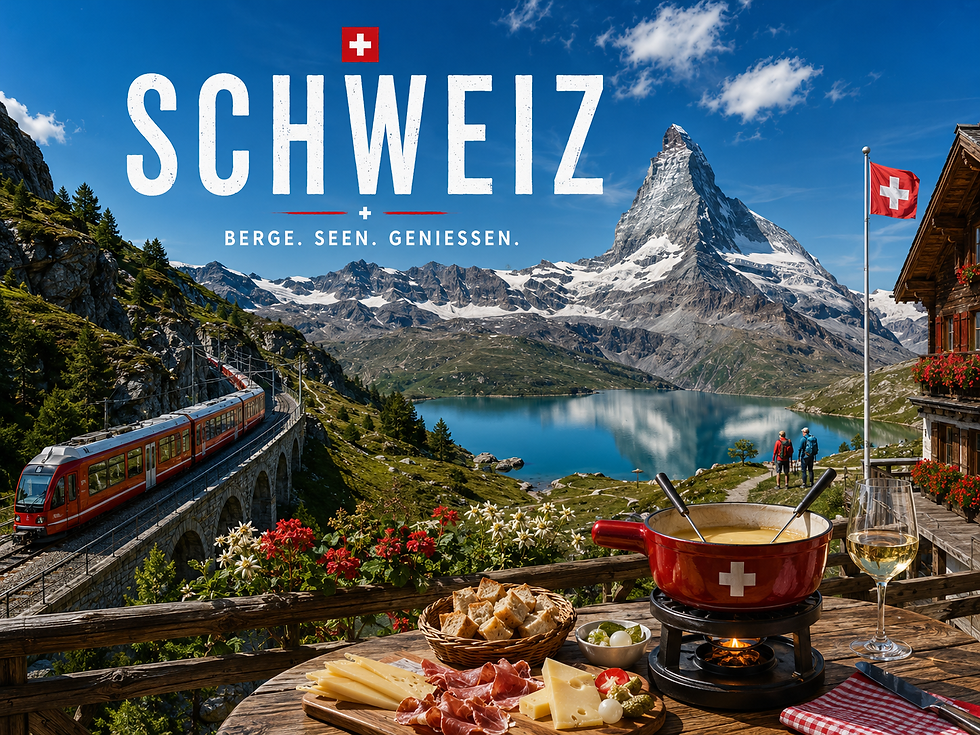
Switzerland is an example of how high prices are not necessarily a disadvantage if they are backed by predictable quality, a strong transportation system, safety, the beauty of the landscape, and a well-built brand and service reliability.

In Croatia, we can see how a coastal country can be placed on the international tourism map in the face of strong competition, but also the challenges caused by excessive seasonality, periodic overload of infrastructure, and differences between individual regions.

And France can remind us that tourism, gastronomy, culture, wine, the countryside and luxury work really well when they appear not as separate products, but as mutually reinforcing systems.
Thursday's topic will not only be about European examples.

Sometimes we also look at more distant markets. Because many lessons can come from Asia, the Middle East, the Caucasus, Central Asia or even smaller, rapidly developing tourism countries. Not all examples will be directly transferable, but many can help you ask new questions, give ideas, and think about things. One of the important goals of an international outlook is precisely this: to broaden your professional horizons.
Hungarian tourism often moves through its own internal debates. Who gets support? Which region is developing? What was the season like? How many guest nights were generated? What records were set? These are important questions, but they are not enough.
The real question is how competitive we are in international comparison:
Is the product strong enough?
Is the positioning clear enough?
Is the accessibility good enough?
Is the service quality consistent enough?
Is the price-performance ratio attractive enough?
Is destination thinking conscious enough?
Does the cooperation between the state, the market, local governments and professional actors work well enough?
We often only get clearer answers to these questions if we look at examples from other countries. Not all foreign models are better, nor can they all be successfully copied. Many countries cannot be compared to Hungary due to their characteristics: an alpine region, a coastal destination, a global metropolis, or a luxury market operate under completely different conditions.
Therefore, in Thursday's articles, we do not simply collect examples, but interpret them:
What is really transferable?
What is just inspiration?
What would require different conditions for us?
What would require institutional, transportation, training, or market changes?
What is something that we should not copy because it does not suit our own abilities?

A good international outlook is particularly important in the field of tourism policy and destination development. In many countries, it is clear that successful tourism is not only about entrepreneurial performance. It requires predictable regulation, sensible infrastructure, well-functioning transport, professional training, a credible country brand and long-term strategic thinking.

Tourism is not built overnight. A country will not become attractive by launching a campaign, but by ensuring that the guest actually receives what it promises. If communication develops faster than the product, it will sooner or later become a disappointment. On the other hand, if the product is strong but not well positioned, then the opportunity remains unused.
International examples also help with this: they show the proportions:
What are others communicating?
What are they building for?
What kind of clientele are they targeting?
How do they handle premium, mass-market, active, cultural, gastronomic or wellness tourism?
How do they talk about themselves?
At least as important: what are they not trying to sell together?
Because good positioning is a choice, and also the support that underpins the decision. It is not possible to appeal to everyone in every country, every region, every city at the same time. International examples often show that successful destinations know who they want to be: they are not necessarily perfect, but they are recognizable.

Thursday's topic will therefore also be about identity:
What story does a country tell about itself?
What kind of experience does a city promise?
How does a region become more than just a collection of accommodations and attractions?
How can a place be positioned in a way that doesn't sound like artificial marketing language, but is built on real assets and functioning services?
Ultimately, an international outlook is also about us, about understanding our own situation better, about not only evaluating ourselves according to our own internal standards, and about having the courage to learn, compare, question, and reinterpret.
The guest has long since stopped choosing within national boundaries.
They choose experience, accessibility, quality, trust, value for money, impressions, experiences, tastes, sights, atmosphere, story. They often choose the place that is not necessarily the cheapest or the most well-known, but the one that is the most understandable, the most attractive and the most accessible to them.
That's why Thursday will be the International Outlook Day on Szálloda.blog with examples, comparisons, lessons learned, inspiration and competitiveness comparisons. Hungary's competitors in the fight for guests are those places that compete for the same travel decision and argument from the guest.


Comments