


Tourism Celebrated. But Where Were Hungary's National Tourism Leaders?


Across Hungary, tourism professionals organised activities for World Tourism Day. Tourinform offices, chambers of commerce, spas and local tourism organisations filled 27 September with events. By 30 September, however, we found no public World Tourism Day greeting addressed to the profession from the Hungarian government, the Ministry for the Economy and Energy responsible for tourism, or the leadership of the Hungarian Tourism Agency (MTÜ). Visit Hungary meanwhile promoted almost one hundred events. We examined what lay behind that figure — and who thought it important to address the industry itself.
Tourism 360 | Tamás Pakuts | 30 September 2026
This article was updated after publication with the Hungarian Tourism Agency's response.
World Tourism Day does not transform the economic position of an industry. It does not generate more guest nights, higher room occupancy, easier recruitment or a more predictable regulatory environment. But once a year, it offers an opportunity to present tourism not only through records, campaign figures, traffic data and destination marketing, but as a profession.
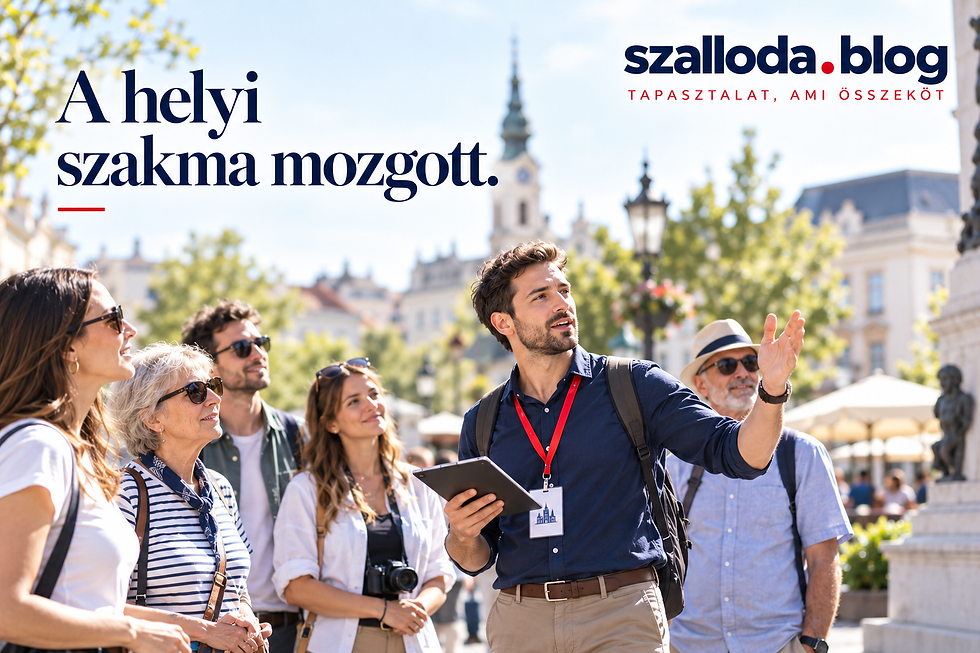
Hungary had plenty to celebrate on 27 September. Tourinform offices organised city walks, games and excursions; spas prepared special activities; chambers of commerce created their own event series; and municipal and regional tourism organisations made the industry visible through their own initiatives.

Yet we searched in vain for a message to the profession from the leaders of national tourism management.
By the morning of 30 September, Szalloda.blog had reviewed the publicly identifiable communications of the government, the Ministry for the Economy and Energy, MTÜ and Visit Hungary. We found no World Tourism Day greeting from the Hungarian government. Nor did we identify a ministerial or state-secretary-level message to the profession from the ministry responsible for tourism, or a separate professional greeting or sectoral statement from MTÜ's leadership.
An Events Programme, but No Professional Message
On 23 September, Visit Hungary promoted a nationwide programme. According to its announcement, more than 57 Tourinform offices joined World Tourism Day with almost one hundred events. The offering included themed city walks, cultural and gastronomic activities, active tourism, games and initiatives showcasing local heritage.
Considerable organisational work went into many local events. In Szeged, for example, a free themed walk specifically designed for World Tourism Day offered residents a new perspective on their own city.
The Tourinform network was active, programmes were organised and Visit Hungary provided a national framework. But the announcement remained programme promotion: it contained no leadership greeting, professional message or assessment of the industry's situation.
An events list tells people where they might go. A professional World Tourism Day message shows what the industry's leadership thinks of the people who keep it running.
Who Considered 27 September Worth Marking?

Public communications reveal a marked contrast between the activities of national management and those of several professional and local participants.
Organisation | World Tourism Day message to the profession | Event or campaign | Leadership statement | Publicly identified activity |
Hungarian government | Not found | — | Not found | No separate World Tourism Day communication identified |
Ministry for the Economy and Energy | Not found | — | Not found | No ministerial or state-secretary-level message identified |
MTÜ leadership | Not found | Through Visit Hungary/Tourinform | Not found | No separate leadership statement identified |
Visit Hungary | No separate leadership greeting found | Yes | Not found | 57+ Tourinform offices, almost 100 promoted activities |
BKIK | Yes | Yes | Institutional professional message | Multiday World Tourism Day programme |
Local Tourinform and tourism organisations | Yes, in several places | Yes | Locally, in several places | Walks, excursions, games and open programmes |
Spas, attractions and service providers | Varied | Yes | Varied | Special programmes, discounts and activities |
The Budapest Chamber of Commerce and Industry clearly described what the occasion meant to it: on 27 September, visitors, tourism service providers and people working in the sector celebrate tourism together while highlighting its social, cultural and economic significance. The chamber has regularly organised World Tourism Day activities since 2011 and built its 2026 programme around water.
That contained something missing from national government communications: recognition of tourism professionals as a community.
Not Every One of Those Almost One Hundred Events Represented the Same Achievement

Almost one hundred events was the standout figure in Visit Hungary's communication. Our review showed that the nationwide collection combined quite different types of tourism offerings.
Some programmes were newly created for World Tourism Day. Elsewhere, existing products were made free, discounted or supplemented with special content. The list also included regularly scheduled, guaranteed activities available both before and after the occasion.
Creating a new event, offering a special edition of an existing product and adding an ongoing programme to a national list represent different kinds of professional effort.
Programme category | What does it mean? | Example or characteristic | What does it tell us about the activity? |
Created specifically for World Tourism Day | New content or a new event | Themed walk in Szeged and other locally created programmes | New professional and organisational effort |
Special World Tourism Day edition of an existing programme | Existing product offered free, at a discount or with extra content | Model used in several places | Genuine additional activity without creating a new tourism product |
Regular guaranteed programme | Available before and after World Tourism Day | Identified in several destinations during the audit | Part of the World Tourism Day offering, but not a new event |
This puts the figure of almost one hundred events into better perspective. It did not mean almost one hundred newly created programmes. Rather, nearly one hundred programme opportunities were brought into World Tourism Day communications, with varying degrees of new content.
The headline number is impressive. Its composition reveals how much additional activity it represents.
We Asked the Organisation That Published the Figures
On 28 September, Szalloda.blog sent a press enquiry to MTÜ and Visit Hungary. We asked for the final data source behind the claim that more than 57 Tourinform offices had organised almost one hundred events, and the methodology used to count them.
We also asked whether the organisation distinguished new World Tourism Day events, special editions of existing programmes and tourism products that were already running. Another question concerned whether quality-assurance points, bonus tasks or other incentives encouraged Tourinform offices to participate in 2026.
Our sixth question addressed national leadership directly: had MTÜ, Visit Hungary or the government's tourism leaders issued a World Tourism Day professional or leadership statement that our public search had failed to identify?
No response had arrived by our initial publication deadline. Our full letter and questions are available here:
UPDATE — 30 September 2026, 16:00. MTÜ provided a substantive response after the article's initial publication.
After publication, the Hungarian Tourism Agency replied to Szalloda.blog's questions about the Tourinform network's World Tourism Day activities. Its response clarified several methodological details not apparent from the original national announcement.
According to MTÜ, programme data were collected directly from Tourinform offices using a questionnaire developed for that purpose, and the national total was based on the information supplied by network members. Each separate type of programme was counted as one event, but no distinction was made among new events created expressly for World Tourism Day, special or discounted sessions of existing programmes, and tourism services regularly available on other dates.
Consequently, the published national event count did not consist exclusively of programmes created for 27 September. The same total could include a newly organised activity, a special occasion within an existing programme, a discounted or highlighted version, and a tourism service that was already part of a destination's normal offering.
MTÜ described this as a deliberate organisational principle. The national initiative was not intended solely to create new programmes for this occasion, but to make tourism experiences available to as many communities and visitors as possible on World Tourism Day. Individual Tourinform offices therefore decided on content and formats in line with local conditions, attractions and visitor needs.
Another new detail was that activity linked to World Tourism Day was encouraged with bonus points under the Tourinform Quality Assurance System. MTÜ nevertheless emphasised that, in its experience, participation was not merely a way to fulfil a quality-assurance requirement; organising local activities and engaging visitors also reflected professional commitment. According to its response, the 2026 programme ran from 21 to 30 September, and several Tourinform offices contributed more than one activity.
The Methodology Behind the Event Count
The newly disclosed methodology explains more precisely what the nationally promoted figure represented. It was not just a count of new events created specifically for World Tourism Day, but the range of local offerings that Tourinform offices identified as connected with the occasion.
Those figures measure different things. One would show how many new professional, community or tourism initiatives were created specifically for the day. The other measures how many existing or newly developed tourism offerings were included in the national programme associated with 27 September. MTÜ's response confirms that its published figure referred to the latter.
Digitalisation and AI Formed a Separate Professional Theme
The central theme of World Tourism Day 2026 was the role of digitalisation and artificial intelligence in transforming tourism. MTÜ stressed that these were not new directions in Hungarian tourism development, but part of work already under way, with data playing an increasing role in forecasting, decision support, marketing, capacity utilisation and improving the visitor experience.
MTÜ cited AI workshops, themed webinars, efforts to broaden access to and use of NTAK data, and the development of tourism providers' digital capabilities. Its response therefore described two distinct yet related levels: the Tourinform network's World Tourism Day programme, and development work aimed at digitalising tourism and expanding the use of artificial intelligence.
The full response can be downloaded here:
The Silence Reveals More Than a Missing Greeting
A ministry, tourism agency or professional organisation should not be judged solely by whether it posts something on 27 September. The quality of tourism governance is demonstrated by regulation, policy decisions, competitiveness, investment, institutional cooperation and industry outcomes.
Communication, however, is part of institutional culture. It reveals whom an organisation regards as a partner, whom it addresses, and when it considers the people behind the figures worth acknowledging.
Tourism is labour intensive. For visitors it is an experience lasting a few days. Behind it stand the daily efforts of receptionists, chefs, servers, guides, housekeepers, salespeople, event staff, spa employees, travel professionals, Tourinform colleagues and entrepreneurs.
A World Tourism Day professional message solves no economic problem. But it reveals whether industry leaders recognise the people whose work creates the records, guest nights and revenue figures.
While We Counted Events, the World Was Talking About AI

The international theme of World Tourism Day 2026 was 'Digital Agenda and Artificial Intelligence to Redesign Tourism'. In his message, UN Secretary-General António Guterres noted that AI was already transforming how destinations are chosen, tourism businesses operate and travel experiences are planned. Alongside technology, he emphasised smaller businesses, local communities and tourism workers.
This is highly relevant to Hungary. NTAK generates considerable tourism data, while AI-based systems are spreading through hotel sales, revenue management, guest communication and marketing. Online intermediaries, algorithmic recommendations and automation already affect how guests find service providers.
Visit Hungary's World Tourism Day communications focused on local heritage, sustainability and the nationwide programme. We found no national Hungarian leadership or policy message addressing the international theme of digitalisation and AI.
That was a missed professional opportunity. The international theme directly concerns the competitiveness, labour market, sales, data management and future business models of Hungarian tourism.
The Celebration Shifted Down the Institutional Hierarchy
World Tourism Day was far from empty in Hungary in 2026. Visit Hungary organised a nationwide Tourinform campaign. Local offices created new activities, service providers offered discounts and special sessions, and the Budapest Chamber of Commerce and Industry used a multiday programme to discuss tourism's economic, cultural and social value.
Yet the centre of the celebration was lower down the institutional hierarchy.
Activity was visible among Tourinform offices, chambers, spas, attractions, local organisations and providers. We did not identify a corresponding professional statement at the leadership level of national tourism governance.
That says more about World Tourism Day 2026 than the event count by itself. On an industry's day of celebration, it matters not only how many programmes appear on the calendar, but who considers it important to address the people working in the industry.

Sources
1. United Nations — World Tourism Day 2026: Secretary-General's Message, António Guterres, 27 September 2026. The official UN message on AI, digitalisation, tourism workers, communities, small businesses and emerging destinations. The United Nations in Indonesia; United Nations — World Tourism Day 2026.
2. Government of Hungary — Ministry for the Economy and Energy. The government's official pages, leadership information and ministry communications. István Kapitány was the minister responsible for the economy and energy. https://kormany.hu; Ministry for the Economy and Energy — Government of Hungary.
3. Visit Hungary / Igyutazunk.hu — World Tourism Day: Special Programmes Across Hungary's Tourinform Offices, 23 September 2026. According to the announcement, more than 57 offices offered nearly 100 activities between 21 and 30 September. Igyutazunk; Visit Hungary / Igyutazunk.hu — World Tourism Day 2026.
4. Tourinform — World Tourism Day 2026 national event list. A seven-page programme attached to Visit Hungary's announcement, including locations, activities, dates, programme types, prices and further information. It was the primary source for our programme audit. Turizmus Kft.; Tourinform World Tourism Day 2026 Programme (PDF).
5. Budapest Chamber of Commerce and Industry — World Tourism Day 2026, 9 September. Since 2011, the chamber has joined the event; in 2026 it organised a programme around water between 24 and 27 September. Its statement explicitly described the occasion as a shared celebration for visitors, providers and employees. Budapest Chamber of Commerce and Industry; BKIK World Tourism Day 2026; BKIK 27 September programme.
6. Szeged Tourinform — World Tourism Day Is Coming!, 22 September. Szeged created a city-discovery passport and a free themed walk expressly for the occasion; its official announcement said the passport had been created for this event. Szeged Tourinform; World Tourism Day Is Coming!; Be a Tourist in Your Own City!
7. City of Tata — World Tourism Day in Tata. The official municipal website shows that the 'Grandfather Told Me...' walk had previously been a successful summer programme at the Kuny Domokos Museum and returned free of charge on World Tourism Day. Tata municipal website; World Tourism Day in Tata.
8. Hévíz — World Tourism Day: Spa History Walk, 27 September. The special occasion was free, while the official listing also showed the normal participation price of HUF 3,900 for other dates. Hévíz; World Tourism Day Spa History Walk.
9. Hévíz — earlier and regularly scheduled Spa History Walks. The programme was available on 14 July and 27 August 2026; HévíziTúrák also sold it as a guaranteed, normally priced tourism product. This confirms that World Tourism Day featured a special edition of an existing offering. Hévíz, 14 July; Hévíz, 27 August; HévíziTúrák normal programme and prices.
10. Other local examples of different programme types. Gyomaendrőd opened existing local attractions free of charge, while Pécs's official listing included free, discounted and paid programmes. These document the mixed nature of the programme. Gyomaendrőd; Pécs World Tourism Day 2026.
11. Szalloda.blog — press enquiry to MTÜ and Visit Hungary, 28 September 2026. The editorial team submitted six questions on data sources and counting methods, the distinction between new and existing events, incentives for Tourinform offices and statements by national leaders. We again noted that Szalloda.blog still did not regularly receive the organisations' press releases or professional newsletters. The letter is included in the article.
Editorial note: This article was prepared based on official communications publicly identifiable by the morning of 30 September 2026. Substantive responses received after publication from MTÜ or Visit Hungary are presented as updates.
AI transparency: AI-assisted tools supported background research and source organisation. The analysis, editing and conclusions remained under the author's control.
Closed: 30 September 2026.
This article was translated from the original Hungarian using artificial intelligence. The original language is Hungarian.


Comments