


Twelve Points for the Renewal of Hungarian Tourism — and One More


What Should Hungary Do Differently So Tourism Becomes Not Just Bigger, but More Competitive, More Valuable and More Resilient?
We do not need another logo, another campaign or another grant programme. We need tourism that works differently.
Hungarian tourism has changed visibly in recent years. Hotels have been built and renovated, destinations have received development funding, new marketing campaigns have launched and records, rising guest nights and new investments have regularly been announced. But none of this automatically means that tourism's operating model has become more modern, competitive or sustainable.
Over recent months Szalloda.blog has examined seemingly distant subjects: the strong forint's effect on tourism, professional associations, regional airports, transport, education, service culture, nepotism and favouritism, unique accommodation concepts and river-cruise disruptions caused by low water. The more angles we explored, the more the same question returned: is Hungarian tourism operating where and how it will need to operate in the next decade?
Often the answer is not simply more money, campaigns or projects, but a different way of thinking. Tourism should be treated as an interdependent economic and social system, not a collection of isolated hotels, events, flights, destinations and subsidies.
We believe renewal requires at least twelve important areas of change — and one more.
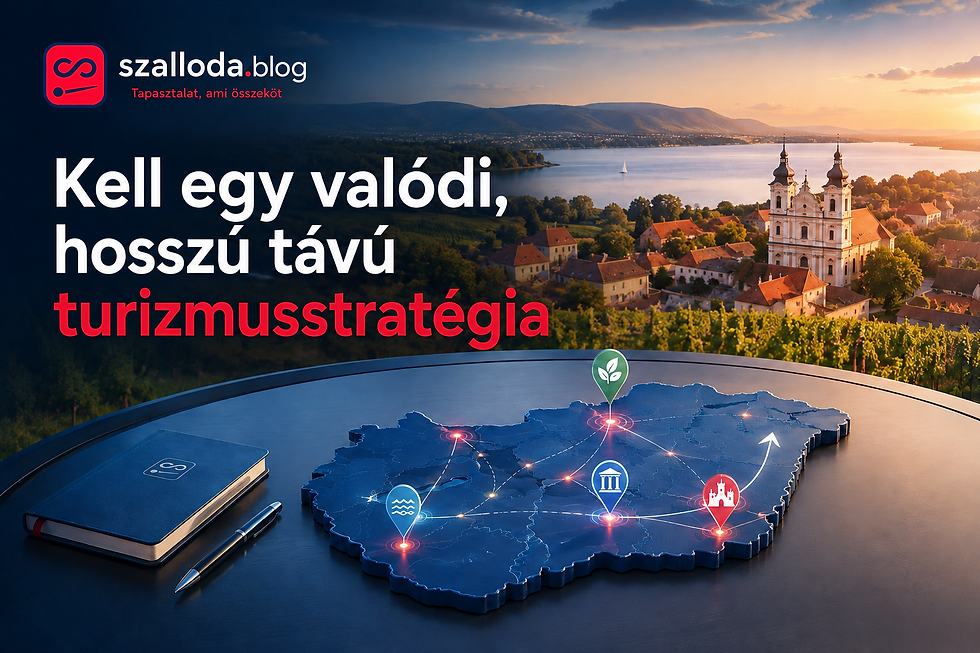
1. Hungary Needs a Genuine Long-Term Tourism Strategy
Tourism also needs to know its destination. Wanting more guests, more nights and more revenue every year is not a strategy by itself.
A real long-term strategy should specify which guests Hungary seeks, how long they should stay, how much they should spend, which regions should grow, how to reduce seasonality, what transport infrastructure is required, how domestic and international demand support each other, and where we want to stand in ten or fifteen years compared with Austria, Slovenia, Croatia and other competitors.
That requires different indicators. Alongside guest nights, monitor spending per visitor, average length of stay, satisfaction, return rates and how much tourism-generated income stays in Hungary and the particular destination.
Strategy exists when objectives, decisions and resources point in the same direction over time.

2. Government Tourism Administration Should Direct Less and Serve More
A strong and competent public tourism administration is necessary. The real question is its role.
MTÜ, Visit Hungary and the wider public tourism system could serve the profession best by offering outstanding data, market analysis, research, international comparisons, infrastructure and coordination, while leaving destinations and businesses room to make their own decisions.
Central data collection can create great value if businesses receive usable knowledge in return. International marketing, market development and investment coordination work similarly. The state's purpose should not necessarily be to make every decision itself, but to create conditions in which others make better decisions.
Professional criticism should not be treated as hostility. In a functioning sector, critical views are feedback rather than system errors, enabling authorities, businesses and associations to learn.

3. Professional Associations Must Return to Genuine Representation
An association exists not to remain on good terms with everybody under all circumstances, but to represent members' professional and economic interests clearly and consistently.
A good professional body is neither a ceremonial meeting place nor an empty club. It is a centre of expertise and genuine advocacy.
Sometimes it should support a government or regulatory measure, and sometimes say plainly that a decision harms hotels, restaurants, travel businesses or other tourism operators. Representation proves its value when interests diverge.
Hungarian tourism needs strong, credible and sufficiently independent organisations that do more than organise events and conferences. They should publish their own data and analysis, prepare policy proposals, initiate public debate and accept conflict where necessary.

4. Hungary Beyond Budapest Must Become a Tourism Product
Budapest is a powerful international destination brand and one of Hungary's greatest competitive strengths. Yet the country's tourism cannot consist only of Budapest, Lake Balaton and a few highlighted destinations.
Lake Tisza, Tokaj, Pécs, Sopron, Szeged, Debrecen, Gyula, Eger, the Mátra, Bükk, Őrség, Danube Bend and numerous other places could become attractive products in their own right. That takes more than renovating hotels, building attractions or running occasional campaigns.
Destinations have to be developed as systems: transport, food, culture, activities, events, cycling and active tourism, public spaces and local businesses. Visitors experience these not as separate services but as one journey.
Success is not necessarily more people arriving in town, but more reasons to stay longer, spend with local businesses and return.

5. Measure Value, Not Just Guest Nights
Guest nights are important, but on their own say little about a destination's real performance.
Spending per guest, average length of stay, expenditure outside accommodation, guest satisfaction, repeat intent and the proportion of revenue remaining locally are much more revealing.
The most valuable guest is not necessarily the one staying longest. Someone paying a fair room rate, eating out, buying local products, visiting cultural attractions, using transport and other services, then returning or recommending the destination may contribute more.
Higher prices are not inherently a problem. A tourism market can move sustainably to a higher price level when product and service quality improve alongside them.
The problem is not Hungary becoming more expensive. It is Hungary becoming more expensive without becoming better.
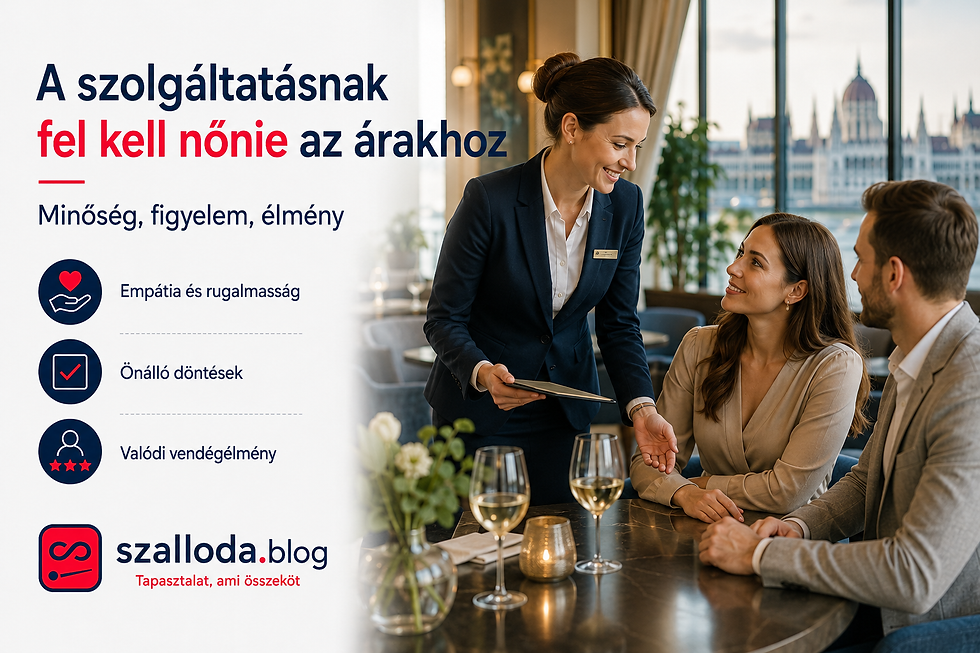
6. Service Culture Must Catch Up with Prices
Many Hungarian services have become considerably more expensive in recent years. Guests may accept higher prices when quality, attention and the experience justify them.
The problem starts when prices rise faster than service standards.
Good service is not simply mechanical execution of an SOP. It requires judgment, communication, attention, empathy, professional confidence and ownership. Skilled frontline employees are essential, but managers who create the right environment matter just as much.
In a modern hospitality business, staff should not need permission for every decision. They should know the boundaries, understand guests' and the business's interests and be able to act independently within agreed limits.
Tourism will become more technologically advanced, but service will fundamentally remain people serving people. Service culture may therefore become an even stronger competitive factor.
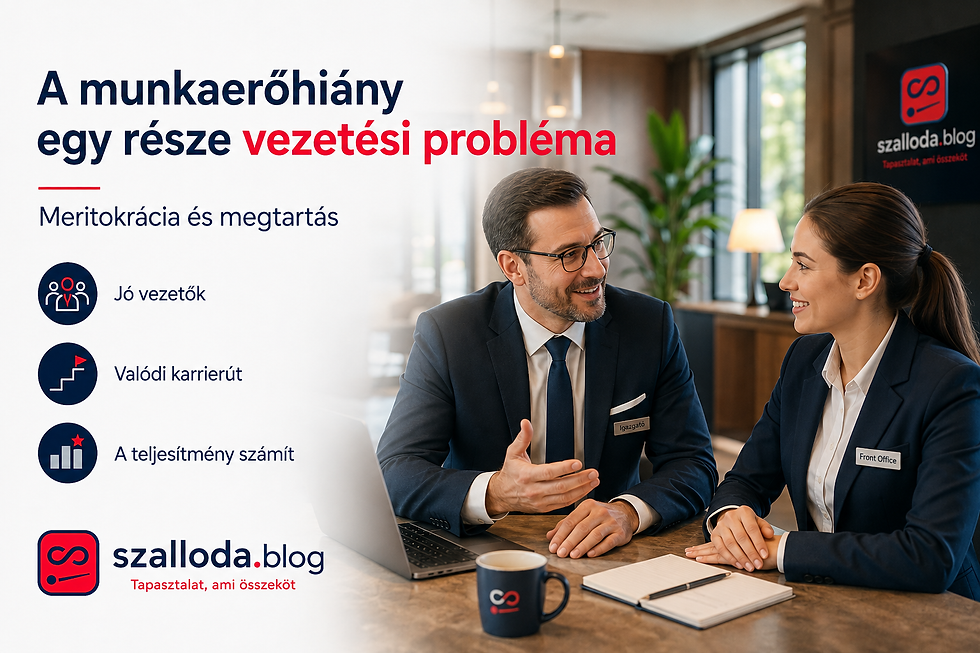
7. Some Labour Shortages Are Actually Management Problems
We have heard for years that tourism and hospitality lack enough employees. That is real, but more complex than it sounds.
Many excellent professionals left the industry or country not because they disliked their work, but because they saw no prospects, received no development opportunities or experienced management cultures where personal connections, loyalty and belonging to an inner circle counted more than performance.
Nepotism and favouritism are therefore not merely ethical concerns, but substantial business risks. They drive out strong colleagues, weaken professional standards and can make mediocrity safer than initiative.
Hungarian tourism needs more meritocratic operations, transparent career paths, credible performance assessment, deliberate succession planning and far stronger leadership development. A good manager remains one of the most important factors in retaining employees.
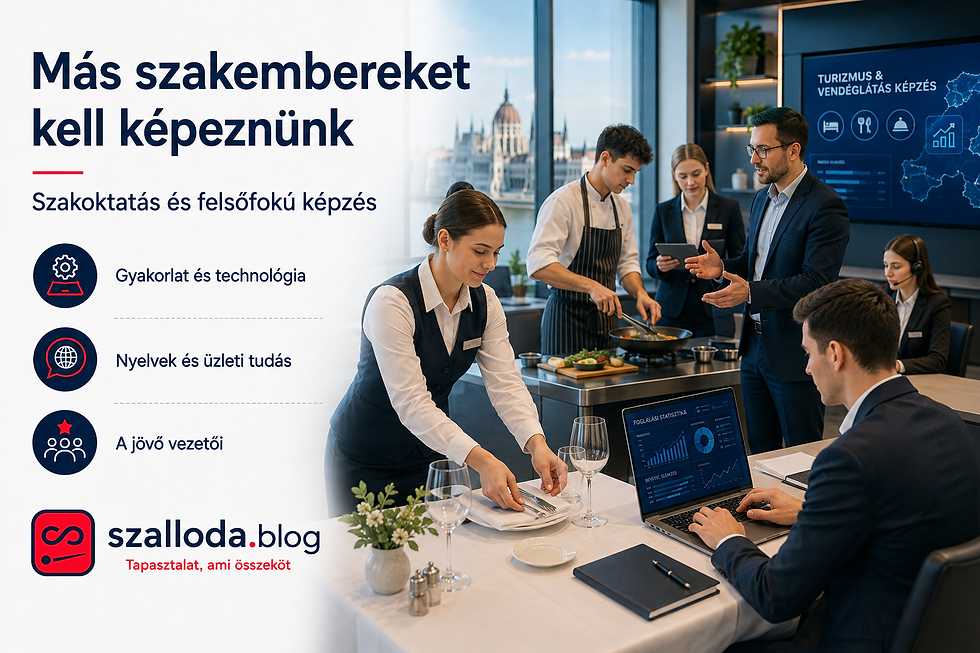
8. Renew Vocational and Higher Education in Tourism and Hospitality
Tourism education faces problems of prestige, rapidly changing professional requirements and the growing gap between schools, universities and operational reality.
It is not enough to repackage old course material in modern presentations while hotels, restaurants, travel companies, event organisers and transport operators fundamentally change how they work.
Vocational education must still teach actual craft: cooks must cook, pastry chefs must create excellent products, servers must deliver proper service and receptionists must manage guests. Today this also requires technology, languages, communication, sales, sustainability and basic commercial thinking.
Higher education needs even greater change. Revenue management, finance, data interpretation, AI, digital distribution and marketing, leadership, customer experience, crisis management and international business are essential to preparing graduates who can actually manage a hotel, restaurant, destination or tourism company in a few years.
Education and industry must be reconnected through more practicing professionals in classrooms, real corporate partnerships with universities and vocational schools and fewer courses the industry itself abandoned years ago.
The goal should not be to issue as many tourism diplomas and certificates as possible, but to prepare people the industry genuinely needs.

9. Mobility Must Be Treated as Part of Tourism
Opening and closing air routes, regional airports, railway connections, coaches, ports and river-cruise infrastructure are often treated as separate transport-policy questions in Hungary. For the visitor, they form one system.
If a destination is hard to reach, connections are poor, direct services limited or guests must research how to get from airport or station to hotel, even an excellent property will struggle.
A new flight is not a tourism product by itself. It becomes one when the timetable, destination marketing, hotels, activities, local transport and actual market demand work together.
The tourism experience begins not at the hotel reception desk, but when the trip is planned.

10. More Authenticity, Fewer Templates
One of international tourism's strongest trends is demand for distinctive, authentic and place-specific experiences. Hungary has considerable untapped potential here.
Family hotels, country restaurants, wineries, castles, heritage buildings, remarkable landscapes, regional products and personal stories can attract international visitors. They do not necessarily need another wave of identical developments, but recognition and professional marketing of what makes each place special.
Not every town needs the same hotel, spa concept or destination message.
Guests increasingly seek something unavailable elsewhere. Hungary has much more of that than it currently reveals.
11. Sustainability Must Not Become Greenwashing or a Marketing Slogan
Sustainability is among tourism's most overused terms, increasing the risk that it becomes decoration instead of substance.
A hotel does not become sustainable because it asks guests to reuse towels, prints menus on cardboard, replaces plastic straws or plants trees a few times a year. Such measures can help, but do not amount to a sustainable operating model.
The concept is broader: energy and water, buildings, transport, food sourcing, waste and climate adaptation, together with how a tourism business supports the local economy, chooses suppliers, hires people, retains value in the region and contributes to a community's long-term liveability.
Sustainable tourism cannot be separated from rural development. A well-run rural hotel or restaurant creates more than guest nights or dining revenue. It can purchase from local farmers, protect jobs, involve wineries, artisans and other businesses in the visitor economy, and help give young people reasons to remain or return.
Sustainability is environmental, economic and social at once. A tourism investment that hardly connects to its surroundings, displaces local operators or exports most of the value it creates is hard to call genuinely sustainable, regardless of its ESG communication.
Resilience belongs here too. Heat, drought, low river levels, extreme weather, energy-price shocks, transport disruption and changes in demand already affect tourism. Future assessments must consider not just how 'green' a business is, but how well it can adapt while strengthening its surrounding community.

12. We Must Learn to Conduct Professional Debate
This may be one of the most important changes — and among the hardest to measure.
In Hungarian tourism, what should remain a professional debate too often becomes a personal conflict. A critical article, dissenting opinion or objection to a measure is easily interpreted as an attack on an entire institution or industry.
A mature tourism culture should accept that a hotelier may criticise state tourism policy, a travel agent may challenge an airline practice, an association may disagree with government, or an employee may question a corporate decision on professional grounds.
The other party should equally be able to respond, argue, present evidence and defend its position.
A healthy industry is united not because everyone says the same thing, but because different perspectives lead to better decisions. Debate does not weaken tourism; it is essential to its development.

+1. Tourism Must Finally Be Treated as a Real Economic Sector
This point unites the other twelve. Tourism is too large and complex to be regarded primarily as nation-brand campaigns, events, hotel-development grants or statistics on guest nights. A functioning visitor economy involves transport, hospitality, hotels, retail, agriculture, culture, education, urban and rural development, employment, energy and international economic relations.
Some of the worst problems arise when these fields make decisions independently. Governments may fund tourism where connections are poor, build hotels where workers or restaurants are missing, promote destinations visitors can barely reach, or discuss rural development without recognising tourism's potential to sustain local economies.
The sector's economic value neither begins nor ends with hotel revenue. Visitors buy tickets, use taxis and public transport, dine out, buy wine and local goods, visit museums and events and support jobs, business revenues and taxes. The crucial question is how much of that value remains in Hungary, and specifically where the visitor spends money.
Tourism therefore needs to be governed as an economic ecosystem rather than separate projects. Transport, education, culture, rural development, employment and tourism policy should more often be made together. For guests they form one experience; for the economy, one interconnected value chain.
Recognising this would shift renewal away from more logos, campaigns or subsidies and towards defining the role tourism should play in Hungary's economy, regional development and international competitiveness, then aligning decisions, institutions and resources with that role.
The twelve points are not separate wishes. They are twelve sides of one question: can Hungary operate tourism as a modern, competitive, value-creating and self-critical economic sector?
Perhaps the most important question is not how many tourists we will have next year, but what sort of tourism we build for them — and for ourselves — over the next ten or twenty years.

What We Have Written About So Far
Since Szalloda.blog relaunched, we have examined many connected questions in Hungarian tourism. We analysed MTÜ and Visit Hungary's operations, leadership and long-term strategy, the role and potential renewal of professional associations including MSZÉSZ, and tourism's place in political and economic programmes. We studied the effect of a strong forint on domestic and inbound tourism, local prices and value for money, comparing Hungarian practices with effective and questionable models elsewhere in Europe.
We repeatedly explored rural and regional tourism, lakes, destination potential, distinctive local accommodation and links to local economies. Mobility was another major theme: regional airports, Pécs and regional aviation, railway and public transport connections, Rail & Fly and river cruises facing low water levels.
We wrote about hospitality service culture, leadership, staffing, DISC, intercultural differences, nepotism and favouritism, professional performance and management responsibility, and the challenges facing vocational and higher education. We examined gastronomy's economic role, pricing and consumer value, sustainability versus greenwashing, passenger rights, tour operators' and airlines' duties, EU261 and lessons from the Robinson Tours case.
Our work received substantial support, feedback and professional recognition. Hotel, hospitality, travel, transport and other industry contacts reached out, shared experience, supplemented our information or said there was a need for forums willing to discuss uncomfortable questions openly.
Unfortunately we cannot yet say the same of government institutions. We repeatedly submitted questions and enquiries; some organisations promised replies, but substantive responses had not arrived at the time of writing. Silence is communication too, but an industry that repeatedly values dialogue, cooperation and data-driven decisions deserves more.
Together these subjects point in the same direction. Tourism should be examined not as isolated sub-sectors, but as a connected system linking mobility, accommodation, hospitality, education, employment, consumer protection, rural development and economic policy. The twelve-plus-one points are their shared conclusions.
Related Earlier Articles
Tourism Strategy, Government and Professional Representation
Regions, Destinations and International Comparisons
Mobility, Rail and Regional Aviation
Workforce, Leadership and Service Culture
We also examined nepotism and favouritism at work: how organisations form in which loyalty and personal relationships outweigh professional performance, damaging retention, leadership and ultimately guest experience.
Sustainability, Price, Value and Gastronomy
Passenger Rights, Crisis Management and Responsibility
The list shows that twelve-plus-one points are not a wish list assembled for one article. The same structural problems and opportunities have emerged repeatedly, whether we examined tourism strategy, regional airports, Michelin-star restaurants, Lake Velence, labour shortages, sustainability or the price of ice cream.
That is why the discussion should move beyond individual symptoms to the operating system Hungarian tourism actually needs.
This article was translated from the original Hungarian using artificial intelligence. The original language is Hungarian.


Comments