
.png)

What makes a city hotel sustainable – and when is it just greenwashing?

LED lighting, towel changes only on request, bamboo toothbrushes and a few plants in the lobby. Many hotels' sustainability communication still only goes so far. However, the environmental and social impact of a city hotel does not begin with the bathroom sign - and it does not end there.

Sustainability has become one of the most commonly used terms in the hotel industry. There is hardly a new development or renovation that does not include the words “green”, “eco-friendly”, “energy-efficient” or “conscious” in its communication.
The problem begins when sustainability is reduced to a few spectacular measures that are marginal compared to the overall operation. Guests are asked to use their towels for another day, while the air conditioning is running at maximum capacity all summer due to the poorly designed glass facade, a significant part of the breakfast buffet ends up in the trash, and employees drive to work from distant settlements.
A truly sustainable city hotel is not just a few green products. The building, energy and water use, hospitality, transportation, procurement, employee status and the relationship with the city are all part of a single system.

Sustainability may be decided before opening
The most important environmental decision for a city hotel is often not what cleaning products it uses or how often it changes the linens, but what kind of building it is built in.
A new, energy-efficient hotel is not necessarily more sustainable than a renovation of an existing building. New construction requires concrete, steel, glass, transportation and significant amounts of energy. The associated embedded carbon emissions are created before the first guest even occupies their room.
According to the World Green Building Council, buildings and construction are responsible for about 39 percent of global energy-related carbon emissions. Of this, 28 percent is related to building operations and 11 percent is related to materials and construction processes.
In an urban environment, repurposing a former office building, department store, post office, school or factory as a hotel can therefore be particularly valuable.
Hotel Marcel, New Haven, United States – when they don't demolish it, but give it a new function
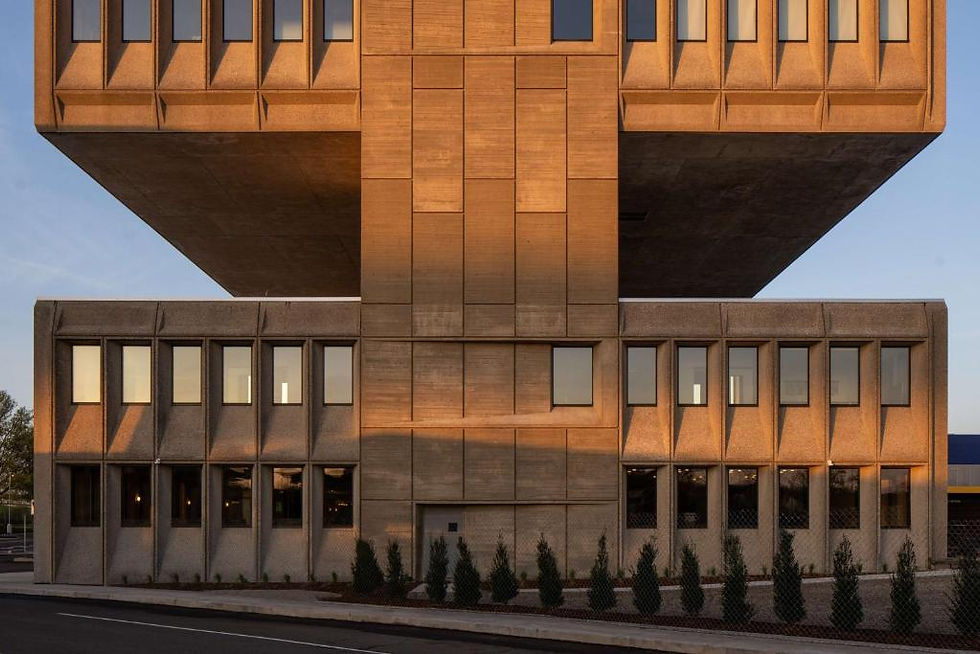
Hotel Marcel was created by converting the former Armstrong Rubber Company, later Pirelli office building designed by Marcel Breuer. The brutalist structure of the building was preserved and transformed into a 165-room hotel, restaurant and conference center.
The hotel is all-electric, fossil-free, LEED Platinum and Passive House EnerPHit certified, using heat pumps, heat recovery, over a thousand solar panels and battery energy storage.
However, the term “net zero” should be treated with caution. According to the hotel’s own website, net zero certification is still pending, so we can safely say that it is fossil fuel-free, all-electric, and highly energy efficient – not that it is already a certified net zero hotel.
The most important lesson from the project is not any technological detail, but rather that reusing an existing structure can avoid creating an entirely new concrete and steel building.
However, the site is located near highways and large parking areas, which shows that a high-performing building is not necessarily perfect from a mobility perspective.
Price and Reviews: Hotel Marcel is a four-star, upper-middle-range hotel. It has a 9.0 rating on Booking.com and is ranked #5 out of 14 reviewed hotels in New Haven on Tripadvisor. KAYAK deals in July 2026 started at $127, while Agoda's last month's data showed a typical room rate of $242, compared to a city average of $200. So it can be competitive in terms of pricing, but its typical price position is above the New Haven average.

Energy efficiency is more than just LED lighting
City hotels operate 24 hours a day. In addition to the guest rooms, energy is constantly used by the reception, kitchen, laundry, ventilation, cooling, hot water system, elevator and in many cases the wellness area.
Energy-efficient operation requires a coordinated system:
adequate insulation and external shielding;
for heat recovery;
low-emission heating and cooling system;
occupancy-based room control;
for detailed consumption measurement;
well-functioning building supervision;
prepared maintenance team.
A smart room is not a solution in itself. It is pointless for the system to turn off the lights when the guest leaves if the building design requires the room to be cooled at maximum capacity all summer long.
Boutiquehotel Stadthalle by Cocoon, Vienna, Austria – energy, water and mobility in one system
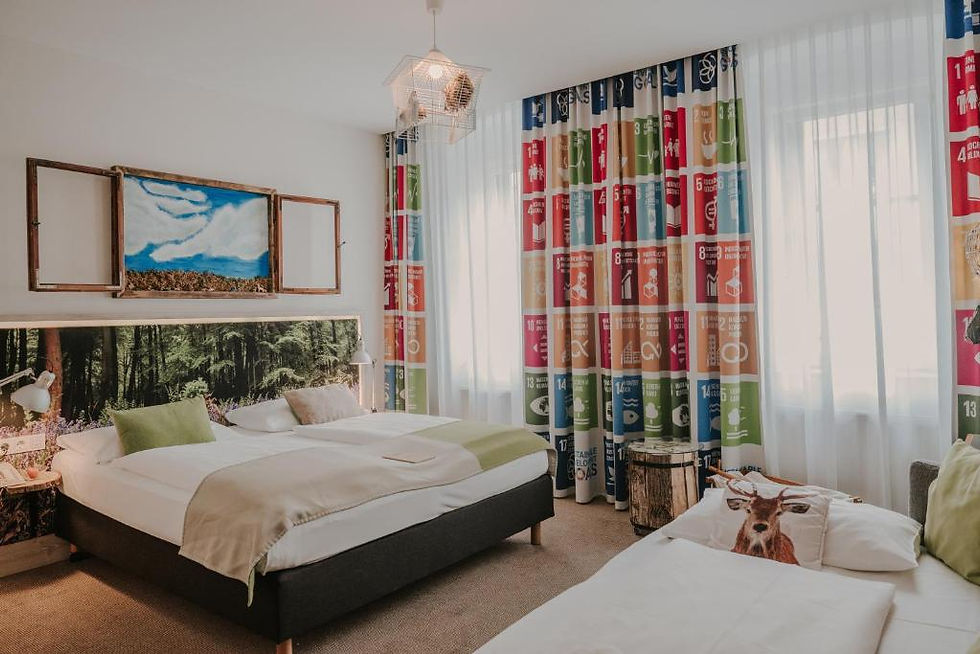
Boutiquehotel Stadthalle consists of a renovated 19th-century building and a later passive house wing. 38 of the 79 rooms are located in the new part of the building.
The new wing uses a ground-source heat pump, concrete core activation and controlled ventilation. Rainwater and well water are used to flush some toilets and irrigate the garden.
However, it is important to precisely define the system boundary: the near-zero energy performance primarily applies to the new passive house part of the building. The old wing also uses district heating.
The hotel offers bicycle rentals and has discontinued daily automatic room cleaning as of January 12, 2026. Guests can still request cleaning free of charge, but must notify the day before.
This is a more fair solution than simply removing the service. The guest's choice remains, but the hotel should also communicate how much water, energy and chemicals the change actually saves.
Price and reviews: The three-star Stadthalle is one of the more affordable boutique hotels in Vienna, while also being highly rated. It has an 8.9 rating from over 2,200 reviews on Booking.com and is ranked 21st out of 396 hotels in Vienna on Tripadvisor, putting it in the top 5 percent of the city. KAYAK's recent average weekday rate was €87, while the overall average for a double room in Vienna is around €136. So it's below the city average in price, but well above it in reviews.
Hotel Jakarta Amsterdam, Amsterdam, Netherlands – wooden architecture and measurable energy use
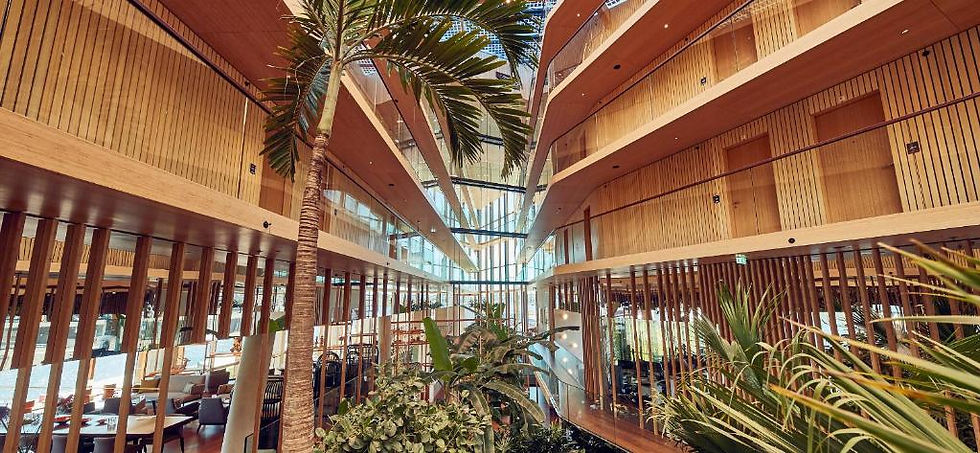
The four-star Hotel Jakarta Amsterdam is a new building, so it is interesting not for its adaptive recycling, but for its wooden structure, energy supply, and detailed consumption metering.
The building features geothermal heat and cold storage, triple glazing, LED lighting and a solar panel system. Larger energy and water consumers are monitored with separate digital meters. Traditional concrete has been replaced with wood where possible.
The hotel achieved a BREEAM Excellent rating with a score of 71.81 percent. BREEAM stands for Building Research Establishment Environmental Assessment Method . It is an international building sustainability rating system that examines, among other things, energy and water use, materials, waste management, transportation, healthy indoor environment and ecological impact.
BREEAM rating levels range from Pass, through Good, Very Good and Excellent, to Outstanding. Excellent is a high score, but it does not automatically mean that the building is carbon neutral or fossil fuel free.
Hotel Jakarta's own communication speaks of an "energy neutral" building. This is based on the EPC energy performance indicator and is not the same as full life cycle carbon neutrality. Therefore, it is more accurate to say that the hotel operates in a highly energy efficient building with a BREEAM Excellent rating.
Price and reviews: Hotel Jakarta is one of the more expensive four-star hotels in Amsterdam. It has a 9.0 rating on Booking.com from around 4,700 reviews, which is a strong score for a high-traffic city hotel. Recent room rates on KAYAK ranged from $286 to $299, while the average price for a four-star hotel in Amsterdam is around $170. So it's clearly above the average for a four-star in the city, in the upper-middle-range category.

Water consumption is not just about the guest's shower
Hotel water conservation communication is mostly aimed at the guest. Turn off the tap. Take shorter showers. Don't ask for clean towels every day. These are important, but a hotel's kitchen, laundry, cleaning, wellness, cooling system or vegetation can also be major water consumers.
True water management requires separate metering of consumption points, rapid detection of leaks, energy-saving fittings, and – where technically and hygienically justified – rainwater or greywater utilization.
Reducing towel changes can be a useful measure. It just shouldn't be communicated as if this is sustainability itself.
Especially not if you primarily save on laundry and housekeeping costs, while the hotel doesn't disclose how much water or energy you actually saved.
You have to get to the sustainable hotel
One of the great advantages of city hotels is that they are accessible by public transport, on foot or by bicycle.
However, hotel websites often feature parking and airport taxis most prominently, while there is hardly any useful information about trams, metro or buses departing from the train station.
A sustainable mobility concept can include:
accurate public transport information at the time of booking;
Rail & Stay package encouraging rail arrivals;
secure bicycle storage;
walking and cycling sightseeing offers;
transportation solutions adapted to the start of employees' shifts;
optimization of the hotel's own taxi and transfer traffic.
A guest's flight itinerary cannot simply be written into the hotel's direct output. However, the hotel has influence over which arrival methods it makes visible, convenient, and attractive.
Increasing the number of parking spaces is just as much a business decision as encouraging rail arrivals.

The breakfast buffet is one of the most honest tests of sustainability
There are few places where a hotel's operating culture is more visible than in its breakfast service. The oversized buffet is still a symbol of quality in many places. However, the spectacular abundance easily leads to overstocking, constant refills and significant food waste.
The solution is not necessarily to drastically reduce the selection. Rather:
accurate measurement of waste;
better forecasting of guest numbers;
using smaller bowls;
more controlled refilling;
multiple serving sizes;
a more attractive presentation of the plant offering;
proper handling of safe food.
It is easy to say that what is not measured is not significant. What is measured often turns out to be not only an environmental loss, but also a serious financial loss.
Housekeeping: sustainability or service reduction?
Skipping daily cleaning can reduce water, energy and chemical usage. But it is only credible if the guest is clearly informed, can easily request cleaning, and the measure is not simply an invisible reduction in service and labor costs.
The same goes for toiletries and other amenities. Large dispensers or a toothbrush provided upon request can be sensible solutions.
But not every disappearing service element can be called sustainability.
If the hotel provides less, provides fewer working hours, and at the same time charges the same or higher price, the question rightly arises:
Who is this model sustainable for?
The most sustainable furniture is the one that doesn't need to be replaced.
Due to lifestyle trends and brand standards, many hotels are replacing furniture, textiles, and decorative elements that could still be used.
The circular approach, on the other hand, examines whether furniture:
can it be repaired;
can it be reupholstered;
Can the damaged part be replaced separately?
whether it can be passed on to another user;
or will the manufacturer take it back?
A less trendy piece of furniture designed for twenty years may be more sustainable than a spectacular, cheaply manufactured interior that is replaced every five years.
Good design is not only beautiful: it is also durable, repairable and adaptable.
A city hotel cannot be an island
The sustainable urban hotel connects with the neighborhood, works with local businesses, and doesn't want to keep all guest spending within its own walls.
You can recommend nearby restaurants, cultural venues, local guides, and event hosts. Your restaurant, bar, or coworking space can also be used by locals.
At the same time, the hotel also generates traffic, noise, freight, taxis and waste. It can affect the real estate market and commercial composition of the area. Therefore, urban sustainability cannot be interpreted solely within the boundaries of the site.
The question is also whether the hotel's presence makes the area better or worse for those who are not its guests.

There is no sustainable hotel without human sustainability
It is difficult to talk about sustainable operations when there is a permanent shortage of staff, unpredictable shifts, regular overtime, high turnover, and outsourced employees doing the same work under worse conditions.
A hotel cannot be called sustainable if it saves water but at the same time feeds its employees.
High turnover is also a waste of business. It requires constant recruitment, onboarding, uniforms, education and training. Knowledge is lost, the workload of remaining colleagues increases, and the quality of service fluctuates.
magdas HOTEL Vienna City, Vienna, Austria – when the social mission is part of the business model
The magdas HOTEL is a social business hotel established by Caritas Austria. It provides work, vocational training and entry into the Austrian labor market for people with refugee experience.
According to magdas data, around a hundred people with refugee experience have started their professional careers here since 2015. The hotel has also been training chefs, restaurant professionals and hotel administrators since 2017.
The current hotel has been operating in a former priest's residence in Vienna's Landstraße district since 2022. The renovation included both old and recycled equipment; the building uses modern green technology and has the Austrian Ecolabel.
The most important message of magdas is not any technical solution, but that social sustainability is not a separate CSR program in addition to the operation of the hotel.
It's part of the business model itself.
Price and reviews: Magdas is a three-star, budget-friendly mid-range hotel. It has an 8.9 rating on Booking.com from over 3,200 reviews, which is based on a strong and broad guest base. Its current ranking of 248th out of 396 hotels in Vienna on Tripadvisor is based on only around twenty reviews, so it is less representative. KAYAK recently reported a booking price of around €96, compared to the average in Vienna of around €136. So it is more of a more affordable mid-range hotel in terms of price, and one of the city's top-performing hotels in terms of reviews.
Climate adaptation: we must also prepare for urban heat
A sustainable city hotel must not only reduce its own emissions. It must also adapt to changing urban conditions. Heat waves, the urban heat island effect, flash floods, water shortages and power outages can directly affect operations.
Resilience can be part of:
adequate external shielding;
building design that reduces overheating;
the green roof;
rainwater retention;
emergency power supply;
the alternative supplier base;
a safe working environment even in the heat.
A rooftop garden in this context is no longer an Instagram backdrop. It can also be a real urban infrastructure.
A textbook example of greenwashing: Booking.com's green leaves
One of the most instructive cases of greenwashing in the hotel industry is not related to a single hotel, but to Booking.com's former Travel Sustainable program.
In the program, accommodations were given levels from 1 to 3+ and green leaf symbols based on their declared sustainability measures. The labels also appeared in the search results, thus directly influencing guests' choices.
According to the Dutch consumer and competition authority, ACM, the system could have created a misleading impression. The name Travel Sustainable and the green leaf could have suggested that the trip or stay itself was sustainable. It was also not sufficiently clear what measures and weightings were used to create the levels.
Meanwhile, the wrong impression may have developed about accommodations without the sign that they are not taking any environmental steps at all. Some of the scored measures did not necessarily mean real additional performance: for example, if a single-use plastic product is already prohibited by law, avoiding it is not an outstanding, voluntary commitment.
Following ACM's action, Booking.com discontinued the Travel Sustainable designation, tiers, and green leaf icons globally on March 25, 2024.
The most important lesson from this case is that greenwashing does not always mean that all claims are false.
It often means that a partial or difficult-to-compare result is exaggerated into a too-strong, too-general, and visually compelling claim. The green leaf promised a simple answer to a very complex question. However, the guest may not have known that the hotel received a higher rating because it operates without fossil fuels, measures its food waste, or simply eliminated some single-use packaging.
This is the difference between measurable performance and the appearance of sustainability.
Certificate or real achievement?
Certifications can provide an important handhold.
BREEAM and LEED primarily assess the sustainability performance of a building. EU Ecolabel, Green Key and national ecolabels can also assess multiple areas of a property's operations.
The certification can help ensure that not every hotel defines what it means by “green” on its own.
However, certification does not mean that the hotel performs outstandingly in every area. Not all systems examine the entire life cycle of the building, employee conditions, impact on the local community or guest arrivals in the same depth.
For authenticity, in addition to the logo, publicly traceable data is also needed:
energy and water consumption per occupied room;
carbon emissions per guest night;
amount of food and other waste;
renewable energy share;
local procurement rate;
employee turnover;
annual change compared to the set goals.
The problem is not that a hotel is not yet perfect. The problem is that it does not measure its performance, does not communicate concrete results, and tries to substitute a few spectacular measures for systemic change.
Eight questions every city hotel should answer
Was an existing building reused or a new one built – and was a full life cycle analysis conducted?
What is the energy use, carbon emissions and water consumption per occupied room?
Are the performance of the kitchen, laundry, wellness and other large consumers measured separately?
Do you know exactly how much food goes to waste every day?
How do you encourage guests and employees to arrive by public transportation, bicycle, or on foot?
What happens to the furniture, textiles and equipment discarded during renovation?
Are the working conditions of employees improving, or are green measures that are only visible to the guest increasing?
Are comparable data publicly available, or are only general promises made?
A sustainable urban hotel is not a product, but a system
Sustainability is not a room decoration, a green door card, or a marketing campaign.
Hotel Marcel shows the value that can be gained from repurposing an existing building.
The Boutiquehotel Stadthalle is an example of how energy, water, mobility and guest communication can be connected.
Hotel Jakarta demonstrates the importance of wooden architecture, detailed consumption measurement, and precise use of concepts.
And magdas HOTEL proves that social sustainability can be part of a workable business model.
The story of Booking.com's green leaves, on the other hand, warns of how easily sustainability can become a marketing signal that is easily recognizable but difficult to interpret in its content.
The truly sustainable city hotel:
not only does he consume less, but he knows what and how much;
not only wants to change the guest's behavior, but also its own operations;
it thinks not only in the building, but in the entire life cycle;
takes into account both employees and the local community;
not only announces goals but also communicates results;
and does not claim more than its data can actually prove.
The most important question is therefore not whether the hotel has a green roof, but what remains of the entire operation for the city, the environment, the employees and the next generation, because a city hotel is not sustainable because it looks green, but because it operates in a way that is sustainable in the long term.
Price and rating data are based on platform information available on July 14, 2026. Hotel prices are dynamic, and platform rankings and ratings are constantly changing, so the price and quality position of individual hotels in the city should be considered as the main guide.



Comments