.png)


Michelin star doesn't pay the bills

If two Michelin stars aren't enough: what does the closure of Platán Gourmet mean?
Why are the best restaurants in Hungary closing?

The closure of Platán Gourmet in Tata in its current form is not simple gastronomic news. It is more of a symptom. A symptom of a system in which professional success, international recognition and business sustainability do not always meet.
Platán Gourmet did not fail professionally, quite the opposite: it was the only two-Michelin-starred restaurant in rural Hungary, which also retained its two-star rating in the Michelin Guide 2025, alongside Stand in Budapest. After eleven years, chef István Pesti will nevertheless end his creative work associated with Platán, and on July 31, the operation of Platán Gourmet Restaurant in its current, permanent fine dining restaurant concept will end.
The lesson of the story is not about whether Platán Gourmet was good, but rather about whether a sophisticated fine dining restaurant of this level can be sustained in Hungary in the countryside.

Prestige and business reality are usually not on the same page.
In the world of fine dining, we often confuse professional prestige with business success. A Michelin star is a huge recognition, a country image asset, a tourist buzzword and a communication weapon. But the star does not pay for the wages, energy, ingredients, kitchen technology, continuous development, wine list, service, marketing and the background costs that determine the daily operation of such a restaurant.
The higher a restaurant rises, the more expensive it becomes to maintain the level for which it was recognized. This is one of the great contradictions of fine dining: success raises expectations, expectations raise costs, and someone has to pay the costs.
A two-Michelin-starred restaurant doesn't just sell dinner. It offers experience, attention, time, precision, creativity, and flawless operation. This requires more people, more preparation, better ingredients, higher professional knowledge, greater discipline, and a more expensive operating environment.
The Hungarian market is simply too narrow for premium hospitality

In Hungary, the problem starts with the market, because domestic solvent demand is limited. It is not that there is no demand for quality gastronomy and that Hungarian guests do not appreciate a good restaurant. However, for the stable operation and maintenance of a fine dining restaurant, occasional festive consumption is not enough. It is not enough for someone to be willing to spend a significant amount of money on a special dinner once or twice a year. Such a model requires a regularly returning, highly solvent, mostly international clientele.
The situation of Budapest's hospitality industry is somewhat better, as the capital is home to foreign tourism, business travel, diplomatic presence, the international corporate environment, and the clientele that naturally includes a multi-hour, high-priced gastronomic experience.

In the countryside, the restaurant must become a destination
In the countryside, however, a two-Michelin-starred restaurant must operate not only as a restaurant, but also as an attraction, a destination in its own right. The guest must travel there, take the time, book accommodation, organize a program, and integrate the experience into a complete travel decision.
The success of a rural fine dining restaurant depends not only on the cuisine. It also depends on transportation, accommodation, the tourist appeal of the area, local programs, wine region connections, the power of destination marketing, and whether the given region is able to package gastronomy into a multi-day experience.
Tata's facilities are excellent. The surroundings of the Platán, the Öreg Lake, the castle, the Esterházy Castle and the entire urban atmosphere provided a special backdrop to the story. But for a two-Michelin-starred restaurant in the countryside to operate, it is not enough that the location itself is beautiful and the restaurant is professionally excellent.
The international gourmet guest must be taken there. Not once and not just as a campaign, but consistently, for years, consciously, in a professional gastrotourism system.
There are strong Hungarian actors, but they often operate in isolation.
However, the story is not black and white. It cannot be said that Hungary does not have top gastronomy, creative energy, or strong actors. There are.
Budapest, for example, remains a significant player on the region's gastronomic map.
The story of Onyx is a particularly exciting example: the former two-Michelin-starred restaurant did not simply close and reopen, but underwent a long metamorphosis. With a workshop, a creative community, research and development logic, sustainability thinking and a new experience format, it tried to reinterpret what progressive Hungarian cuisine means today.
Onyx is a good example because it shows that there is innovation in Hungarian gastronomy. The problem is not that there are no good restaurants, talented chefs or brave owners, but rather that they operate in isolation. A restaurant, investor, chef or workshop is capable of creating international-level performance, but there is not a strong enough national gastronomic strategy, a national gastro-tourism route system, conscious rural guest management and long-term institutional support behind it.
Slovenia is not just showcasing restaurants, it's building an ecosystem

At this point, it is worth looking at Slovenia. The Slovenian tourism strategy does not just promote good restaurants, but also builds a gastronomic image of the country. The country was awarded the title of European Region of Gastronomy in 2021, and official tourism communication connects local ingredients, regions, wines, producers, restaurants and sustainability messages as a unified experience. (Click on the logo to get a sense of the perfection of the Slovenian example.)
The essence of the Slovenian model is that excellent restaurants are embedded in the region, history, route, wine region, local producers and tourism brand. The gourmet guest is not left alone, but guided.
They are also directed towards locations outside the capital with publications, regional recommendations, gastronomic maps, thematic routes and conscious communication. This is not by chance important: a top restaurant in the countryside has a better chance of operating if it does not have to sell itself on its own, but appears as part of a complete destination experience.
This is still lacking in Hungary today, in such depth and professionalism.

There is also a lack of a clear Hungarian gastronomic classification system
We have high-class restaurants, internationally outstanding and special wine regions, excellent and reliable producers, festivals, new and new Michelin recommendations are coming, and after a break of several years, Gault&Millau is also present again, which evaluates restaurants with a scoring system ranging from 1 to 20.
But what is missing is a broader, understandable, nationally structured rating and recommendation system that can also be used for tourism purposes, which is not only aimed at the profession, but also orients the guest.
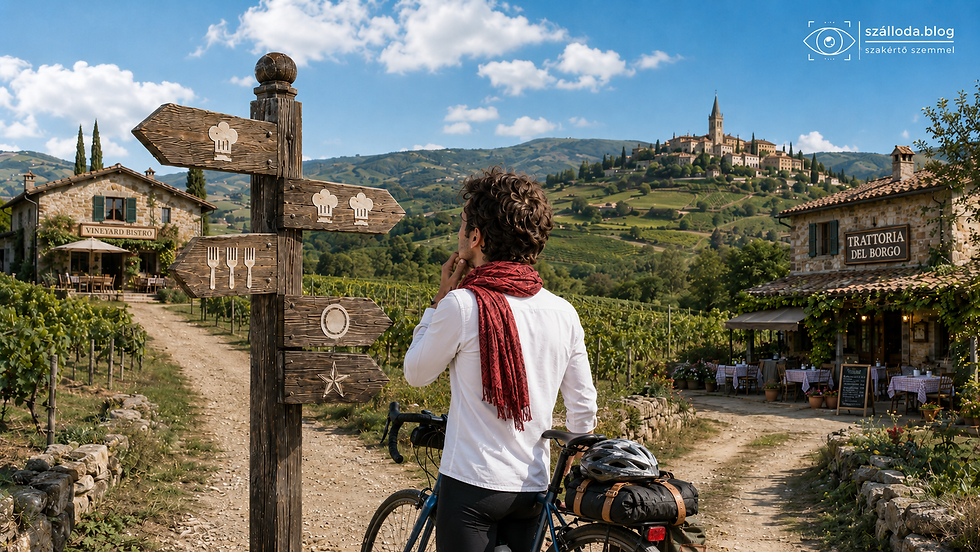
In other countries, hats, forks, plates, stars or other certifications not only give professional prestige, but also help with travel decisions. The guest not only sees where a good restaurant is, but also what region, wine region, accommodation, cultural program or local experience he can expect beyond gastronomy, so that top gastronomy will not be an isolated luxury consumption, but a supporting and determining part of destination development.
Gastronomy is not a luxury fad, but a cultural and tourist value
For this, a real gastronomic section within tourism management would be essential in Hungary. Not an administrative sub-department, not occasional campaigns and communication that only appears at award ceremonies, but a professionally credible, internationally informed gastrotourism workshop that cooperates with chefs, restaurants, hotels, winemakers, producers and destinations.
Gastronomy is not just hospitality. It is also a cultural achievement, an element of the country's image, a touristic motivation and an exportable intellectual product. If the state supports culture, music, festivals, sports or the visibility of national heritage, then gastronomy cannot be treated exclusively as a market luxury product.
This does not mean that the state should support restaurants, but it should build a system whose pillars are certification, communication, ensuring international presence, establishing rural gastrotourism routes, (small) producer relationships, and a wide variety of training.
A Michelin star is a value, but it is not enough on its own
The closure of Platán Gourmet is not a failure of Hungarian gastronomy. Rather, it is a warning that top gastronomy often takes precedence over the tourist and institutional background surrounding it.
A Michelin star can easily become a prestige item without a national gastrotourism system. Prestige alone is rarely a sustainable business model.
The closure of Platán Gourmet does not mean that there is no demand for quality gastronomy in Hungary, but it indicates that the highest level of gastronomy alone cannot do the work that would require a tourism strategy, country brand building, rural destination development, a gastronomic certification system, and state-professional cooperation.

About the author
Tamás Pakuts has been working in the world of tourism, hospitality, aviation and luxury shipping for nearly 35 years. During his international career, he has gained experience in management, consulting and development positions in many countries in Europe and Asia.
His professional interests focus on how tourism is linked to transport, economic policy, regional development and national competitiveness. His analyses often examine areas where tourism goes beyond the world of hotels and guest nights and has an impact on the national economy as a whole.
As the founder of Szálloda.blog, he regularly publishes on current issues in tourism, mobility and transport, paying special attention to long-term trends, international best practices and strategic connections.
The original article was written in Hungarian, the translations are generated by AI.
Source of images: AI, szalloda.blog


Comments