
.png)

Hotel to villa – The suite is no longer enough: has the villa become the new luxury?

Private pool, private chef, invisible staff and total freedom – but is the luxury of building a separate hotel around each guest sustainable?

For a long time, luxury hotels were all about being seen. Monumental lobbies, marble, crystal chandeliers, famous restaurants, sparkling bars, spectacular pools, and communal spaces where guests could not only relax but also show off where they were relaxing. Even the most expensive suite was not completely detached from this world: it was in the same building, with the same elevator, in the same corridor, and operated according to the same hotel rhythm as the other rooms.
The new luxury, on the other hand, increasingly sells invisibility. Private entrances, private pools, separate dining, private wellness areas, personalized schedules, and staff who appear when needed and then disappear almost unnoticed. The guest does not necessarily want fewer services, but fewer hotels around him.
So luxury doesn't simply move out of the hotel. Rather, the entire hotel service system moves into the villa.
The guest is not buying square meters, but control
The trend is not just an architectural fad. According to Virtuoso’s 2026 Luxe Report, the top ten luxury travel trends are immediate family travel and multi-generational family travel. In the survey, which surveyed more than 2,400 luxury travel consultants, 45 percent said they see an increase in demand for ultra-luxury travel. Private spaces are the third most sought-after experience in this segment, while hyper-personalized travel is fifth.
In Hilton’s 2026 Global Trends Survey, 56 percent of respondents cited relaxation and rejuvenation as their top motivation for leisure travel. The need for closeness to nature, mental regeneration and time alone also feature prominently. Hilton describes this trend of seeking peace, quiet and reducing stimuli as “hushpitality.” This demand creates the perfect environment for the proliferation of villas, residences and private homes. After all, guests are not simply buying a bigger room. They are buying control over space, time and service.
Breakfast shouldn't last until ten o'clock, but as long as he wants to eat. He shouldn't have to look for a sunbed by the pool, the children shouldn't disturb other guests, the dog shouldn't have to be hidden, and for dinner in the evening, there shouldn't be any need to dress up or book a table. A multi-generational family can be together without being confined to each other's rooms, while separate sleeping areas, terraces and bathrooms preserve individual privacy.
At the same time, another market is also growing spectacularly. According to the Savills Branded Residences 2025/2026 report, the number of branded residence projects is expected to increase from 764 in December 2024 to 910 by the end of 2025, representing a 19% annual growth rate. The market continues to be dominated by hotel brands, while more and more fashion, automotive, gastronomic and cultural brands are entering the segment.
A branded residence is not always a villa for tourist purposes, but the logic is the same: the guest or owner wants their own home, but with the service system, security, and quality guarantee of an international hotel brand behind it.

A villa is actually a small hotel
In marketing images, a villa looks like a simple product. A few bedrooms, a large living room, a terrace, a pool and a carefully composed sunset. However, from an operational point of view, a real luxury villa is not a holiday home, but an extremely complex, often spatially dispersed hotel unit.
It needs the same housekeeping, maintenance, security, food and beverage, linen management, waste disposal, guest relations, transfers, IT support and inventory management as a traditional hotel. However, all of this needs to be organized in a way that the guest does not encounter the cleaning van, the technical staff or the breakfast delivery vehicle.
In a villa, faults are also more visible. In a traditional hotel, an elevator or an ice machine might break down without most guests noticing. In a private villa, however, a failure in the pool heater, air conditioning, internet connection, or kitchen appliance can determine the quality of the entire stay. There is no other restaurant, pool, or lounge to which the guest can be redirected.
A good villa therefore requires not less hotel presence, but a higher level of back-end operations. A bad villa, on the other hand, is often just an overpriced holiday home with a WhatsApp “concierge” trying to arrange after the fact what a real hotel operation should have provided upfront.
Good examples – but with reservations
When evaluating positive examples, it should also be remembered that a significant portion of sustainability data comes from the hotel companies themselves. These may be important and verifiable commitments, but they do not always represent a comprehensive, independent life cycle analysis.
Solar panels, composting or water recycling alone do not make long-haul flights, large-scale buildings, imported goods or private infrastructure neutral. A good example therefore does not necessarily mean a flawless example, but a model that measures, reduces and communicates the burden of operations more seriously than the average.
Soneva: when the villa is part of a working system

Soneva in the Maldives is a good example of where the villa product is not separated from the overall resort operation. The large, private villas themselves are not necessarily low-resource, but they are backed by measurable waste, energy and community programs.
Soneva says its Waste-to-Wealth program recycles 90 percent of its solid waste. Glass, metal, and organic waste are processed locally, and food waste compost is used in the islands’ gardens. The company’s Soneva Namoona program also works with surrounding local communities to reduce waste incineration and single-use plastics.
Soneva Fushi and Soneva Jani have set a goal of generating nearly 50 percent of their energy needs from solar energy by 2024. The previous photovoltaic system provided approximately 12 percent of Soneva Fushi’s energy use. It is important to note, however, that the 50 percent target is a target and not an independently verified result at the time of publication. ( Soneva’s Solar Program )
This is not to say that Maldivian villa luxury is environmentally friendly. International flights, seaplane or boat transfers, imported goods, desalination and large air-conditioned villas all create significant pressures.
The positive thing is that sustainability here does not end with the bamboo toothbrush in the room and the sign urging the reuse of towels, but also affects the essence of the operation, from energy supply to waste processing.
Six Senses: sustainability is more credible when it can be audited

Six Senses also represents a hybrid model, with private villas and residences backed by a single corporate operating standard. According to Six Senses’ sustainability page, from December 2024, previously operating homes will be GSTC certified, based on an external audit by Control Union. The certification includes criteria for energy and water use, as well as local communities, heritage and environmental management.
Each resort directs 0.5 percent of its total revenue into its own Regenerative Impact Fund, which supports local community, habitat rehabilitation, and conservation programs that are directly related to the destination.
The important difference here is not that every Six Senses villa is automatically more sustainable than a traditional hotel room. The larger floor space and private infrastructure can also result in higher absolute consumption.
The difference is that environmental and social claims are backed by measurement systems, external verification and institutionalized accountability. The “green” label can therefore be something more than a creative decision by the marketing department.
The Brando: technology behind tropical luxury

The Brando in French Polynesia shows that the energy requirements of villa luxury can be reduced not only through minor cosmetic interventions.
According to the resort's own sustainability data, more than 4,700 photovoltaic panels provide approximately 60 percent of its energy needs. The Sea Water Air Conditioning system, powered by deep sea water, can reduce cooling energy consumption by up to 90 percent compared to traditional air conditioning.
Wastewater is treated and used for irrigation, rainwater is collected, and food waste is turned into compost, which is used in local gardening.
However, the resort itself acknowledges that reducing the carbon footprint of transportation to the island remains an area of concern. This is a more important statement than any flawlessly retouched sustainability campaign: a remote private island does not automatically become low-emission even if the local energy and water systems are highly developed.

When your own pool is no longer a luxury, but an automaticity
One of the most spectacular competitions in villa developments is around private pools. In many destinations, a premium villa without a private pool is now considered almost unsellable, regardless of how much the guest actually uses it and whether the water resources in the area allow for its mass distribution.
The pool needs to be filled, evaporation losses need to be replaced, the water needs to be filtered, disinfected and circulated, and often heated or cooled. A study published in 2024 in the Costa Brava examined the water and energy use of hotel pools precisely because, with droughts and Mediterranean water shortages, previous operating practices are becoming increasingly difficult to maintain.
In January 2025, Greece discussed preparing regulations that would allow the use of seawater in hotel pools. The immediate context of the proposal was the dwindling freshwater resources on the Greek islands and the additional burden of the tourist season. ( Associated Press: Greek hotel pools and seawater )
It is telling in itself that a destination must seek a legislative response to how to maintain pool supply even when local freshwater reserves are decreasing.
A private pool can certainly be part of the luxury experience. But when every villa automatically gets one, we're no longer talking about a personalized service, but a real estate development template.

Bali: when the villa boom competes with the local water system
Bali is a particularly strong warning. In recent decades, a huge number of villas, smaller resorts, apartments and tourist properties have been built, while the island's water supply has come under increasing pressure.
A study examining water use by tourism in Bali , conducted with the participation of researchers from Kyoto University, found that water demand for tourism increased by 20.8 million cubic meters, or 295 percent, between 1988 and 2013. 68 percent of the increase was concentrated in the tourism-intensive Badung region, where tourism's share of water demand rose from 31 to 46 percent.
The research also showed that there was a significant gap between the officially provided water volume and the total demand of the tourism sector, while the supply to tourism businesses remained continuous. The authors concluded that the missing volume could be partly provided by locally available alternative sources, such as groundwater.
Bali's problem doesn't prove that all villas are bad or that tourism should be scaled back. It shows what happens when real estate developments grow faster than a destination's water management, waste management, and transportation systems.
The private villa offers independence to the guest, while in the background they become increasingly dependent on the limited resources of the local community.
This is one of the greatest contradictions of villa luxury: the guest can feel completely isolated from the problems of the destination, while the villa's water supply, staff, waste, food supply and transportation are inextricably linked to them.

The villa, which blends into nature, also occupies nature
The phrase “integrated into nature” is one of the most commonly used marketing ploys for luxury villas. Earth-toned cladding, green roofs, local stone, lots of trees, and carefully maintained vegetation can indeed reduce visual intrusion. However, this still takes up space, uses materials, requires infrastructure, and can alter the original habitat.
The crucial question is not whether the villa is visible in the drone footage, but what was in place before construction. Did they have to build a new road, electrical grid, water pipeline or sewage system? Was the hillside broken up, was the original vegetation removed, was the coastline modified? How many square meters of built space and engineering are there per actual guest?
A second home used for a few weeks a year, constantly maintained and air-conditioned, can be energy efficient per square meter, while operating with extremely high material and energy requirements per guest night.
This can become an uncomfortable issue, especially in the branded residences market, where the boundaries between tourist services, investment properties and status products are becoming increasingly blurred.
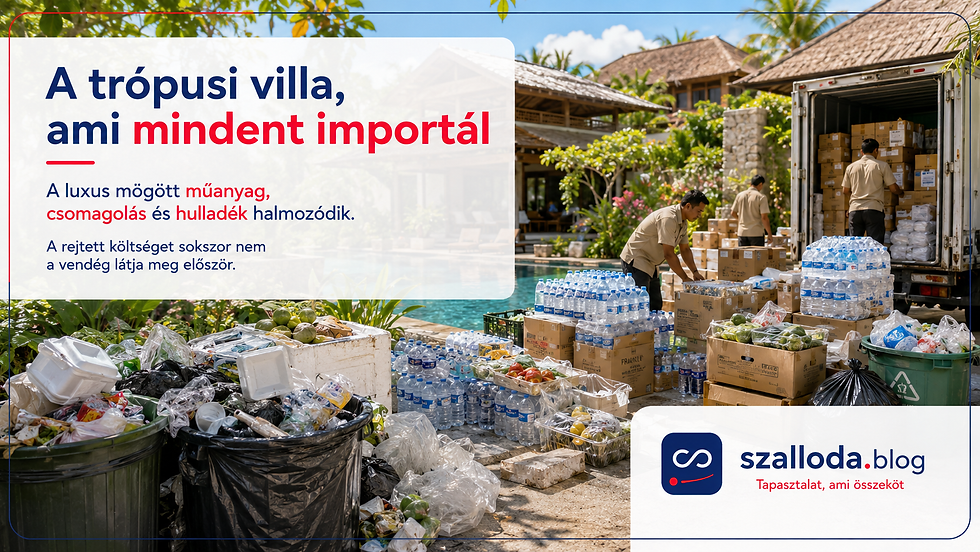
The tropical villa that imports everything
Natural wood, thatched roofs and organic forms do not necessarily mean local operation. A villa can be visually authentic, while the food, wine, bottled water, cleaning products, furniture, textiles, spare parts and even a significant part of the workforce come from far away.
A World Bank analysis of the Maldives found that the resort islands and international airport produced nearly six times as much waste as the local population. A later World Bank estimate put the daily waste at more than 860 tons, a significant portion of which was plastic.
It is therefore not enough to judge the sustainability of island tourism based on what the villa is made of. The entire supply chain, packaging, waste disposal, energy production and wastewater treatment must also be considered.
Locally grown herbs or homemade jam at breakfast alone will not offset the fact that every essential element of the operation relies on air and sea imports. Farm-to-table is only more than a communication panel if it measurably reduces long-distance procurement and provides real income to local producers.
Sustainability should be measured not by square meters, but by guest nights
One of the most common mistakes in sustainability communication for villas is confusing relative efficiency with absolute consumption. A new villa can be 30 percent more energy efficient than an older building, while offering four times the floor space for two guests. It can have water-efficient faucets, while also having a private pool, outdoor shower, irrigated garden and multiple bathrooms.
Therefore, it is not enough to report the percentage reduction in energy consumption per square meter. The relevant indicator is energy, water, waste and land use per guest night. The same should be said about villa occupancy, import ratio, local employment, supplier structure and emissions from transport.
Villa luxury has a greater, not lesser, burden of proof in the area of sustainability.
The more land, machinery, water and personnel movement a single booking takes up, the less a few spectacular green measures are enough. Real performance must be judged on the basis of the entire life cycle, absolute consumption and impact on the destination.

What is a really good fork?
A truly good villa is not distinguished by the size of the pool, but by the system behind it. It primarily uses existing or previously built-on land, or rehabilitates a historic building or abandoned property. Orientation, shading, natural ventilation and proper insulation reduce the need for mechanical engineering during the architectural design.
Water consumption is not only measured, but also assessed per guest night. Rainwater is collected, greywater and treated wastewater are reused, and a swimming pool is not an automatic accessory, but a decision made based on the local water situation.
A villa can be a self-contained guest space, but it doesn’t have to be a self-contained mini-factory. The central kitchen, laundry, maintenance, waste management, storage and staff infrastructure can be shared with other units in a resort or villa community. This doesn’t diminish the private experience, but it does avoid building a completely separate supply system around each guest.
The involvement of local workers and suppliers is not a charitable sideline either. The villa only becomes part of the destination if it does not operate as a closed luxury enclave, but provides training, jobs and predictable demand in its surroundings.
The guest should not receive a luxury set reproduced from an international catalog that can be set up anywhere, but a product that can only be authentic in that location.
What could all this mean in Hungary?
For Hungary, villa luxury should not mean copying the Maldives or Dubai model. What is needed is not oversized resort villas with palm trees at Lake Balaton, Tokaj, the Danube Bend or the historic wine regions, but professionally operated accommodation connected to the landscape, the built heritage and the local economy.

The rehabilitation of existing mansions, press houses, villas and larger rural buildings may be a much more credible direction than the creation of new luxury enclaves in untouched areas. However, the service background cannot remain amateurish.
A high price alone does not make a house a luxury product, just as a private jacuzzi, a smart lock, and champagne prepared upon arrival do not replace a hotel operation.
The question is whether a villa product can be created in Hungary that simultaneously offers true privacy, high-level housekeeping, personalized gastronomy, well-functioning maintenance, professional concierge service, and measurably responsible operation.
Or will we just call larger apartments villas, villas resorts, and premium prices luxury?
Luxury does not mean the disappearance of the hotel
The villa will not replace the luxury hotel. Many people still seek the social spaces, famous restaurants, lobby atmosphere, bars, wellness centers and the experience of being part of the life of a large hotel.
However, the two products are becoming increasingly closer. Hotels are building villas and residences, and professional villas are developing hotel service systems. The brand is becoming less and less about the building itself, and more about the quality guarantee that works in the background.
The luxury of the future is therefore not simply a larger floor space, a private pool or the fact that the guest does not meet other guests. True luxury is the entire hotel operation, from which the guest sees almost nothing, yet receives everything.
But only if the destination doesn't pay the price instead.
Resources and further reading
About the author:

Tamás Pakuts has been actively involved in aviation and tourism for almost 35 years, and in the hotel industry and catering for more than 25 years.
As a manager and consultant, he had insight into the operations of several airlines, as well as hotels, hotel chains, and shipping companies, successfully taking on a role in their operational management, crisis management, and development.
He is currently present in many countries around the world with his colleagues as an expert, consultant, and trainer in the hotel industry and aviation, and he and his colleagues are working on the development of numerous new, internationally noteworthy projects.
Image credits: szalloda.blog , Soneva, AI