.png)


Record tourism or real strategy? Hungary faces important crossroads in the summer of 2026

Demand is strong, visitor traffic continues to grow, Budapest is noticeably strengthening further
Budapest Airport breaks records again
Summer bookings are booming encouragingly

However, the real question for Hungarian tourism in the summer of 2026 is no longer whether there is interest in Hungary, but whether we are able to transform this interest into a long-term, high-quality and sustainable tourism system.
At first glance, Hungarian tourism is in good shape in the summer of 2026. The numbers are encouraging, the market sentiment is more favorable in many areas than a few years ago, Budapest is once again operating as a strong international city destination, rural accommodations are also preparing for a more stable season, and air connections are also improving spectacularly.
According to data from the Central Statistical Office, a record high of 47.2 million guest nights were registered in tourist accommodation in Hungary in 2025, which represented a 5.1 percent increase compared to 2024 - writes turizmusonline.hu .
But in tourism, good numbers often hide more than they show : guest nights are not a strategy, airport passenger numbers are not destination management, and full houses are not necessarily qualitative development. And growing demand is no guarantee that a country's tourism system is truly functioning healthily and efficiently.
The demand is still with us now
Ahead of the 2026 summer season, Hungarian accommodation establishments are starting with a stronger booking base than a year earlier. According to representative data analysis by SabeeApp, national pre-bookings for the June-August period are 31.5 percent higher than in the same period in 2025. The growth is particularly spectacular in Budapest, where this year's summer pre-bookings exceed last year's level by 65.5 percent , while in the countryside there is a 13.3 percent increase, writes turizmus.com .
This difference in itself is remarkable.
Budapest is gaining momentum. The capital is also becoming more and more stable as a summer destination, no longer just a classic spring and autumn city break destination. Major events, festivals, Formula 1, the August holiday season, the return of a large number of international flights and the city's increasing global visibility, as well as the international sympathy and euphoria surrounding the Tisza government led by Péter Magyar, all support this process.
Rural tourism, on the other hand, is growing significantly more slowly , which suggests that the majority of rural destinations continue to be more dependent on domestic demand, weather, last-minute bookings, the rhythm of family vacations and price sensitivity.
In other words, Hungarian tourism is both dynamic and vulnerable.
Budapest is still the driving force, but this is not a country strategy in itself
Budapest's role today is unavoidable. The capital is the international showcase of Hungarian tourism, its strongest brand, its best-selling urban product and its most important air gateway.
Budapest Airport had a record year in 2025: the airport handled 19,632,894 passengers , an 11.7 percent increase compared to 2024. At that time, the airport offered 154 destinations with 45 airlines, which clearly shows that Budapest's air accessibility has strengthened not only in quantity but also in network diversity, the airport announced.
The return of long-distance connections is particularly important. American Airlines' direct Philadelphia-Budapest flight and Air Canada's direct Toronto-Budapest flight will add color to the summer 2026 schedule. However, these opportunities will only become a real tourist value if guests arriving in Budapest not only spend in the capital, but can also travel to other regions of the country comfortably and with attractive offers.
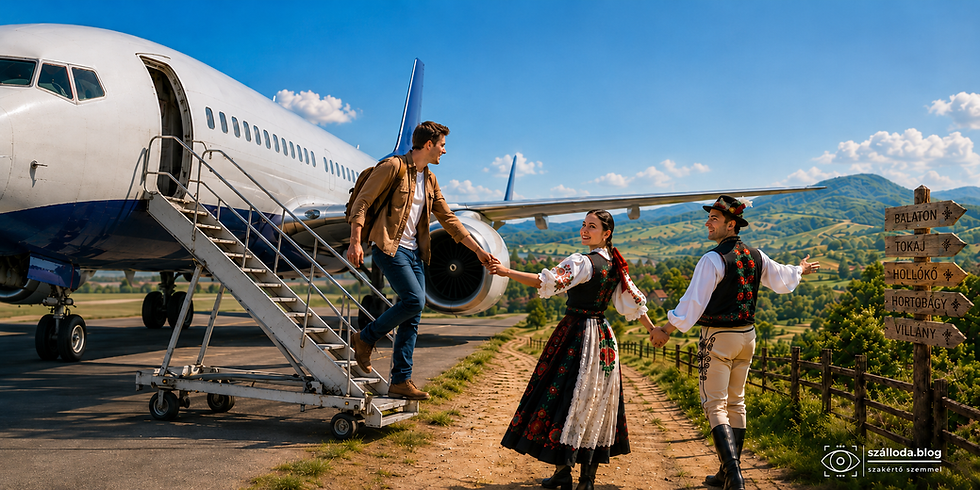
What is Hungary doing with the international demand coming to Budapest? How do we connect the airport with the rural towns, wine regions, spas, lakes, cultural sites? Is there an integrated tourism and transport approach that not only brings passengers to the country, but also takes guests on to Eger, Pécs, Tokaj, Szeged, Debrecen, Villány, Gyula, Hévíz, Sopron or Lake Tisza? Because if there isn't one, then Budapest's strengthening is not a national tourism success, but an increasing concentration in the capital.
The guest is not a statistic, but a person seeking experiences
One of the biggest misunderstandings of tourism is that we often treat the guest as a statistical unit and measure it in numbers: arrival, guest night, spending, room reservation, airport passenger, number of visitors - so many numbered labels.
In reality, however, the guest thinks in terms of destinations and experiences. The airport is just a gateway. The question is what happens after arrival. If the guest arrives in Budapest and then presents itself as a tourist offer that is difficult to understand, difficult to access or poorly packaged for the rest of the country, then we are missing a huge opportunity. Not because there is nothing to show, but because we are not making it easy enough, attractive enough and clear enough to explore the country.
The biggest question in Hungarian tourism: are we building a system or campaigns?
In Hungary, we have long tended to interpret tourism in terms of campaigns, development programs, spectacular numbers, and key investments.
We need to manage visitor flows better, connect Budapest with the countryside in a meaningful way, make rural experiences more accessible and attractive, including supporting local tourism businesses. We need to better anticipate risks and take the true carrying capacity of destinations much more seriously.
Whether it is capacity problems arising from overtourism in large cities, labor shortages, narrow traffic intersections, or even the vulnerability of destinations like Lake Venice, the future of tourism can no longer be treated as an isolated sectoral issue.
Three strategic questions that can no longer be postponed
How can Budapest's success be transformed into a national tourist asset?
If international guests arrive in Budapest but cannot travel comfortably to rural destinations, the country is not taking advantage of the potential of air connections. A few campaign slogans are not enough for this. Integrated airport, rail, bus, water and last mile thinking is needed.
How can rural tourism be made less vulnerable?
Domestic demand is important, but it is not omnipotent in itself. In some rural destinations, seasonal dependence, weather exposure, adaptation to family holiday calendars and last-minute bookings are still too strong. This leaves service providers vulnerable.
How do we protect the reason why the guest is traveling in the first place?
The tourism value of a destination cannot be separated from its natural, infrastructural and community foundations. If these are damaged, the tourism product is also damaged. This is true for a lakeside resort, a wine region, a historic city centre, a spa town or an active tourist area in the mountains.
The problem is not that we are growing. The problem is that we do not know where. The guest is coming. The question is what did he expect and what will he find here. So the summer of 2026 can be both a success and a warning.
Success, because the numbers are strong. Warning, because the structural issues are already visible behind the numbers. Budapest is performing well, but national tourism cannot be built exclusively on the capital. Guest nights are growing, but the quality of the growth must also be measured. The airport is developing, but the air gateway is only truly valuable if the national tourism network is functioning behind it. Rural tourism is stabilizing, but many regions are still overly dependent on the weather, price-sensitive domestic demand and short seasons.
Hungarian tourism today does not simply need more guests, but a smarter system, better transport connections, and a stronger rural offering.
The original article is written in Hungarian, translation is generated by AI.

About the author
Tamás Pakuts has been working in the world of tourism, hospitality, aviation and transportation services for nearly 35 years. During his international career, he has gained experience in management, consulting and development positions in many countries in Europe and Asia.
His professional interests focus on how tourism is linked to transport, economic policy, regional development and national competitiveness. His analyses often examine areas where tourism goes beyond the world of hotels and guest nights and has an impact on the national economy as a whole.
As the founder of Szálloda.blog, he regularly publishes on current issues in tourism, mobility and transport, paying special attention to long-term trends, international best practices and strategic connections.


Comments