


Travel, Monkey Alerts and COVID-19: The Utazómajom Story

Travel in 2020, the Hungarian travel platform Utazómajom and its followers: how did three years change their relationship? We examined what interested audiences, which destinations were accessible and which holidays had to be postponed.
Travel means different things to different people: happy memories, relaxation, adventure, new experiences, spectacular views and culture. Hungarian internet users may also think of Utazómajom, a travel community sharing attractive airfares, dates, tips and personal accounts. For many, it is a traveller's paradise. But 2020 destroyed countless holiday dreams. Did the pandemic damage interest in Utazómajom, or did people become even more curious about travel?
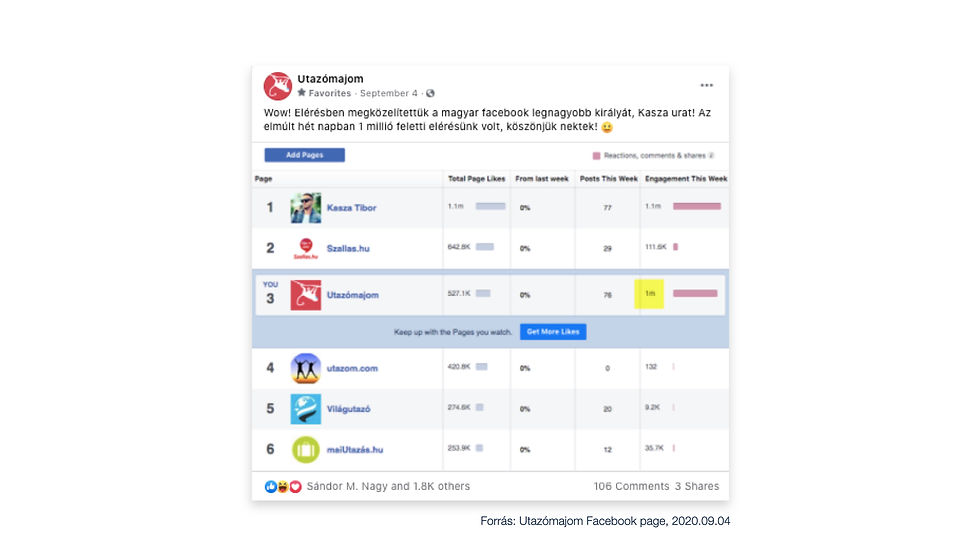
First, consider the audience. Utazómajom has more than 71,000 Instagram followers and over 520,000 Facebook likes. More important, however, is how often its content reaches people. The platform has previously spoken about aspiring to audience figures comparable with Hungarian celebrity Tibi Kasza. How far does its content travel across the entire online environment?
Looking beyond social networks to websites, forums and blogs, Utazómajom-related content reached internet users more than 289 million times in 2018. By 2019 that figure had grown to 424 million. Could the site maintain such enormous reach despite coronavirus?
From 1 January to 30 September 2020, content related to Utazómajom generated over 330 million impressions, compared with 350 million in the corresponding period of 2019. It remained to be seen whether it could again pass 400 million by the end of the pandemic year.

What drives such impressive reach? An interest in travelling alone is not enough; the content must capture attention. Among the most widely seen Facebook posts in 2018, the most popular was about a job opportunity in Greece that involved petting cats. It attracted 1,718 comments and 665 shares.
The second most popular post promoted a Wizz Air offer, while the third covered environmental protection from the perspective of a travelling couple.
In 2019, the highest-reaching post came from a Caribbean beach, where the site's founder promised a prize competition if 2,000 people shared the message. They did, and a KLM giveaway followed. The second most popular post promoted environmental awareness and was shared nearly 9,000 times.

A further giveaway post took third place.
The pattern is clear: Utazómajom followers love competitions, care about environmental protection and sustainability, and enjoy personal travel stories.
In 2020, only one of those themes remained among the leading posts. Unsurprisingly, coronavirus transformed the type of content people consumed. Utazómajom consistently shared practical travel information, with such posts coming second and third in reach. More surprisingly, giveaways remained hugely popular: a competition again ranked first in estimated reach.
The scale of Utazómajom's recognition can also be measured by hashtags. On Instagram, #utazomajom had been used more than 21,000 times over the preceding years.

What other phrase has become synonymous with the community? 'Majomriasztás', or Monkey Alert: the brand's posts highlighting mistaken fares and other extraordinarily cheap air tickets.
The prices of the headline offers had risen over time. In 2018, New York was available for HUF 12,800; in 2019, an Athens ticket at HUF 3,298 was the standout. In 2020, the highest-reaching Monkey Alert offered flights to the Cook Islands for HUF 97,800.

We also examined which cities featured most frequently. Using Tripadvisor's Travellers' Choice list of popular destinations, we selected ten cities and counted posts promoting tickets to each.
Nine per cent of the Facebook posts published over three years offered flights to these particularly popular destinations. Rome appeared 286 times, Mallorca 213 times and Barcelona 196 times. Prague and Crete each appeared fewer than fifty times.

Because followers are keen to comment on Utazómajom's posts, those responses are a goldmine for online monitoring, especially when the founder asks a question.
On 19 October 2020, the question was: 'Did you have to cancel a trip this year? Where would you have gone?'
The 2,957 responses produced a word cloud showing the most frequently used words. Larger words indicate more frequent mentions. Blue indicates neutral sentiment, while red marks negative references.

As might be expected, the word cloud contained many negative comments. Barcelona featured in 109 postponed travel plans, while close to a hundred people each mentioned cancelled Croatian and Italian holidays. Ninety-five respondents referred to March cancellations, 86 to May, and a combined 175 to August and September.
Travel and 2020 were not exactly good friends. Yet the data show that even when journeys could not happen, people continued discussing them online at least as much as before, and sometimes more.
Utazómajom, one of Hungary's largest travel platforms, retained its extraordinary reach. This may be because it understands its audience, measures the success of its posts and tailors material to spread as widely as possible. When quarantine began and attractive travel deals disappeared, it quickly became a travel information service. Other websites cited its practical updates, recognising that travellers cared most about rules and safe ways of leaving and entering countries.
Methodology:

SentiOne's research team used quantitative and qualitative methods to examine Utazómajom's social media channels and publicly available Hungarian-language content from the previous three years containing relevant keywords and hashtags. SentiOne is an online listening platform that monitors public content through keywords and generates analyses of online opinion from mentions.

About the author:
Anikó Farkas is a communications specialist with the Hungarian team at SentiOne. Using the company's advanced web text-analytics platform, she explores online conversations and produces case studies that turn vast amounts of internet data into statistics, insights and engaging stories.
This article was translated from the original Hungarian using artificial intelligence. The original language is Hungarian.



Comments