


Ice Cream in a Taco, Foie Gras in Zserbó: Has Fusion Gone Too Far?


Churro-flavoured ice cream in a crisp taco-shaped shell, coated in chocolate and puffed rice: Taco Bell launched its latest dessert across the United States on 1 September. It may sound outrageous, but there is little reason to panic. We have seen Nutella-topped lángos, celery and tomato ice cream, and foie-gras macarons. Many world cuisines have combined sweet, salty, sour, hot, meat and fruit for centuries. Perhaps flavours have not gone mad; perhaps we have simply become more adventurous.
On 1 September 2026, Taco Bell and the American ice-cream brand Salt & Straw launched the Churro Ice Cream Taco nationwide. The $3.99 limited-time dessert features churro-flavoured ice cream in a crunchy waffle shell, with dark chocolate-flavoured coating and puffed rice. Taco Bell openly explains the logic: turning food trends that spread online into real, purchasable customer experiences people will talk about and share.
It certainly sounds eccentric. Ice cream in a taco with churro, chocolate and crisp rice may perform brilliantly on social media, but in 2026 it hardly qualifies as a culinary revolution.

In Hungary, Nutella or icing-sugar lángos no longer demands an emergency meeting of culinary experts. We have tasted celery and tomato ice cream and foie-gras macarons, while chefs and pastry cooks regularly experiment with considerably bolder combinations.
We have written about ice cream on szalloda.blog from a very different angle. 'Ice Cream Never Lies' explored the economics and guest experience contained in a single scoop's price, while our international Scoop Index used original observations to compare prices, portions and service across countries. The linked articles are 'Ice Cream Never Lies: What a Scoop's Price Says About Hungarian Hospitality' and 'The First International Scoop Index: A Cold Treat as an Economic Indicator'.
The only novelty is that ice cream has now moved into a taco.
Taco Bell Did Not Invent Sweet and Savoury Combinations
It is tempting to present pairings of sweet and salty, meat and fruit, or spicy and sweet as a modern food fad. In reality, many traditional cuisines have worked this way for generations.

Persian fesenjān, for instance, combines walnuts or almonds, pomegranate and poultry or meat. As Encyclopaedia Iranica notes, the acidity of pomegranate sauce is sometimes balanced with sugar. Meat, fruit, sourness and sweetness belong together naturally in one dish.
Thai cuisine likewise depends on a balance of flavours. A Michelin Guide introduction to Thai dining highlights the complementary roles of sweet, sour, salty and hot elements in a well-composed meal.
We could add Moroccan meat dishes with dried fruit, Indian sweet-sour-hot chutneys, the complexity of Mexican mole, and European game dishes long served with fruit or preserves. Meat and fruit, and sweet and savoury, knew each other long before Instagram, TikTok or food bloggers.
Fusion Cuisine Opened the Door
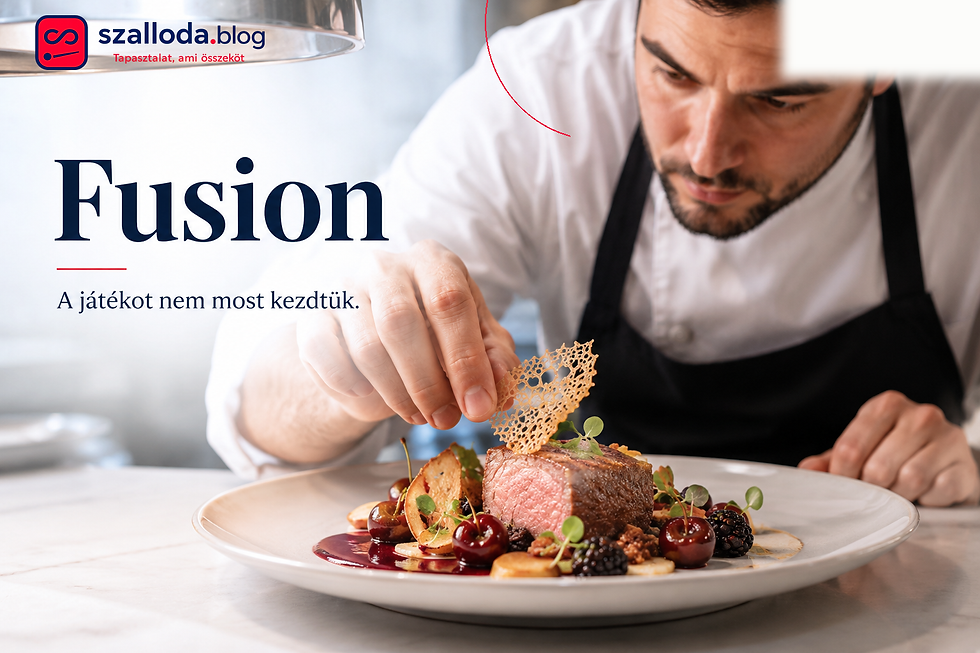
Fusion cooking has made crossing such boundaries feel natural to modern diners. Asian techniques with European ingredients, a French classic with Middle Eastern spices or a traditionally sweet dish served in a savoury version no longer necessarily amount to provocation. They are legitimate forms of culinary creativity.
Guests have changed too. They travel more, encounter more national cuisines, watch cooking programmes, follow chefs and discover street food. On their phones they can now see in seconds dishes they might once have encountered only abroad or at a professional competition. 'That sounds strange' no longer means 'that must taste bad'.

This reminds me of preparing chefs for an international competition and exploring how far we could push familiar flavour combinations. Among other things, I devised a foie-gras zserbó and a gorgonzola-and-fig cheesecake paired with dry sparkling wine and violet liqueur.
Our aim was not to shock the jury with bizarre dish names. We wanted to find the hidden connection between flavours that seemed unrelated, so that after the first bite diners would ask why they had not encountered them earlier. There is an important difference between something that can be combined and something that should be combined.
Yesterday's Chef Competition Is Today's $3.99 Dessert
That may be the most fascinating part of the Taco Bell story. The ice cream taco itself is not revolutionary. What is new is that the kind of playful experimentation with flavours, textures and food categories once associated with chef competitions and fine dining has become a $3.99 mass-market fast-food product.
A Technomic menu analysis published on 31 August, looking ahead to 2028, examined menu data from some 8,000 foodservice outlets and identified 'fusion sweet' as a fast-growing trend, up approximately 25%. Examples include strawberry balsamic, peach salsa, agrodolce and sweet-hot hot-yaki combinations.
Technomic had already given one version of the trend a name in its 2026 US forecasts: 'swavory', combining sweet and savoury. Examples included miso caramel and tahini soft serve, suggesting another rethinking of sweet-and-salty combinations after the earlier sweet-heat trend.
The slightly extreme is steadily becoming a product development category.
It Is No Longer Enough Simply to Taste Good
There is a more significant hospitality lesson here. Increasingly, a dish must do more than taste good: it must tell a story.
Taco Bell's communications are almost a textbook example. The company wants to bring internet food phenomena into its restaurants and create a product that customers not only eat but also photograph, share, send to friends and perhaps argue about.
An ice cream taco can therefore be more than dessert: food, guest experience, marketing instrument and social media content in a single product.
We have examined another side of this development on szalloda.blog. Our article 'Star, Chef's Hat or a 4.8 Google Rating?' asked who determines restaurant quality in 2026, when traditional awards coexist with guest reviews, social platforms and the total experience.
In our recent discussion of Hungarian gastronomy, we also argued that the industry extends far beyond Michelin and Bocuse d'Or. The excellent lángos stall, countryside restaurant, pastry shop, street-food outlet and fine-dining destination all belong to one gastronomic ecosystem. The related article calls for more support for Hungarian gastronomy, rather than taking resources away from Bocuse d'Or.
Innovation follows the same pattern. What begins at the top of the culinary pyramid as a competition dish or chef experiment may become a fast-food product a few years later.

So, Can Ice Cream Go into a Taco?
Of course — provided it tastes good. If it is included only to generate videos but is otherwise unpleasant to eat, we would serve humanity better by keeping the ice cream and taco separate.
Just because almost anything can now be combined with anything does not mean every pairing works. Taste, proportion, technique and a simple question still separate creativity from empty spectacle: does the guest want another bite?
The Churro Ice Cream Taco is notable not for being particularly strange, but because an idea once regarded as avant-garde can now appear effortlessly on the menus of a fast-food chain with thousands of outlets.
And having once invented foie-gras zserbó myself, I find it difficult to be surprised.

Previously on szalloda.blog
Our related coverage has examined the economics of ice cream prices, compiled an international Scoop Index using original observations, compared professional restaurant classifications with guest ratings and discussed the full Hungarian gastronomic ecosystem.
Sources
Taco Bell Corp.: Taco Bell Introduces the Salt & Straw Churro Ice Cream Taco Nationwide. 1 September 2026. Official company press release. Source.
Nation's Restaurant News: Alicia Kelso, Taco Bell and Salt & Straw team up for churro ice cream taco. 1 September 2026.
Nation's Restaurant News / Technomic: Patricia Cobe, What's coming to restaurant menus in 2028. 31 August 2026. Based on Technomic Ignite Menu data from 8,000 foodservice outlets. Source.
Technomic: 2026 U.S. Foodservice Trends. Discussion of swavory pairings including miso caramel and tahini soft serve. Source.
Technomic: 2026 U.S. & CA State of the Menu. Sweet-savory combinations and US menu trends. Source.
Michelin Guide: Don't Settle for Single Plates – Thai Family-Style Eating Ordering. Balance of sweet, sour, salty and hot flavours. Source.
Encyclopaedia Iranica: Etrat Elahi, Fesenjān. Background to the Persian dish of meat, pomegranate and walnuts. Source.
Sources last checked on 1 September 2026.
The regulatory, industry and international information used in this article reflects conditions as of 1 September 2026. AI tools (ChatGPT and Claude) assisted with collecting, comparing and organising information. Final editing, interpretation and conclusions reflect the editorial position of szalloda.blog. AI-based applications also helped create some illustrations and infographic elements.
This article was translated from the original Hungarian using artificial intelligence. The original language is Hungarian.


Comments