


Star, Toque or a 4.8 Google Rating? Who Decides Which Restaurant Is Good?


From First-Class Restaurants to Michelin Stars, Gault&Millau Toques, OAD and Google Reviews — How Restaurants Are Rated in Hungary and Worldwide
There was a time in Hungary when diners knew roughly what to expect before even stepping through the door. They did not need to read twenty Google reviews, examine Instagram photos, compare Michelin with Gault&Millau and Dining Guide, then quickly search what a food blogger or influencer had said. The classification was displayed at the entrance: superior class, Class I, II, III or IV.
I am not claiming Hungarian hospitality was better then, and I certainly do not wish to bring back the hospitality sector of the communist era. Anyone who remembers knows the system also concealed mediocrity, shortages, professional complacency, surly waiters and restaurants one did not necessarily want to revisit. Elsewhere, excellent professionals, elegant restaurants and genuine hospitality flourished. One achievement of that old system is hard to deny: guests understood the message. The class was an advance promise concerning surroundings, service, employee qualifications and — alongside the price controls of the time — price level.
Today we have exponentially more information about any restaurant. Within a minute we can see its menu, prices, hundreds of photographs, thousands of guest opinions, professional rankings, stars, toques and points. On paper we are incomparably better informed. Yet it is worth asking an apparently strange question: do we really know better today what to expect?

Do You Remember Class I, II, III and IV Restaurants?
Our memories are accurate. For decades Hungary required restaurants to be assigned to classes, later categories. At different stages, the historical rules included superior, I, II, III and IV classifications, although the exact number of categories changed over time. Dr Antal Hámori traces that evolution in detail in his analysis of the legal regulation of restaurant categorisation.
The system was not simply someone counting tablecloths and sticking a Roman numeral on a door. The 1998 regulations prescribed specific requirements for each category. In Category I, for example, arriving guests had to be welcomed; foreign-language food and drinks menus had to be available; staff qualifications, experience and appearance were prescribed. The complete text of Decree 43/1998 (VI. 24.) IKIM is linked.
Lower categories did not mean anything went. The rules covered furnishings, clothes storage, washrooms, ventilation, menus and drinks lists, equipment cleanliness, employee skills and invoicing. Some provisions now look overly meticulous on first reading, but on closer inspection reveal how specific a service promise the categories were intended to convey.
One of my favourite rules required staff to serve cold drinking water without being asked if a guest ordered food but no drink. Perhaps a few restaurants today should reread that almost thirty-year-old provision. The category also had to be clearly visible, while menus and price lists had to communicate prices unambiguously.
We should be precise about prices. Class I or III did not mean diners knew the final bill to the last forint. But classification operated for a long time in a much more tightly regulated price environment, making the relationship between category, service standard and price easier to understand. Entering a Class I restaurant, we knew that both experience and bill would differ from those of a Class III or IV establishment. Perhaps that advance certainty is precisely what we have lost.
Restaurant Classification Did Not Disappear in 1989
Interestingly, mandatory restaurant categorisation survived the political transition. Regulations effective in 1998 still prescribed a detailed system, and inspectors could downgrade establishments that did not fulfil the requirements of their declared category. Businesses failing to meet any category's minimum could face serious operational consequences.
The compulsory system ended only on 7 February 2009, when Joint Decree 4/2009 NFGM–SZMM repealed the earlier regulation. When we nostalgically describe the Class I–IV system as a relic of socialist hospitality, we often overlook that it continued for almost twenty years after Hungary's democratic transition.

NTAK Knows Whether You Are a Restaurant or Buffet — but Not How Good
Hungarian hospitality is of course not unregulated today. Operators must comply with extensive food-safety, hygiene, consumer-protection, commercial and reporting requirements. Foodservice businesses register in NTAK, and the rules distinguish business types including restaurants, buffets, confectioneries, cafés and bars. The official NTAK hospitality information is linked.
But that is classification, not quality assessment. Two radically different businesses can both be restaurants: one a family dining room serving daily specials, the other a fine-dining venue with a multi-hour tasting menu. A Balaton beach buffet and motorway service-area buffet can fall into the same legal business type despite enormous differences in products, price, guest experience and performance.
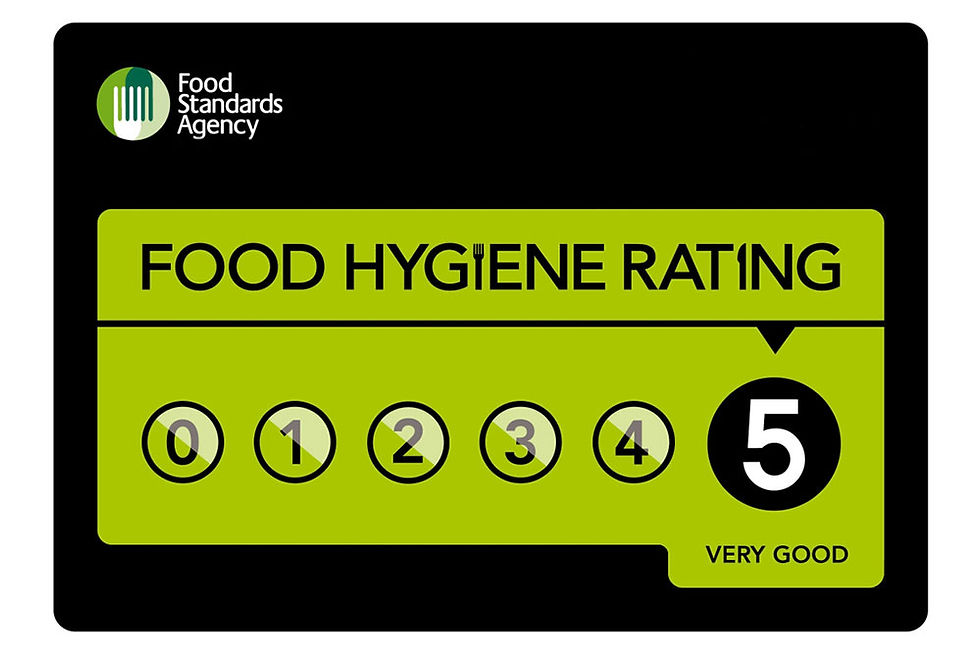
Regulatory compliance is yet another matter. Meeting food-safety and hygiene requirements does not make a restaurant good; it establishes the baseline, not excellence. Other countries communicate that distinction more visibly. The UK's Food Hygiene Rating Scheme, for example, assigns scores from zero to five for food-hygiene performance.
That sticker does not claim the steak is delicious, the chef talented or the waiter friendly. It says what was actually assessed: handling food, hygiene and food-safety systems. This points to one of the article's central lessons: a good rating system first tells us precisely what it rates.
Michelin: A Star Is Not a Grade for the Whole Restaurant Experience

Michelin is probably the world's best-known restaurant-rating brand, which may explain the many misconceptions surrounding it. Its methodology rests on five criteria: ingredient quality, mastery of cooking techniques, harmony of flavours, personality expressed through the cuisine, and consistency across the menu and over time. Michelin's principles are linked.
That matters because a Michelin star is often treated as a universal score for the entire restaurant, although it primarily concerns the cooking. Decoration, the degree of luxury and service in themselves do not form part of those five criteria. Other systems can quite legitimately evaluate the welcome, service competence, comfort, complaints handling and whether guests feel genuinely looked after.
In our earlier article 'A Michelin Star Does Not Pay the Bills', we observed that culinary prestige and a sustainable business model are not automatically the same thing. A restaurant may be outstanding professionally yet extremely fragile economically. No star replaces sound commercial judgment.
Gault&Millau: The Broader Guest Experience Comes into View

Gault&Millau, which has returned to Hungary, takes a different approach. Inspectors visit anonymously and pay their own bills. According to the Hungarian scheme, they assess not just food, but also staff performance, wine lists, atmosphere, comfort, furnishings, lighting, noise and cleanliness. Restaurants receive marks on a twenty-point scale, associated with one to five chef's toques. The Hungarian guide's explanation is linked.
Gault&Millau also acknowledges a key problem in our discussion: a simple bistro is not necessarily worse because it sits in another segment or category and promises a different experience. Its POP category can cover pizzerias, burger outlets, local restaurants, street-food venues and food trucks. That is a valuable direction: not every establishment should be measured with the same ruler.
Dining Guide: Coverage Is Expanding, but Hungarian Hospitality Is Bigger Still

Hungary's Dining Guide has been part of national gastronomic life for over twenty years and has visibly broadened its perspective. In preparing its 2025 guide, it says its team personally evaluated nearly 550 restaurants; the publication also covers alternative formats and a separate pizza ranking.
Dining Guide had already covered street food, burger restaurants and Balaton venues earlier, so it would be unfair to say it is interested solely in white-tablecloth fine dining. Nevertheless, a large blind spot remains. I do not primarily blame Dining Guide; I regard it as a broader gap in how Hungary assesses hospitality quality.

Who tells me which beach buffet is good? Where can I find genuinely excellent lángos, fried hake or a hamburger beside Balaton? What constitutes good street food? Who assesses the corner Chinese takeaway where local workers queue every lunchtime? How can I judge whether the roadside csárda outside a village serves honest, good-quality food? Where is the market stall, roadside diner, rural pizzeria, wine bar, breakfast café, bakery or family lunchroom that has fed local people consistently for twenty years without ever planning a twelve-course tasting menu?
Those businesses are not peripheral to Hungarian hospitality. For many diners they are Hungarian hospitality. The problem is not that one professional guide cannot review every buffet — clearly impossible — but whether anybody tries to make the entire pyramid of Hungarian eating places understandable within appropriate categories.
The aim should not be to decide whether a superb beach buffet is better than a Michelin-starred restaurant. That comparison is meaningless. We should establish whether it is superb as a beach buffet, and apply the same reasoning to the Chinese takeaway, csárda, pizzeria, confectionery and village restaurant. Perhaps the old classification system understood one thing better, despite its shortcomings: establishments do not all promise the same product.
OAD: When the Experienced Diner, Not the Critic, Takes Centre Stage

If I had to pick a personal favourite among today's restaurant guides, it would be OAD — Opinionated About Dining. Not because it is flawless or because I agree with every list, but because its philosophy comes closest to how I evaluate restaurants as a guest: combining the experiences of extremely well-travelled people who eat out frequently, often at their own expense.
Founded by Steve Plotnicki, OAD is a community-based assessment rather than a traditional inspectors' guide. Diners contribute ratings, but votes are not all weighted equally: the methodology accounts for how many restaurants reviewers have visited and at what culinary level. Experienced diners who can make international comparisons may carry more weight than those with narrower points of reference. OAD now publishes separate Top Restaurants, Casual, Cheap Eats, Classical and Top New Restaurants lists, avoiding the temptation to compare every restaurant type in one ranking.
I like this because it reflects the guest's perspective more directly than some heavily promoted prizes and rankings. Rather than one inspector's report from one dinner or the annual votes of a few dozen professionals, it combines assessments by people who are passionate about dining and who often know hundreds of restaurants across multiple countries. Earlier reporting described active OAD reviewers taking 100–150 restaurant meals a year around the world, although most participants were not professional critics but exceptionally experienced diners.
For that reason I find OAD less driven by the awards industry and hype than certain international lists. That is a personal judgment, not an objective quality ranking. OAD has weaknesses: its weighting algorithm is proprietary, so we cannot fully inspect how one reviewer's opinion gains prominence over another. The underlying principle can favour a wealthy, frequent-travelling, fine-dining-focused community. OAD is not a democratic Google, nor does it claim to be.
It nevertheless offers an idea other systems should consider: comparative experience is itself valuable. The judgment of someone who eats out twice a year may not provide the same reference point as that of someone who has seen hundreds of concepts in thirty countries, and who can evaluate performance beyond their hometown's habits and personal tastes. The philosophy is debatable, but at least it is explicit.
Forbes Travel Guide: Looking at the Whole Hospitality Experience

Forbes Travel Guide is particularly interesting because it does not approach the business merely as a gastronomic guide. Its anonymous inspectors personally examine venues and, depending on the type, apply highly detailed standards to hotels, restaurants, spas and other hospitality services.
For a restaurant, therefore, the question goes beyond how good the food is. Atmosphere, staff knowledge, communication, attention, natural service and the complete experience matter. To an operator, that is at least as interesting as cooking technique, because hospitality is not only gastronomy; it is also service.
The British Have Rosettes Too

The UK's AA Rosette system has long evaluated culinary performance. According to AA guidance, hotel and restaurant inspectors award rosettes principally by looking at how skilfully chefs apply techniques, the quality of ingredients and the food eventually served.
Another measuring instrument, and there is nothing wrong with that. Not every rating system must do the same thing, but guests should know what performance each designation actually certifies.
The World's 50 Best: Influential, but Not a Conventional Audit

The World's 50 Best Restaurants is another format altogether. Its ranking results from the votes of numerous international restaurant experts, rather than a uniform, detailed checklist used to audit every venue. Voters must have personally experienced the restaurants they choose, and conflict-of-interest rules apply.
This is not the same as a classic inspector-led audit; it is an expert reputation ranking. It can be hugely influential, but once again we must ask which question it answers.
La Liste: When Ratings Themselves Are Rated

La Liste goes a step further. It aggregates large numbers of professional sources, guides and online reviews and attempts to build a common scoring framework from them.
We have reached a point where so many ratings and rankings exist that another system is needed to rank the rankings. Both impressive and slightly absurd, this shows how hard the restaurant-assessment landscape has become to navigate.
Then We Pick Up Our Phones and Look: 4.8

While professionals debate Michelin stars, toques, points and Top 100 rankings, many guests choose quite differently. They search nearby restaurants on a phone and ask: 4.2 or 4.8? Google's score is essentially the average of one-to-five-star ratings submitted by guests.
An outstanding lángos stall can score 4.9 while a Michelin-starred restaurant scores 4.5. A family csárda might have 4.8, a luxury-hotel restaurant 4.6. Those figures appear on the same screen and five-point scale, so our minds naturally compare them — although the products, prices, promises and especially expectations are not the same.
A 4.9 lángos stall is not necessarily a 'better restaurant' than a 4.7 Michelin-starred establishment. It may simply be an exceptional lángos stall that delivers its promise more effectively and offers outstanding value within its own price segment.
We explored precisely this issue through a scoop of ice cream in 'Ice Cream Does Not Lie: What a Scoop Reveals About Hungarian Hospitality and the Economy'. High prices do not automatically signal quality, nor low prices a bad product; product, price, service and the promise to the guest should fit together.
More Ratings Than Ever, Yet Less Shared Meaning
We have Michelin stars, Bib Gourmand, Gault&Millau toques and scores, Dining Guide rankings, OAD lists, Forbes stars, AA Rosettes, World's 50 Best positions, La Liste scores, hygiene ratings, Google stars and countless other professional and consumer opinions. Never have so many people told us which restaurants are good; perhaps never has it been more important to ask what 'good' means in the context of each rating.
Michelin primarily evaluates cuisine. Gault&Millau looks at a broader restaurant experience. Dining Guide compares Hungarian gastronomic offerings and increasingly includes alternative formats. OAD aggregates weighted judgments by highly experienced diners. Forbes Travel Guide focuses on hospitality and service. AA rewards culinary performance. World's 50 Best reflects expert reputation. La Liste aggregates guides and guest reviews. Hygiene scores assess food safety, while Google broadly signals cumulative guest satisfaction.
The problem is not too many restaurant ratings, but that they measure different things while we tend to call all of them 'quality'. Michelin, OAD and Google therefore need not be competitors. They are more like three instruments measuring an extremely complex phenomenon from different directions: the experience a restaurant delivers.
Who Rates the Raters?
We should ask rating systems the questions we would ask in a serious audit. Who finances them? Who appoints the assessors? What professional or dining experience do they have? Are visits anonymous? Do they pay the bill? How often do they return? How detailed and transparent is the methodology? How are conflicts of interest handled? Are professional assessment and commercial operations kept separate?
These are not hostile questions aimed at any particular guide. They concern credibility. A rating system is not trustworthy simply because it carries a familiar logo. It must demonstrate that it measures its declared subject consistently, professionally and with adequate independence.
Does Hungary Need Restaurant Classification Again?
It would be easy to conclude that we should revive Classes I–IV. I disagree. In 2026, neither the state nor one designated body should decide how many stars, forks, plates or glasses every Hungarian restaurant, csárda, buffet, confectionery and café deserves. Competition between independent systems may be healthier, provided we understand exactly what each assesses.
One feature of the old system is worth preserving: an intelligible promise. A beach buffet need not have a sommelier; a Chinese takeaway can serve food on plastic trays; a roadside csárda need not offer a tasting menu; a Michelin-starred dinner may legitimately last three hours. These are different products for different guests, prices and expectations.
The problem begins when an establishment fails to deliver what it promised. A fast, clean, friendly and fairly priced beach buffet serving excellent, freshly made lángos is a great beach buffet; it does not need a Michelin star. A Chinese takeaway offering affordable, quick, hygienic and consistently good food can be excellent in its category. A premium restaurant charging premium prices while service is mediocre, the washrooms neglected and guests feel like an inconvenience cannot rely on a beautiful plate alone.
Instead of ranking the narrow top of the hospitality pyramid ever more precisely, learn to assess the whole pyramid within its own categories. Perhaps the best future rating system will not ask who is number one and number one hundred overall, but help guests understand how well each establishment fulfils its own promise.
Could We Once Have Known Less, Yet Understood More?
A Class I, II, III or IV sign did not tell the whole story. It could not guarantee a delicious dinner, a smiling waiter or the best schnitzel of one's life. The system embodied the bureaucracy and economic limitations of its time. Today, by contrast, a minute suffices to read a hundred reviews, browse two hundred photos, compare Google, Michelin, OAD, Gault&Millau and Dining Guide, consult rankings and see the meal somebody photographed yesterday.
On paper we are incomparably better informed, yet perhaps less clear about what awaits us. The era of Class I signs is over and need not return. The principle behind them has not aged: at the moment of choice, guests should understand what a business offers, what standard it promises, roughly what it costs and by which criteria they should judge it.
Perhaps the most important question in 2026 is therefore not how many stars we put on a restaurant's door. It is whether the star, toque, point score, ranking or 4.8 carries a meaning guests can trust — one that genuinely helps them decide whether a restaurant is right for them.

About the Author
Tamás Pakuts has been active in tourism and aviation for nearly 35 years, and in hotels and hospitality for more than 25. As an executive and consultant, he has worked with hotels, groups, restaurants, airlines and cruise lines across operations, development, crisis management, service quality and staff training.
His view of hospitality goes far beyond the plate. Food and drink quality, service standards, staff competence, guest experience, value for money, economic sustainability and the promise a business makes to guests are all parts of one system. Having travelled and worked in over a hundred countries, he examines rating systems from both guest and operator perspectives. What matters is not whose logo is best known, but whether a rating really helps guests understand what to expect.
As founder of Szalloda.blog, he analyses current issues in tourism, hotels, hospitality and mobility, regularly comparing Hungarian practice with international examples. His articles ask not which model sounds most impressive, but which works in reality for guests, operators and the profession.
Sources and Further Reading
AI tools (ChatGPT and Claude) assisted my research into the information presented and the visual concepts in this article.
This article was translated from the original Hungarian using artificial intelligence. The original language is Hungarian.


Hozzászólások