


Ice Cream Does Not Lie: What a Scoop Reveals About Hungarian Hospitality and the Economy


Today ice-cream prices are more than summer small talk: they reflect ingredients, labour, energy and operating costs, purchasing power, and how much hospitality businesses respect their guests.
Few hospitality products are as universally familiar as ice cream, associated with childhood, travel, summer afternoons and personal favourites, and almost everybody has an opinion on its price. For years it was among summer's simplest, most democratic pleasures: no restaurant reservation, elaborate programme or special occasion, just stopping at a gelateria, choosing one or two flavours and enjoying a few minutes.
By 2026, however, ice cream is no longer a negligible expense. Hungarian market reports suggest typical scoop prices of HUF 600–700, with higher prices in tourist hotspots, at Lake Balaton, in central Budapest or for special premium flavours. HUF 700 is becoming a psychological threshold above which guests expect not only ice cream but perceptible quality and fair hospitality.
Neither HUF 600 nor HUF 900 alone tells us whether an ice cream is expensive. We need the portion size, ingredients, whether real pistachios, vanilla, chocolate, fruit and cream were used, how much air is incorporated, and what service accompanies it. It also matters whether we receive it in a clean, attractive environment with friendly service or leave feeling we have merely completed an impersonal financial transaction.
Ice-cream prices are therefore not purely a gastronomic issue. A single scoop brings together agriculture, food manufacturing, energy, imports, the forint exchange rate, wages, commercial rents, taxation, seasonality and tourism demand. Because ice cream is small, simple and familiar, it exposes economic and hospitality problems that are easier to hide inside a multi-course restaurant bill.

From Persian Ice Houses to Parisian Cafés
Almost every major culinary civilisation wants a starring role in ice cream's history. Persians point to chilled sweets flavoured with rosewater, honey, fruit and spices; Chinese traditions include early cooled milk and fruit preparations; India has kulfi, Italy gelato and France the refined tradition of crème glacée. Yet ice cream was probably not invented by one person at one well-documented moment. Refrigeration techniques, recipes and trade developed across civilisations over centuries.

The predecessors of ice cream were truly dependent on natural cold. Snow and ice were collected in winter, stored in ice houses or underground chambers and used during warmer months to cool drinks, fruit mixtures and eventually creamy milk-based desserts. Bringing winter to the table in midsummer remained a privilege of royal courts and the wealthiest households because collecting, storing, transporting and using ice required infrastructure, staff and money.

Italy's role in the development of modern European ice cream is unquestionable. During the Renaissance, Italian courts served increasingly sophisticated fruit ices and sorbets, later joined by milk and cream preparations. Recipes alone were not enough: technical knowledge was essential. The use of ice mixed with salt made it possible to bring the freezing mixture below water's normal freezing point.

One of the most important European stages in this story was Paris. Sicilian Francesco Procopio dei Coltelli founded Café Procope in 1686. It later became a meeting place for Parisian art, literature and politics, visited by Voltaire, Rousseau and Diderot. Coffee, lemonade, candied fruit, sorbets and frozen sweets joined a new urban social culture.
The Italian-French debate over ice cream's origins becomes especially interesting here. Italians can rightly say a Sicilian entrepreneur brought Mediterranean frozen-dessert expertise to Paris. The French can equally regard as part of their gastronomic heritage the transformation of ice cream into a refined dessert, café tradition and social occasion. Symbolically, Italy supplied the technique and entrepreneur; Paris provided the stage on which ice cream became a European cultural phenomenon.
Café Procope's story is especially appealing because ice cream moved beyond royal palaces into a café where people debated literature, philosophy and politics. Frozen desserts were no longer simply luxuries, but part of social life, enjoyed in conversation and increasingly connected with modern urban culture.

From Snow-Cooled Sweets to 'Cold Licks': Ice Cream in Literature
The Hungarian language preserves the period when ice cream was rare and difficult to define. From the late eighteenth century it was called various names, including hideg nyalat, literally 'cold lick', alongside fagyos and fagyalt. István Cziffray's cookbook dedicated a section to these frozen delicacies. Ice cream appeared in Hungarian cafés and restaurants from the 1780s, and numerous recipes were known by the early nineteenth century.
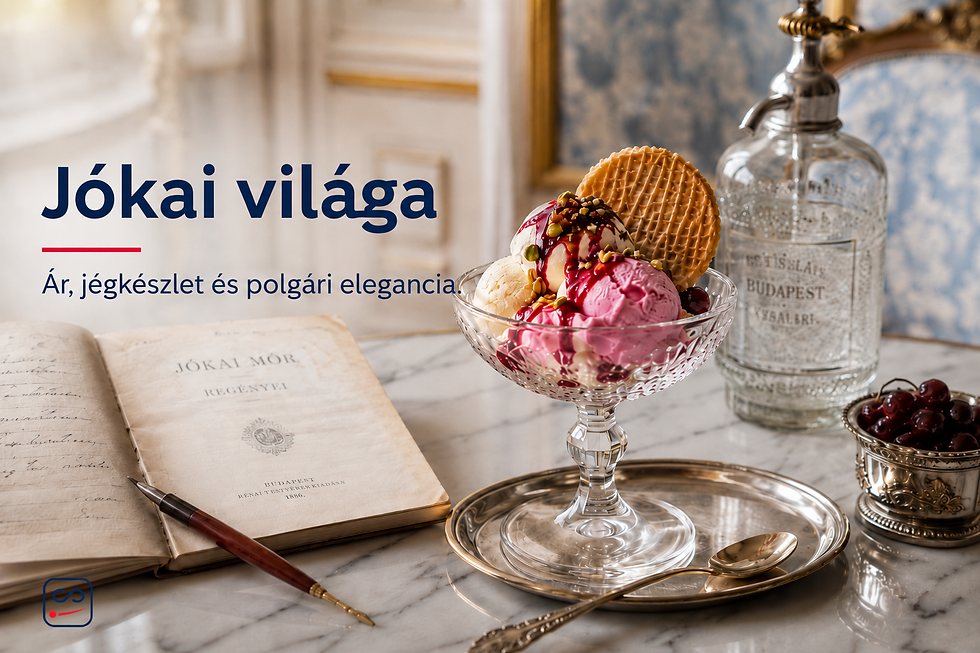
In Mór Jókai's work, ice cream already serves as both a social pleasure and an economic product. In Zoltán Kárpáthy he writes:
'Ice cream will be cheaper this year, sir, than last year [...] there is plenty of ice to be had.'
Those few words capture an age's technology and pricing: a cold winter meant more natural ice could be harvested and stored, potentially making ice cream cheaper the following summer.
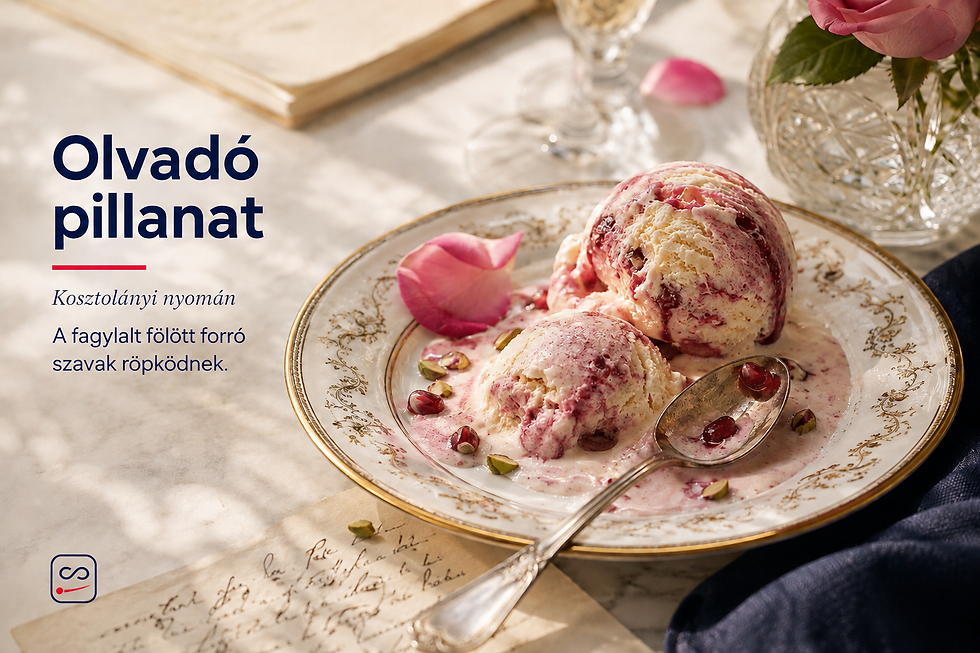
In Dezső Kosztolányi's short story 'Bathing', ice cream also measures the emotional temperature of a scene:
'Hot words fly above the ice cream.'
As the conversation becomes tense, the cold dessert melts into a lukewarm mass, losing the very qualities that made it desirable. Ice cream becomes a symbol of a spoiled moment that cannot be recovered.

Gyula Krúdy is even more concise in his Dream Book:
'Ice cream: disappointment.'
Those two words could describe a modern hospitality complaint. A guest may feel exactly that after buying impressive, expensive, fashionable ice cream when its flavour, size or service fails to match the promise communicated by appearance and price.
So ice cream travelled from royal luxury cooled with snow through the Hungarian 'cold lick' to novels, stories and personal memories. For Jókai it is about prices and stored ice, for Kosztolányi a melting moment, for Krúdy disappointment. Ice cream disappears in minutes; its associated experience lasts much longer.
HUF 700 for a Scoop: Too Much or Too Little?
We often convert ice-cream prices to euros, but exchange rates tell us nothing about local earnings, serving sizes or the quality and service received. Hungarian ice cream may not appear exceptionally expensive when expressed in euros, but the picture changes dramatically in relation to Hungarian incomes.
According to Hungary's Central Statistical Office, the median net monthly wage was HUF 436,200 in May 2026. Half of employees earned less and half more.
Using a technical working month of 174 hours, median net income is roughly HUF 2,500 per hour. Buying a HUF 700 scoop therefore requires around seventeen minutes of work; a HUF 900 scoop nearly twenty-two minutes. For a family of four buying two scoops each, the bill is HUF 5,600 at HUF 700 per scoop or HUF 7,200 at HUF 900: more than two hours or nearly three hours of median net earnings respectively.
A family ice-cream outing is not necessarily a luxury, but it is no longer an insignificant, automatic expense for everybody. A single scoop may be affordable; a bill reaching HUF 7,000–8,000 rightly makes guests more attentive to portions, ingredients, service and value.

A Scoop Is Not a Standard Unit
One fundamental problem in comparing prices is that a scoop is not a standard measure. It can weigh forty, fifty or seventy grams, be round or spatula-shaped, dense or heavily aerated. Two identically priced servings may therefore differ substantially in quantity and quality.
At Hungary's 2026 Ice Cream of the Year competition, visitors paid HUF 600 for a fifty-gram tasting portion, corresponding to HUF 12,000 per kilogram. It was, however, a discounted and standardised portion at a professional event. The competition received 72 entries in five categories; with former winners included, visitors could taste about one hundred flavours.
In an ordinary gelateria, guests typically have no idea how many grams a scoop contains. That is why an annual Szalloda.blog Scoop Index would make sense, tracking not only prices but also actual weight, perceived ingredient quality, service and local purchasing power.
The genuinely comparable question is not what 'one scoop' costs but the price per 100 grams, minutes of local labour required and complete guest experience in return.

What Are We Actually Paying HUF 700 For?
Good ice cream costs more to make than it might appear from the other side of the counter. Real pistachios, quality cocoa and chocolate, vanilla, nuts, cream, fresh fruit and fruit purées vary enormously in quality and price. Many ingredients are imported, so costs depend on global harvests, transport, energy and the forint exchange rate.
Then come qualified employees, long opening hours including weekends, refrigeration and freezing energy, food-safety compliance, premises, spoilage and the risk of seasonal operations. Hungarian confectioners have faced substantial challenges from energy prices, inflation, labour shortages and the need to cover wages and employment costs.
Quality ice cream means more than stirring powder into water or milk. It involves recipe development, cooking, pasteurisation, maturation, freezing, texture control and continuous hygiene. Higher prices for products using better ingredients can therefore be understandable.
Cheap ice cream is not necessarily good news: it may conceal inferior ingredients, smaller portions, more air, low wages or an unsustainable business. Yet expensive ice cream is not automatically excellent either. The price may reflect genuine pistachios, fresh raspberries and skilled preparation — or simply a premium for a central or tourist location.
Hungarian hospitality should not be judged by whether ice cream is cheap or expensive, but by whether price, quantity, quality and service are proportionate.

Competition Prizes and Guest Experience Are Not the Same
Hungarian ice-cream culture has strong professional achievements, visible in national competitions, award-winning flavours and constantly evolving pastry businesses. In 2026, the Ice Cream of the Year main prize went to Annamária Molnár of Budapest's Mikrokosmos Fagyizó for Soléa. Silver in the artisan category went to Incanto della nocciola from Margaréta Fagyizó in Balatonszemes, and bronze to Napcsók from Hisztéria Cukrászda in Tápiószecső. The free-from category was won by Bergamott kertje from Promenád Kávéház in Balatongyörök, while Mikrokosmos's Vadbogyós törökméz placed first in the Edible Forest category.
These awards recognise real professional achievement, but a competition judges a particular recipe, ingredients, technique, flavour balance and product presented on one day. Guests experience the entire business: entering, examining prices, asking questions, choosing, paying and forming opinions about portions, ambience, products and service within minutes.
Even an outstanding recipe cannot indefinitely compensate for unfriendly staff, inconsistent portions or the impression that guests are an inconvenience rather than welcome visitors.
How Hisztéria Fell from One of My Favourites
Hisztéria illustrates this for me personally. For years it was among my favourites, even on my personal podium, but recently it has slipped far down the list. Based on several visits to the Andrássy Avenue and Westend outlets, I found service distinctly unfriendly on more than one occasion.
I was particularly disappointed when I observed ice cream sold by weight without what appeared to be a separate tare adjustment for the cup, making me think the container's weight might also have been included in the amount charged. This was my personal experience, not a general assertion about every branch or transaction. For me, however, it was enough for a former favourite to lose its place among the leaders.
One thing undeniably offsets part of this negative experience: the interior design created by Singer Design. Hisztéria's visual identity is sophisticated, distinctive and memorable, providing a setting worthy of the products and adding value to the visit. That makes the contrast with repeated unfriendly service particularly striking. Design creates expectations; service must rise to them every time.
This is a central lesson of the article. Guests evaluate not only ice cream but also surroundings, service, fairness, transparency and how they feel when leaving. Professional awards and excellent design are valuable; maintaining long-term trust is a daily task.

Those Who Have Earned My Trust for Decades
My personal favourites are not necessarily businesses with the most media coverage or competition awards in a given year. Consistent quality sustained for years or decades matters far more.
Tóth Cukrászda in Dunaföldvár is among Hungary's strongest examples for me. The family business began in 1983 as a fifteen-square-metre ice-cream café called Mini presszó, moving in 1993 to its current site beside main road 6. It offers around 28 flavours a day and says its total repertoire comprises roughly 150 classic, unusual and award-winning varieties. More important than those numbers is my experience: for decades Tóth Cukrászda has been consistently excellent, and every time I have visited I received superb ice cream. It is a favourite not because of one fashionable flavour, campaign or competition win, but because it reliably maintained high standards over many years.
Sulyán Cukrászda in Veresegyház is another favourite for the same reason. Opened as a family business in 1980, it has grown from a small pastry shop into a modern production operation spanning generations. Its ice cream is cooked, largely using local ingredients, and the family's pastry chefs have a long record of professional awards. For me Sulyán's importance lies not in one prize but in the confidence with which I can return year after year. Stable quality, tradition and development together outweigh a short-lived fashion.
Szent Korona Cukrászda in Soltvadkert also belongs on my personal shortlist. Founded in 1971, the family pastry shop is widely known for its ice creams and cakes, and guests can normally choose from about thirty varieties. I value not only its almost intimidating selection, but its ability to keep innovating without lowering standards. Many businesses chase novelty and fashionable ingredients, but innovation has value only if it does not undermine existing quality. Szent Korona manages to combine a huge range, new ideas and reliable execution.
Those three pastry shops demonstrate that Hungary's ice-cream culture is not confined to central Budapest or Lake Balaton's busiest towns. Dunaföldvár, Veresegyház and Soltvadkert have created businesses worth travelling for. A good confectionery is more than a local provider: it can be an attraction, a destination brand and a community meeting place.
Romantika in Ráckeve: When a Pastry Shop Becomes Part of the Excursion
Szalloda.blog published an article on Romantika Cukrászda in Ráckeve in June 2020. At the time, we found this somewhat hidden, retro-style establishment offered dependable quality, extensive cake and ice-cream choices, carefully composed sundaes and friendly hospitality. We wrote that Romantika could represent the same reliable quality in a small town, world city or village.
The sundae described in that article combined three chosen flavours, freshly whipped cream and carefully arranged fruit. Fig, raspberry dark chocolate and rhubarb strawberry were not simply three scoops but a composed dessert in which appearance, taste, texture and presentation all mattered. Service took longer because the venue was full, but flavour and quality compensated.
The Ráckeve example shows why confectionery and ice cream can become tourism experiences rather than simple purchases. A good pastry shop encourages visitors to stay longer, spend more, return and recommend the town. The ice-cream price then becomes part of the value of the entire excursion.

What Does an Ice-Cream Price Tell Us About a Country?
First, it tells us about the business: its ingredients, pricing, portions, valuation of its own work and respect for guests.
Second, it tells us about the destination. A tourist town may have higher rents, a shorter season, heavier weekend staffing needs and greater weather risks. Higher prices remain acceptable only if they are matched by better quality, surroundings, cleanliness, transparent portions and professional service.
Third, it tells us about the economy. The nominal price matters less than how many minutes people must work to afford a scoop. Ice cream can cost more in one country yet be more affordable because wages are higher; elsewhere a seemingly cheap serving is substantial relative to local earnings.
Finally, it reflects the culture of hospitality. Good operators show prices clearly, provide consistent portions, do not quietly charge unexpected extras and do not treat an attractive location as a substitute for performance. Guests will pay for quality, but increasingly reject paying for its appearance alone.

Ice Cream Does Not Lie
One scoop cannot replace GDP, inflation figures, real-wage indices or purchasing-power parity. But it is a remarkably revealing everyday economic indicator because nearly everybody knows the product and can compare it with previous experience.
HUF 700 or HUF 900 for ice cream need not be excessive if it contains genuine high-quality ingredients, the portion is fair, surroundings are attractive, service is friendly and pricing transparent. The same amount may be unjustifiably high if the product is average, portions small or unpredictable, staff unfriendly and the visit feels like a quick transaction instead of an experience.
Ice-cream prices reveal more than what milk, sugar, fruit or pistachios cost. They show how labour is valued, what local purchasing power can sustain, how tourism operates and how hospitality providers regard their guests.
Ice cream is not excellent simply because it is expensive, nor is hospitality good merely because it is cheap. The decisive question is whether guests feel they received fair value for their money.
We will soon examine ice-cream prices, serving sizes and hospitality practices in other countries in a separate article — not merely converting them into euros, but comparing them with local incomes and the quality received.
About the Author

Tamás Pakuts has worked in aviation and tourism for almost 35 years, and in hotels and hospitality for more than 25 years.
As an executive and consultant, he has worked with airlines, hotels, hotel groups and cruise operators, supporting their operations, crisis management and development.
He and his colleagues currently work internationally as hospitality and aviation specialists, advisers and trainers, developing new projects of international significance.
This article was translated from the original Hungarian using artificial intelligence. The original language is Hungarian.


Hozzászólások