


Switzerland and Scotland: How Professional Consultation Becomes Tourism Strategy


Best Practice: When Real Professionals Are Not Merely Heard but Involved in Decisions — Not Yet the Hungarian Model
Hungarian debates about tourism over recent weeks keep returning to the same basic question: who genuinely represents the industry and how does professional knowledge reach decision-makers? The answer may look straightforward: we have national associations and public tourism bodies, they sometimes meet, therefore dialogue exists. On closer inspection it becomes much harder to say on whose authority participants sit at the table, who is absent, what happens to proposals and how consultation turns into actual tourism policy.
We raised these issues in 'After 89 Days of TISZA Government, Why Is the Same Circle at the Table as Since 2018?' Minister for the Economy and Energy István Kapitány reported consultations with MSZÉSZ, VIMOSZ, MaReSz, MUISZ and MABEUSZ. We did not object to these major organisations being invited; quite the opposite, they belong there. The questions were why these five, how others would join, and how consultations would become regular, transparent and accountable.
Tourism is itself an ecosystem, not one industry. Besides hotels, restaurants, travel agencies and event organisers, it includes spas, attractions, cultural institutions, guides, rural and active tourism, airlines, airports, rail and coach operators, municipalities, destination organisations, education providers, technology companies, workers and thousands of small businesses. The challenge is therefore not buying a bigger conference table, but creating a decision-making system in which this variety of knowledge and interests appears in a structured way, at the right time and with appropriate weight.
In 'Twelve Points for the Renewal of Hungarian Tourism — and One More', we argued that the country needs not another logo, campaign or subsidy, but a different way of organising tourism. Our analysis of the ÉTREND Hungarian Chefs' Association's 21-point concept reached the same conclusion from another direction: the missing ingredient is not another programme, but an operating system built on genuine representation, clear responsibilities and effective government coordination.
What does this look like where countries have tried to institutionalise professional dialogue? Switzerland and Scotland cannot be copied wholesale into Hungary, but that makes them interesting: two distinct political, administrative and tourism systems offering different answers to the same problem.

Switzerland: Invite Expertise, Experience and Knowledge — Not Just Organisations
In Switzerland, the Tourism Policy Advisory Group works alongside the State Secretariat for Economic Affairs, SECO. It functions as a professional sounding board for implementing the Swiss tourism strategy. The current group has eighteen members drawn from tourism businesses, associations, cantons, academia and politics, deliberately preventing any single viewpoint or interest group from dominating. SECO explicitly says its role is to keep the federal tourism strategy connected to the sector's actual needs. Source: SECO — Advisory Group Tourism Policy.
What makes the model especially interesting is not the number eighteen, but how members participate. They are appointed in a personal capacity, not as official delegates of their organisations, and cannot send substitutes. Selection consciously balances entrepreneurship, associations, political perspectives, academia, regions and genders, while SECO's director chairs the group. The Swiss model effectively recognises that professional expertise and institutional representation are not necessarily the same thing.
That speaks directly to our recurring Hungarian question: does leading a national association mean representing every business in a profession? And conversely, can a person without a title such as association president or secretary-general possess expertise without which a country's tourism strategy would be poorer? Switzerland's answer is that both kinds of knowledge matter, but need not be expressed in the same forum or role.
Importantly, the Swiss advisory group does not replace formal consultation opportunities for tourism stakeholders. SECO explicitly describes it as complementary to, not a substitute for, those channels. Thus one manageable, diverse expert body can exchange ideas while formal mechanisms remain available for associations and other stakeholders to express institutional positions. That distinction is largely missing from Hungarian professional dialogue today.
Nor is the Swiss arrangement a one-off representation exercise. The group meets twice a year; members may put their own issues and suggestions on the agenda, and SECO regularly reports on implementation progress. Its current mandate runs until the new tourism strategy planned for 2027, when the strategic framework, mandate and membership will be reassessed. Expertise is thus built into strategy development rather than added afterwards to legitimise a finished document.

Scotland: A National Strategy Is Not Written in a Conference Room
Scotland approached the same problem differently. The Scotland Outlook 2030 tourism strategy launched in March 2020 was not drafted solely by a ministry or tourism agency. The Scottish Tourism Alliance, Scottish Government, VisitScotland, Scottish Enterprise, Highlands and Islands Enterprise and Skills Development Scotland collaborated. An industry and public-sector Strategy Steering Group guided the work, drawing on feedback from approximately 2,500 stakeholders. Source: VisitScotland — Scotland's National Tourism Strategy.
That does not mean 2,500 people tried to speak simultaneously in one conference room. It demonstrates that broad participation requires a consultation system, not simply a larger table. Policymakers need usable routes through which every relevant stakeholder can submit views, experience and proposals.
The strategy's four central priorities — people, places, businesses and experiences — show what treating tourism as an ecosystem means. It presents objectives as shared responsibilities of government, public and private sectors, industry and local communities. Sustainability is not a mere green communications theme: the strategy aims to ensure tourism develops without undermining communities or the environment.
The process continued after the document was written. In 2022 Scotland established the Tourism and Hospitality Industry Leadership Group to support implementation of Scotland Outlook 2030, monitor progress and sustain partnership between industry, government and public agencies. Its formal terms explicitly refer to 'genuine partnership working'. Source: Scottish Government — Tourism and Hospitality Industry Leadership Group.
Its membership makes the model tangible. Alongside the Scottish Government and VisitScotland sit regional economic development bodies, Skills Development Scotland, the COSLA local-government association and Unite trade union. Industry participants include IHG Hotels & Resorts, rural tourism, events, cultural and heritage organisations, a university, travel-technology specialists and other tourism businesses. Scotland does not pretend that tourism is one homogeneous profession; it acknowledges the industry's diversity.
The group's work is also traceable. Minutes of its meeting on 4 February 2026 are public and show who participated and what was discussed, including long-term infrastructure requirements, tourism's place in infrastructure planning, community-led tourism, fair work and the net-zero transition. This is far removed from a press statement merely claiming the participants 'reviewed the sector's situation and agreed to continue cooperation'. Source: Scottish Government — THILG Minutes, 4 February 2026.

We Are Not Talking About a Swiss or Scottish Miracle
It would be easy to respond that Switzerland is Switzerland, Scotland is Scotland, and Hungary has different institutions and political traditions. That is true, but the wider international direction still resembles these two examples.
OECD Tourism Trends and Policies 2026 dedicates a chapter to renewing tourism governance. The OECD observes a shift towards strategic models combining economic, social and environmental goals while strengthening competitiveness and resilience. That requires closer coordination among policy areas, levels of government and local stakeholders, connecting national visions to broad participation and local needs. Source: OECD Tourism Trends and Policies 2026 — Tourism Policies, Priorities and Governance.
This matches findings from our earlier Best Practice articles. In '365 Days of Tourism? Successes and Blind Spots of the Austrian Model', we found that Austrian strategy is not simply about guest nights, but links value creation, employment, innovation, sustainability and economic resilience. In 'Not More Tourists, but More Value', our analysis of Slovenia concluded that national tourism strategy must express economic and social choices rather than merely traffic targets.
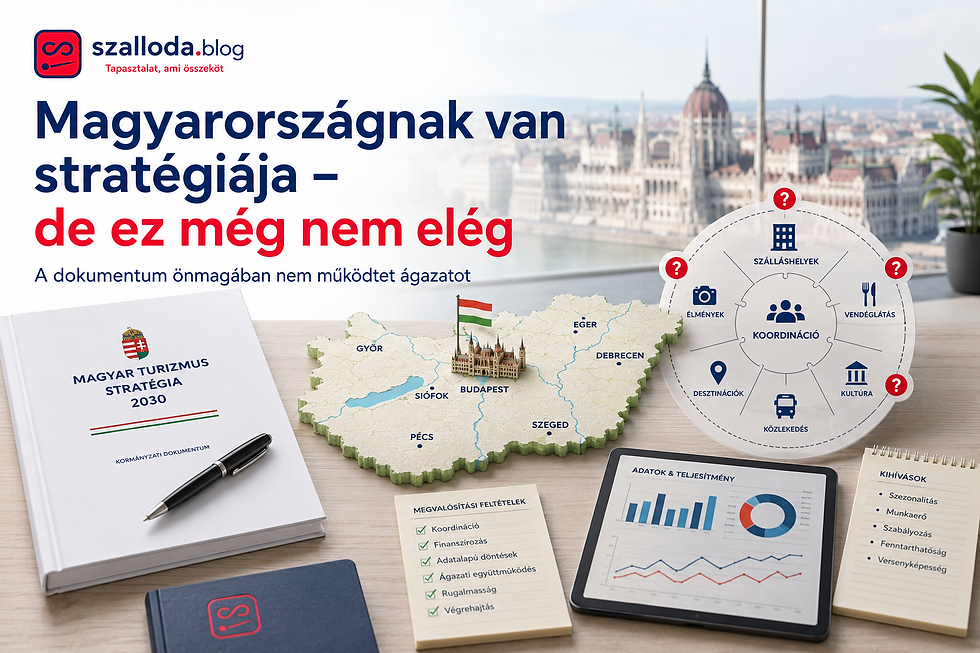
Hungary Still Formally Has an Outdated Tourism Strategy — but It Cannot Resolve the New Challenges
A clarification is important because precision matters in professional debate. Hungary formally has a National Tourism Development Strategy 2030, amended in 2021 and 2023, which the OECD still identified in July 2026 as the foundation of Hungarian tourism policy. The OECD also noted 'a collaborative ecosystem' among its horizontal principles and that several ministries share government responsibility for tourism. Source: OECD — Hungary, Tourism Trends and Policies 2026.
Our earlier article 'Can Hungarian Tourism Succeed Without a Modern, Renewed Strategy?' did not claim Hungary lacks a PDF containing the word strategy. We asked whether there is an active strategic approach responsive to new economic, transport, labour, climate and competitiveness realities — one whose designers, evidence, objectives and implementation accountability are known. Having a strategy document and operating according to a strategy are not necessarily the same.

What Can Hungary Adapt from Switzerland and Scotland?
The lesson is not the name of another national council or committee. It is the operating logic: rather than continually seating thirty or fifty people around one table, distinguish expert thinking, representation of interests, broad-sector consultation and government coordination.
The first pillar could be a Tourism Policy Advisory Group of around eighteen to twenty people selected for personal professional competence rather than organisational quotas or automatic seats for association presidents. Beyond hotels, restaurants, outbound and inbound travel, it should draw practical expertise from events, destination management, rural and active tourism, spas and attractions, culture, aviation and airports, rail and mobility, travel technology, education and labour markets, academia, and small and medium enterprises. Members would contribute personal expertise, not read out their organisation's official position.
The second pillar would be a genuine, open system of industry consultation and dialogue in which associations, chambers, representative bodies, municipalities, destinations, education institutions, civil communities and businesses have clearly defined access. The aim is not everyone's presence at every meeting, but predictable rules: who is consulted on which issue, how proposals are submitted, how dissenting views are recorded and what feedback participants receive. We addressed this in 'The Hotel Association: Representative Body or Private Club?' An association's influence must derive not merely from its name, but from measurable representativeness, transparency and accountable performance.
The third pillar would be high-level government coordination of tourism policy. The OECD's Hungary profile shows how fragmented responsibility is: active, eco, health, sports and heritage tourism, international relations and other areas fall under different ministries. Transport, education, employment, regional development, environmental and water policy also fundamentally shape tourism. If we genuinely regard tourism as a horizontal national economic issue, we cannot expect one tourism institution to coordinate all those policies alone.
A fourth, less visible but equally important element would be transparency and measurement. Publish advisory bodies' membership, mandate, principal meeting subjects and approved recommendations. Give tourism strategy annual targets, accountable officials, deadlines and measurable outcomes. We should track not only guest nights, but profitability, seasonality, average stays, staff retention, regional destination results, transport accessibility, guest satisfaction and local communities' attitudes towards tourism.

An Infinitely Larger Table Does Not Guarantee Better Governance or Culture
Switzerland and Scotland teach us that the number of people in a consultation is less important than the quality and structure of participation. Adding twenty chairs beside the five Hungarian organisations recently consulted would not automatically improve dialogue. Instead, distinguish who contributes expert strategic thinking, who formally represents economic and professional interests, where excluded or dissenting views can be heard and who ultimately ensures decisions follow.
We therefore welcome István Kapitány's statement at the start of consultations that 'our joint work is just beginning'. If that means a genuinely new, regular and substantive dialogue, now is the moment to make the system itself transparent and predictable: permanent partners, thematic working groups, access for new participants, forums for minority views, documented meetings and response deadlines for professional proposals. These are not minor administrative details, but foundations of credibility.
In discussing the ÉTREND Hungarian Chefs' Association's 21 points, we argued that strategy does not emerge because everyone agrees on everything, but because professional communities present their ideas, compare and debate them, then seek a shared path. Switzerland and Scotland add an institutional lesson: good intentions must be supported by a system that survives changes of leaders, governments and current political priorities.
A country's tourism future is not ultimately determined by how many organisations received ministerial meeting invitations or how many pages its national strategy contains. It depends on whether the right knowledge reaches decision-makers at the right time, whether decisions possess professional legitimacy and whether promised results can later be measured.
Neither Switzerland nor Scotland is perfect, and neither model should be copied uncritically. Their examples show that involving professionals is not a ceremonial gesture but a fundamental institution of tourism policy. Perhaps Hungary needs not another invitation list, but a system in which the profession is not merely heard, but genuinely involved in decisions.
Sources
1. Swiss State Secretariat for Economic Affairs (SECO) — Advisory Group Tourism Policy. The group's responsibilities, eighteen-member composition, personal membership principle, operating rules, consultative role and mandate running until 2027.
2. VisitScotland — Scotland's National Tourism Strategy: Scotland Outlook 2030. Its development, participating institutions, feedback from approximately 2,500 stakeholders and central priorities.
3. Scottish Government — Tourism and Hospitality Industry Leadership Group. The body's mandate, partnership model, institutional and industry membership, and its role linking government, public agencies and tourism.
4. Scottish Government — Tourism and Hospitality Industry Leadership Group, Minutes, 4 February 2026. Attendance and discussion of infrastructure, community tourism, fair work and net zero.
5. OECD — Tourism Trends and Policies 2026: Tourism Policies, Priorities and Governance. Trends in governance, policy coordination, stakeholder participation, data-driven decisions and sustainable strategy.
6. OECD — Hungary: Tourism Trends and Policies 2026. Hungarian governance, the National Tourism Development Strategy 2030 and key institutional and policy arrangements.
Related Articles on Szalloda.blog
After 89 Days of TISZA Government, Why Is the Same Circle at the Table as Since 2018? — Representation, legitimacy and stakeholders missing from consultations.
Twelve Points for the Renewal of Hungarian Tourism — and One More — A discussion paper on systemic reform, the state's role, representation and higher government coordination.
21 Proposals to Renew Hungarian Tourism from the ÉTREND Hungarian Chefs' Association — Comparing professional ideas, representation and the need for permanent dialogue.
Can Hungarian Tourism Succeed Without a Modern, Renewed Strategy? — Why staffing and institutional changes are insufficient without a clear long-term direction.
The Hotel Association: Representative Body or Private Club? — Credibility, representation, independence and measurable advocacy performance.
365 Days of Tourism? Successes and Blind Spots of the Austrian Model — Connecting tourism value creation, labour, sustainability, innovation and competitiveness.
Not More Tourists, but More Value — What Hungary Can Learn from Slovenia's tourism strategy and its economic and social priorities.

About the Author
Tamás Pakuts has been active in aviation and tourism for nearly 35 years and in hotels and hospitality for more than 25 years.
As an executive and consultant, he has worked with airlines, hotels, hotel groups and cruise operators, supporting operations, crisis management and development.
He and his colleagues work internationally as experts, advisers and trainers in hospitality and aviation, developing new projects of international significance.
This article was translated from the original Hungarian using artificial intelligence. The original language is Hungarian.


Comments