


Wizz Air Faces the Vikings: Norway's Resistance to Its Expansion


The usually measured and reserved Norwegians have rarely been so stirred up as by Wizz Air's ambitious Scandinavian expansion, beginning with Norway's domestic market. The response was forceful: even Norway's prime minister publicly supported a boycott, while unions, aviation and public-health experts, senior Oslo politicians and local authorities joined the criticism.
The latest response, in our view, is a new public service obligation (PSO) tender for domestic flights whose requirements make it difficult for Wizz Air to succeed. Trade union rights, employment contract conditions and collective bargaining — all themes in the criticism of Wizz Air — have become tender criteria. By contrast, a Hungarian PSO tender for Balkan destinations in 2016 was structured in a way that only Wizz Air could meet, and it was the sole bidder and winner.
Some background:
Throughout 2020, Wizz Air attracted attention from aviation professionals, investors and passengers by boldly seizing opportunities created by weaknesses among competitors during the first two waves of the pandemic.
It opened new bases in Milan, Catania and Bari and entered Italian domestic markets, competing not only with troubled Alitalia and Blue Air but with established low-cost airlines such as Ryanair, easyJet, Alba Star and Volotea, as well as Bulgaria's Tayaran Jet.
Entering the Italian and Norwegian domestic markets was a potentially profitable response to pandemic conditions. Domestic passenger traffic and load factors fell much less sharply than international and long-haul travel. According to ICAO, Norway and Italy were among the comparatively resilient domestic markets outside Russia and China.

Opening a base in Dortmund was not enough to launch Wizz Air into the German domestic market. Its Salzburg base in Austria also offered only international flights because of geography and environmental restrictions.
In Romania, Wizz Air had not yet established profitable domestic flights despite new or reactivated bases, and struggled to compete on domestic routes with Blue Air and Tarom.
In Tirana, Wizz Air quickly occupied some of the space left by the collapse of Ernest Airways in spring 2020, though pandemic waves in Albania hindered its development. Observers expected a further push into the Balkans after Montenegro Airlines ceased operating at Christmas 2020. Airline executives, including personnel from Wizz Air, were reportedly seen meeting authorities in Podgorica.
New bases in Germany and Italy had already alarmed transport unions, often citing Romanian employment disputes involving Mircea Constantin of FPU Romania, whom Wizz Air dismissed, as well as cases from Bulgaria and Ukraine where labour relations were troubled.
Comments by CEO József Váradi in an AeroTelegraph interview further intensified the controversy, particularly in union-conscious Scandinavia. He depicted unions as obstacles to business performance, cited Lufthansa critically and suggested Wizz Air could close bases and relocate wherever unions threatened its model. A related ultimatum in Kyiv received widespread coverage. After public criticism, he softened the position in later interviews but appeared to convince few Norwegians, particularly when his comments also described critics, including Prime Minister Erna Solberg, as childish.

The most surprising announcement came in autumn 2020: Wizz Air intended to enter Norway's domestic market with extensive national expansion plans. Flights began on 5 November 2020, targeting profitable routes such as Oslo–Bergen, Oslo–Tromsø and Oslo–Trondheim, where SAS, Norwegian and Widerøe already operated. Several planned winter launches were subsequently postponed, which Wizz Air attributed to the pandemic. Its spring and summer 2021 plans nevertheless covered airports throughout Norway, including Alta, Bergen, Bodø, Harstad/Narvik, Haugesund, Kirkenes, Stavanger, Tromsø and Trondheim.
Wizz Air's reputation in Norway was also damaged by reports that Polish crew members assigned to its first domestic services had tested positive for COVID-19. The Norwegian press and regulators focused on the case, leading to accusations of irresponsible operation. Questions were also raised about the use of a Dutch employment agency and the contract conditions for personnel.
Wizz Air's Norwegian launch was bold and, in some respects, exemplary, but inevitably attracted intense scrutiny. Váradi is a distinctive and visionary figure among global business leaders, well beyond aviation. His outspoken manner, sometimes perceived as arrogance, divides opinion and draws attention to the airline's unconventional decisions.
Before domestic services began, we explored these issues in an interview with Attila Méreg of the Vienna World Travellers' Club. Click the image to watch.

We were pleased that András Radó, Wizz Air's corporate communications manager, responded to that interview in another episode of the Vienna World Travellers' Club programme. Click the image to watch.
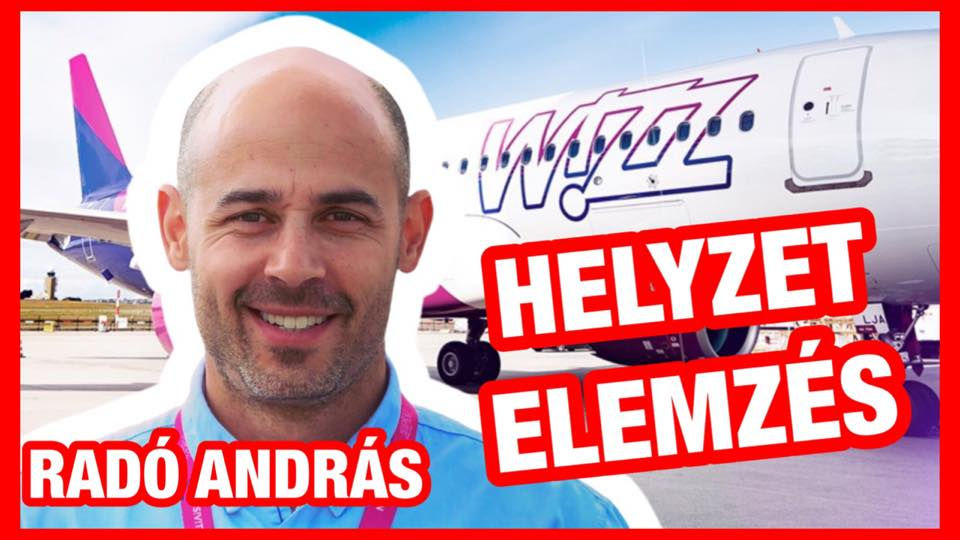
To present a balanced picture, we also asked Wizz Air directly about its Norwegian launch. András Radó, corporate communications manager, answered our questions:
(Blog) Was entering Norway's domestic market part of an existing strategy, or an ad hoc response to opportunities created by COVID-19?
(András Radó, Wizz Air) Wizz Air continually monitors market opportunities and assesses hundreds of potential new routes. Entering Norway's domestic market therefore did not come entirely without preparation.
The market changes caused by COVID-19 accelerated some processes and opened new commercial opportunities, including Norwegian domestic flights. Wizz Air has a deliberate expansion strategy, rather than simply reacting to opportunities, but takes advantage of openings that fit that strategy.
(Blog) Wizz Air has faced serious criticism from unions at current and former bases. What do you believe is the real reason?
(András Radó, Wizz Air) For more than 16 years, Wizz Air has maintained interactive and honest communication with employees and believes that this direct relationship is of fundamental importance.
We accept that others may hold different opinions, but intend to continue motivating, rewarding and communicating with employees in the way that has served us well. You would have to ask our critics about their motivations.
(Blog) Does Wizz Air cooperate with or tolerate trade unions among its staff, and are there provisions about this in employment contracts?
(András Radó, Wizz Air) Wizz Air complies with the laws, rules and regulations of every country where it operates. Employees everywhere are engaged under the applicable local labour laws.
The company does not prohibit forming or joining trade unions, but employees themselves must initiate the creation of a union if they consider one necessary.
Over almost seventeen years, our employees have not formed a union, which reinforces our belief that we have established and maintained good relationships with colleagues.
(Blog) Before entering Norway, did Wizz Air study domestic travel patterns, expectations and the wider market, including cultural, legal and national considerations or social listening?
(András Radó, Wizz Air) Of course. As before every new route or base opening, we carried out thorough and detailed studies.
(Blog) How do you view boycott calls from Norway's prime minister, ministers and union leaders? Will you respond through communications or legal action?
(András Radó, Wizz Air) Although we disagree, we respect their opinions. We hope that once they learn the facts and try the airline, rather than relying on rumours, they will change their minds.
We have taken legal action against Norwegian municipalities and companies that called for a boycott following our entry into the domestic market.
(Blog) Did you assess whether Widerøe's PSO operations might create major obstacles on future domestic routes?
(András Radó, Wizz Air) We considered this, as every other factor, before making decisions. However, Widerøe operates different aircraft types and mainly serves different routes.
(Blog) József Váradi's public statements may have offended Norwegians and other socially sensitive audiences. Are you concerned that communication some consider arrogant could lead to significant passenger losses?
(András Radó, Wizz Air) We do not regard Mr Váradi's communication as arrogant, nor do we believe sharing his professional opinions will make fewer passengers choose Wizz Air.
We believe Wizz Air's entry into Norway's distinctive domestic aviation market could be a milestone in aviation and a turning point for the airline. We will watch with interest whether the Vikings release their arrows or accept this colourful, flexible low-cost carrier and the Váradi phenomenon.

About the author:
Aviation has shaped my life for almost 35 years.
As an executive and consultant, I have worked with several airlines and contributed to amendments to international bilateral agreements governing air carrier designation.
In the mid-1990s, I was a founder of the first Central and Eastern European virtual airline specialising in unusual transport needs, and of several airlines in former Soviet republics.
I studied international aviation law in Leipzig and earned my Airline Management qualification in Geneva.
This article was translated from the original Hungarian using artificial intelligence. The original language is Hungarian.


Comments