


Children in Restaurants: Guests or a Distraction?


Family-Friendly, Child-Free and Adult-Friendly Restaurants: Arguments For and Against, Good and Bad Practice
Few issues in hospitality can divide people into two camps as quickly as the presence of children in restaurants.
On one side are families who understandably believe children are part of society and should be able to eat out, learn dining culture and develop social behaviour in public spaces. On the other are guests who pay for a romantic dinner, business meeting or simply two peaceful hours and do not want the experience accompanied by a child running between tables, a baby crying for a long time or loud cartoons playing at the next table.
The debate often becomes pointless because we immediately turn what is primarily a hospitality, positioning and operational issue into a moral question. We need not decide whether we like children or whether adults have the right to dine peacefully. We should decide what experience a particular restaurant promises, for whom it is designed and whether it can deliver consistently.
In our earlier article 'The Challenges of Hospitality', we argued that a restaurant begins with concept, target audience, pricing position and deliberate operations. No restaurant has to please everybody, but it should know precisely whom it intends to please. This changes the discussion of family-friendly and child-free restaurants.

Children Are Guests, Not Miniature Adults
A child is not simply a guest who needs a smaller chair and plate. Their sense of time, patience, eating rhythm, interests and preferred environment differ. A two-year-old, six-year-old and twelve-year-old can have needs as different as two adult guest segments.
It is unrealistic to expect a three-year-old to sit motionless at a table for two-and-a-half or three hours while adults talk and courses arrive. If nothing happens for twenty minutes after a family arrives, followed by another long wait for food, restlessness is unsurprising. We may later label the child badly behaved, when some restaurant conflicts involving children are really failures of service design.
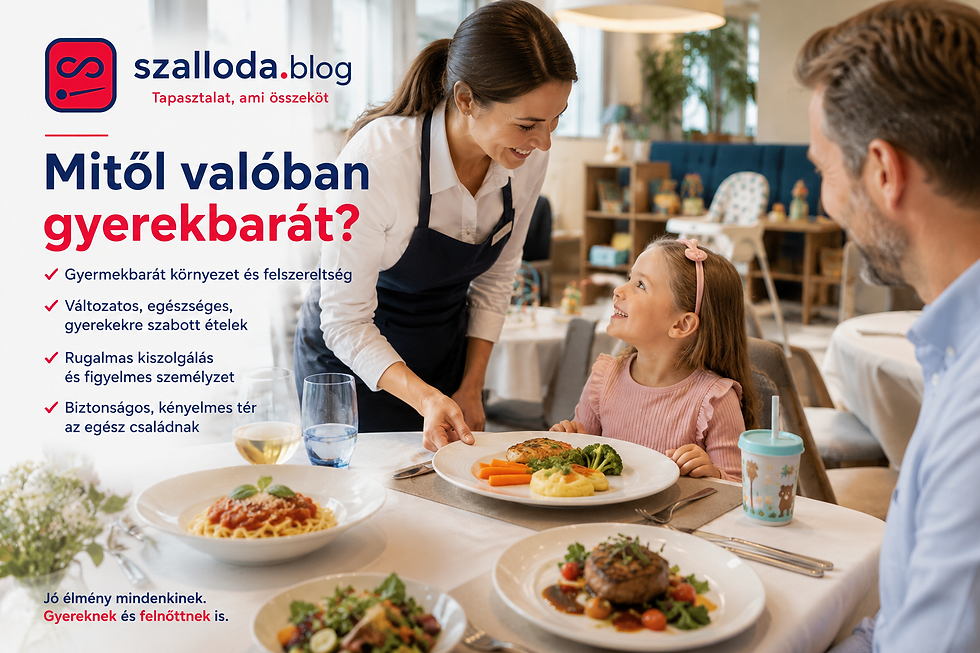
A genuinely family-friendly restaurant makes first contact quickly, brings drinks or a simple bite promptly, can prioritise a child's meal where needed, provides appropriate chairs and buggy space, and does not respond to a family as though an unexpected technical fault has occurred. This is not necessarily a matter of major investment, but of adapting operations to the target audience.
We made the same point in 'Vegan, Vegetarian, Flexitarian: Trend or a New Basic Requirement in Hospitality?' There the issue was different dietary requirements, here it is age, but the principle is identical: a guest does not become troublesome simply by consuming a service differently. Different needs are not the problem; unprepared service is.
What Does Family-Friendly Actually Mean?
In Hungary, three things are often automatically associated with a family-friendly restaurant: a high chair, colouring sheets and a children's menu. All are useful, but a high chair makes a restaurant about as family-friendly as one salad makes its menu a vegetarian concept.
Genuine family-friendly hospitality is much more complex. It requires thought about space, safe circulation, toilets and ideally baby-changing facilities, table placement, speed of service, staff communication, portion sizes, food choices and ways to occupy young children without turning the entire restaurant into a playground.
Budapest already offers thoughtful examples. We Love Budapest's 2026 selection reports that VakVarjú Újlipótváros provides weekend childcare by a 'substitute grandmother', a play corner, children's menus and high chairs; Pingrumba offers generous space, a play corner, children's meals and shareable small plates. Porcellino Grasso adds weekend entertainers, an indoor children's corner, outdoor playground and even a pizza school, while Villa Bagatelle organises Sunday children's activities in a separate room.
The last approach is particularly interesting because it does not assume that one group must accommodate the other. It organises space and service so children enjoy themselves while their parents can remain guests too. That is not a marketing label, but conscious positioning.
A Children's Menu Need Not Mean Fried Meat and Chips
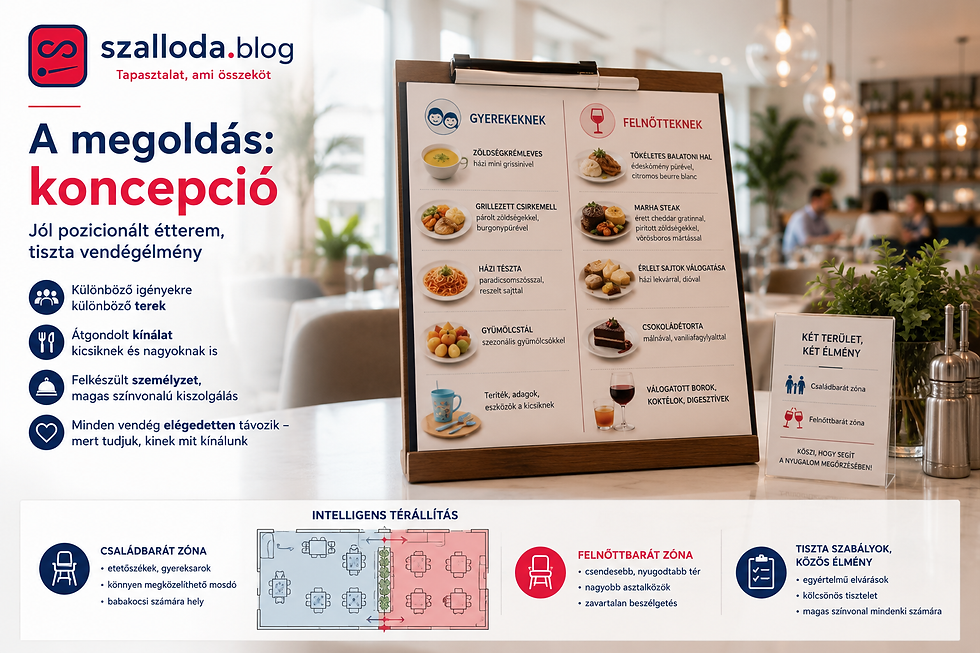
One odd contradiction in family dining is that adults receive increasingly imaginative, seasonal and health-conscious menus while children are often restricted to fried meat, nuggets, chips and tomato pasta. As though gastronomic curiosity were prohibited under the age of twelve.
A good children's menu need not create a separate culinary world. Often a simpler or smaller portion from the normal menu is better, allowing children to experience the same ingredients and flavours as their parents in a manageable form. A restaurant then does more than feed a child; it includes them in the dining experience.
The Michelin Guide's London family-friendly restaurant selection published on 28 July 2026 offers an interesting example. Apricity has a dedicated five-course 'Culinary Kids' tasting menu intended to introduce new flavours while keeping dishes enjoyable for children. It shows that welcoming children need not mean lowering culinary standards.
The Michelin Guide also produced a Paris family-friendly selection in March 2026, featuring nine restaurants including brasseries, informal international concepts and more elegant establishments. The very fact that Michelin now addresses quality dining with families shows that serious gastronomy and family-friendly operations are not mutually exclusive.

Fine Dining with Children? Why Not — but Why at Any Cost?
The other extreme assumes that because a child is a guest, every restaurant should welcome every age group under every circumstance. That is as simplistic as blanket exclusion.
In 'A Michelin Star Does Not Pay the Bills', we explained that fine dining sells not just food but a precisely designed product involving ingredients, service, setting, employees, time and substantial operating costs. A multi-hour tasting menu has a rhythm, quietness and dramaturgy quite different from Sunday family lunch. It is hardly surprising if one appeals to a small child and the other does not.
California's Seline provides an interesting example. In a 2025 Bon Appétit interview, chef Dave Beran described its eighteen-course, roughly three-hour tasting menu as a deliberately adult experience requiring a certain maturity and attention. Rather than simply saying 'children are not allowed', he explains the nature of the product and leaves parents to judge whether their child can appreciate it.
There is nothing anti-child about this. Not every restaurant is suitable for young children, just as not every restaurant suits business lunch, a first date, a twenty-person birthday party or a loud group celebration. One of hospitality's key professional tasks is matching the right customer to the right product.

There Is Demand for Adults-Only Dining — Including Among Parents
We should not dismiss people seeking a child-free dinner as people who dislike children. In research published by Lightspeed Commerce in May 2026 across seven countries — the US, Canada, UK, France, Germany, Netherlands and Belgium — 75% of respondents supported restaurants offering some form of adults-only dining. Surprisingly, support among parents was even higher at 79%.
The detail is more illuminating than the headline 75%. Some 49% considered child restrictions acceptable late at night, 46% in separate adults-only areas, another 46% in romantic settings, and 43% in predominantly alcohol-focused venues. The results indicate demand for differentiated experiences rather than general hostility towards children.
High support among parents is understandable. For a couple raising young children, the few occasions each year when they dine together without them can be particularly valuable. They may deliberately choose a place offering a different atmosphere from the rest of their week.

Child-Free or Rather Adult-Friendly?
We should start with language. 'No Kids' is unnecessarily confrontational: it says whom the restaurant does not want rather than what it offers. A clearly explained 14+, 16+ or 18+ evening concept, adults-only dining area or description of the audience for a long evening experience is much more intelligent communication.
The difference is not only verbal. One excludes, the other positions. One invites public conflict; the other communicates a product promise. Of course, the legal treatment of age restrictions or exclusions varies by country, so restaurants must examine local law before introducing them.
And Where Does Parental Responsibility Come In?
Family-friendly hospitality cannot mean that the entire restaurant automatically becomes a playground. Children have the right to be children, but restaurants are shared spaces with other guests and employees working around them.
A child running across the path of a waiter carrying hot plates, glasses or a heavy tray is not merely noisy; they may create an accident risk. A crying baby cannot be switched off, and a reasonable society should be able to accept that. It is quite another matter when a parent ignores a manageable situation for a long time or plays cartoons at full volume in the middle of the restaurant to obtain peace for themselves.
A family-friendly restaurant is not a childcare institution unless it explicitly offers that service. Staff are responsible for hospitality, parents remain responsible for supervising their children. Both work well together when the restaurant prepares the right environment and the family respects the fact that other guests share it.
Ten Specific Examples of What Can Work — and What Can Go Wrong
Hungarian examples show there is no universal formula. VakVarjú Újlipótváros effectively makes childcare and the 'substitute grandmother' part of its service so parents can eat peacefully. Pingrumba uses space, shareable dishes and an accessible menu; Porcellino Grasso turns dinner into a family activity through entertainers, play areas and pizza school. Villa Bagatelle is especially interesting for organising children's activities in a separate room rather than surrendering the entire dining area. Each model is different, but all treat family-friendly service as something deliberately designed.
London's Apricity pursues a different approach. Instead of trying to attract families with a play corner, it offers a five-course Culinary Kids tasting menu, adapting its own culinary identity for younger diners. Children are not reduced to a simplified separate consumer category, but can participate in the same gastronomic experience.
Chicago's two-Michelin-star Ever goes further. According to Bon Appétit, the restaurant tries to seat families in a private space or an accessible but somewhat separate table where possible, plans for buggy storage and provides somewhere a child may be comforted or fed. Older children may even receive a brief visit to the pastry kitchen while their parents enjoy a course. That is genuine hospitality thinking: not asking why the child is here, but how to design the experience so everyone benefits.
Nashville's Fancypants offers another operational example. Staff may arrange a kitchen visit, card game or an unused private room when a child begins to tire or become restless. Rather than ignoring the situation until it turns into conflict, they try to intervene before it becomes a problem.
California's Seline, mentioned earlier, demonstrates the other side. Its eighteen-course tasting menu lasting several hours is not a children's programme and is not marketed as one. It has no high chairs and openly describes a focused, adult-oriented experience requiring a certain maturity. Every restaurant need not become family-friendly; describing the experience clearly is also fair hospitality.
Among more problematic examples, Germany's Oma's Küche became particularly well known. In 2018 the restaurant in Binz on Rügen decided not to admit children under fourteen after 5 p.m. The owner cited recurring disruptions and instances where children damaged furnishings while parents, according to him, did not intervene. The decision attracted supporters but also considerable criticism.
The lesson from Oma's Küche is not necessarily that age limits are wrong, but that the path towards them and the way they are communicated matter greatly. When long-standing operational and guest-management problems end in a blanket ban, that can feel like a punishment directed at all families, including those who never caused any trouble.
Another instructive incident was the 'Alinea baby' debate. In 2014, an eight-month-old baby's crying interrupted a multi-hour fine-dining dinner at Grant Achatz's three-Michelin-star Chicago restaurant. Achatz responded publicly and international debate followed about whether babies belong in such establishments. More than a decade later, it remains interesting because there was no single obvious villain: it showed what happens when guest expectations, parental decisions and restaurant concepts are not aligned in advance.
Together these cases say far more than a simple pro-children versus child-free argument. Some restaurants succeed through children's programmes, others through separate spaces or gastronomic experiences adapted for children. Adult-focused restaurants can also be professional. Bad practice is not choosing one model or another, but having no clear choice, concept or honest communication.
The Worst Practice: When a Restaurant Does Not Know What It Wants to Be
It is poor practice to claim to be family-friendly while having no buggy space, visibly annoyed staff when a high chair is needed, no practical facilities, and an inability to prepare a smaller or simpler portion. It is just as questionable to place a play corner directly in service traffic or leave it unclear who is supervising the children there.
The other extreme is equally poor: a supposedly adult-oriented restaurant whose concept amounts to irritated statements about children and parents. A professional establishment need not fight those outside its target market. It only needs to explain clearly what it offers and for whom.
This is the same relationship between price, value and expectations explored in our article 'Ice Cream Does Not Lie: What a Scoop's Price Says About Hungarian Hospitality and the Economy'. For guests, neither the price nor a single service feature is decisive. What matters is whether the experience matches what was reasonably promised for the price.
Perhaps We Need Well-Positioned Restaurants, Not Simply Family-Friendly and Child-Free Ones
A family restaurant should genuinely welcome families, not merely advertise the term. It needs to prepare for children of different ages and consider service rhythm, menus, space, safety and ways to give parents as good an experience as their children.
A fine-dining restaurant may reasonably explain that certain evening experiences are designed for older guests. Larger establishments may create family and quieter zones; another can welcome families for lunch but operate a more adult-focused late evening. Early family dinners, special Sunday meals, children's activities or childcare can work, just as a properly communicated adults-only evening can be legitimate, subject to local law.
Innovation may begin precisely when we stop trying to sell the same product to everybody. Not every guest must dine at every restaurant, and no restaurant must serve every conceivable segment simultaneously. The world's strongest hospitality concepts usually succeed because they know exactly whom they are addressing, not because they aim at everyone.
Children are not only today's guests but tomorrow's too. They need to learn table manners, dining culture, flavours and appreciation for food and service somewhere. Restaurants can naturally be part of that social education. If every serious restaurant excludes them until they 'know how to behave', where exactly are they supposed to learn?
At the same time, adult guests need not apologise for seeking quiet, intimacy or an experience specifically designed for adults on a particular evening. These needs need not conflict when hospitality businesses are professionally capable of serving and distinguishing between them.
Perhaps the traditional question — whether a restaurant should be family-friendly or child-free — is itself wrong. The more useful questions are who the guest is, what experience we intend to sell and whether we are genuinely prepared to deliver it.
With precise answers, children's presence ceases to be a problem. It becomes a natural part of the concept — or a deliberate exclusion for a particular time, space or service, where lawful. Poor hospitality is not caused by children. Unclear concepts, bad spatial planning, unprepared staff, inconsistent communication and misunderstood expectations are much more likely culprits.
Sources and Further Reading
Lightspeed Commerce — '75% of Consumers Support Adults-Only Dining as Gen Z Fuels Shift Toward Dog-Friendly Restaurants and Protein-Packed Menus', 27 May 2026. Seven-country State of Hospitality 2026 survey on adults-only dining and changing guest preferences.
Michelin Guide — 'The 10 Best Family-Friendly Restaurants in London for Foodie Parents', 28 July 2026, including Apricity's five-course Culinary Kids menu.
Michelin Guide — 'The 9 Best Family-Friendly Restaurants in Paris', 15 March 2026, covering nine different Paris restaurant concepts suitable for families.
Bon Appétit — 'Should Kids Be Allowed in Fine Dining Restaurants?', 6 March 2025, discussing Ever, Fancypants, Seline and Alinea.
We Love Budapest — '11 Family-Friendly Restaurants for Summer', 2 July 2026, including VakVarjú Újlipótváros, Pingrumba, Porcellino Grasso and Villa Bagatelle.
The Independent — 'Restaurant Bans Children After 5pm So Adults Can Eat in Peace', 17 August 2018, on Oma's Küche's evening restriction for children under fourteen.
Related Szalloda.blog Articles
The Challenges of Hospitality — changing guest expectations, restaurant styles and professional service standards.
Vegan, Vegetarian, Flexitarian — Trend or New Basic Requirement in Hospitality? — managing differing guest requirements and why genuine choice matters more and more.
A Michelin Star Does Not Pay the Bills — fine dining, positioning and economically sustainable restaurant concepts.
Ice Cream Does Not Lie — what a scoop's price reveals about value, hospitality and the total experience.

About the Author
Tamás Pakuts has been active in aviation and tourism for almost 35 years, and in hotels and hospitality for more than 25 years.
As an executive and consultant, he has worked with airlines, hotels, hotel groups and cruise companies, contributing to operations, crisis management and development.
He and his colleagues currently work as hospitality and aviation specialists, advisers and trainers internationally, developing projects with international significance.
This article was translated from the original Hungarian using artificial intelligence. The original language is Hungarian.


Comments