


The Five Associations Have Spoken — But Whom Do They Really Represent?


MABEUSZ, MaReSz, MUISZ, MSZÉSZ and VIMOSZ have presented a joint package of proposals to the Hungarian Tourism Agency.
There is much to agree with, but the closer we read, the more it feels like a reflection of a fairly narrow circle's interests and priorities, rather than a map of the problems facing Hungarian tourism as a whole.
On 14 August, five tourism associations published joint recommendations to improve Hungarian tourism's competitiveness. We read them alongside Szalloda.blog's twelve-plus-one-point discussion paper, our analysis of the ÉTREND Hungarian Chefs' Association's 34-page, 21-point strategy, and Csilla Csillag-Csatlós's open letter, which could be regarded as a twenty-second point. The comparison is both reassuring and unsettling: significant professional agreement is emerging on many problems, yet nobody has explained the principles that decide who may sit at the table where tourism's future is negotiated.
The joint proposals by the Hungarian Incoming Tour Operators Association, the Hungarian Association of Event Organisers and Service Providers, the Hungarian Travel Agencies Association, the Hungarian Hotel and Restaurant Association and the National Association of Tourism and Hospitality Employers cover many topics: regulation, administrative burdens, labour, third-country workers, education, taxation, the tourism-development contribution, SZÉP cards, NTAK, meetings and events, conference facilities, airport connections, tourist coaches, Danube ports, energy efficiency and Budapest's positioning. Yet counting subjects is not the same as examining how thoroughly and from whose perspective they are addressed.

Even How We Learned About the Proposals Is Revealing
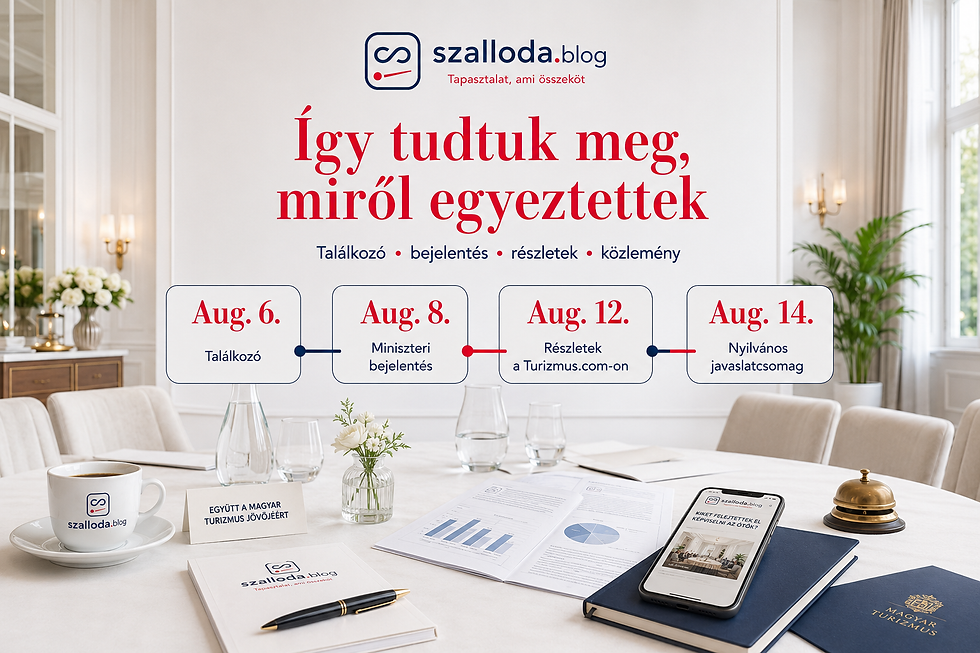
Before examining their substance, consider how news of the process reached the profession. On 6 August, the five association leaders met Ágnes Fábián, state secretary for economic development at the Ministry for the Economy and Energy. The profession was not told beforehand, the agenda was unknown, and no detailed public explanation immediately identified the participants, their mandates or the issues discussed. We previously examined why exactly the same five organisations were repeatedly selected.
On 8 August, Minister István Kapitány's social-media page informed the wider profession that he had consulted the five organisations described by government as leading representatives. But we still learned little of the substance. Days passed before more concrete details appeared. We considered the peculiar sequence — meeting first, announcement later, substantive information emerging gradually — problematic from the outset.
On 12 August, Turizmus.com began publishing details of the 6 August meeting, including the five organisations' own estimate that collectively they represent around 70–75% of the sector. The route by which this emerged is interesting in its own right: not through a detailed ministry summary, joint minutes or public professional report, but fragments of information appearing through the trade press.
A trade publication acquiring and publishing information is of course entirely appropriate; that is journalism's role. What merits examination is why Turizmus.com so often becomes a primary channel for information from these internal discussions, and how the publication sits within professional, business and personal institutional networks. We intend to examine those connections and the five associations' claims of representativeness.
Even by 14 August the picture was incomplete. This morning Szalloda.blog found a relatively short summary on the hotel association's website, which had become longer by afternoon, with additional explanatory sentences. More words appeared, but still no detailed diagnostic analysis, ranking of priorities, owners, deadlines, cost or impact assessment, or accountable implementation plan.
This matters because one of the five associations' first demands is more regular, substantive professional consultation and earlier industry involvement in policymaking. There is a contradiction between that demand and the opacity of the process by which their own consultations became public. After the 6 August meeting we wrote that consultation is not yet policy, a Facebook post is not a strategy, and claiming representativeness cannot replace a transparent system. Several days later, nothing had dispelled those concerns.
It Is Good They Spoke Up, but a Statement Is Not a Strategy
We have no objection to professional organisations speaking together. We welcome it, particularly where their proposals overlap with issues we consider important. The problem is that their 14 August publication is surprisingly brief, general and underdeveloped relative to the weight of the five organisations and their claims to speak for most of the industry.
We do not know whether MTÜ received a substantially more detailed background paper. If one exists, we would welcome reading it, as would the profession. But the published version contains no rigorous assessment of current conditions, ordered priorities, responsible institutions or deadlines, cost estimates, outcome indicators or implementation model showing how demands will become workable policy.
That is notable because other professionals have recently produced more detailed and sometimes bolder analyses of many of the same issues. We examined ÉTREND's 34-page, 21-point strategy and praised its concrete systemic interventions. Our own twelve-plus-one-point discussion paper asks what operating model Hungarian tourism needs, rather than merely assembling discrete proposals.
Csilla Csillag-Csatlós's open letter published today criticises even ÉTREND's more comprehensive paper for insufficient prioritisation, timescales, costs, KPIs and attention to the people who must implement reforms. If those questions are relevant to 34 pages of strategy, they are even more pressing for the five organisations' few paragraphs of loosely grouped demands.
István Asztalos: What Matters Now Is Not Who Said It First

In responding to the five associations, ÉTREND president István Asztalos did not turn cutting red tape, reviewing NTAK, reconsidering tourism-development contributions or training into a competition over who proposed them first. Instead he stressed the much more important phenomenon of independent industry bodies increasingly identifying the same problems: once they converge, those problems become harder to dismiss.
We agree. Our earlier comparison of ÉTREND's 21 points reached a similar conclusion: these independently developed professional approaches have more in common than initially appears. If the five associations, ÉTREND, Szalloda.blog and others converge on predictable regulation, taxation, employment, training, infrastructure, data and representation, it becomes harder to claim Hungary lacks professional alternatives or ideas for reform.
We publish Asztalos's complete reaction as an unaltered downloadable PDF, enabling readers to consult ÉTREND's position directly rather than only our selected passages. István Asztalos's response:
The less reassuring fact is that the same five organisations repeatedly appear as the government's and MTÜ's principal industry partners. We asked why in 'After 89 Days of TISZA Government, Why Is the Same Circle at the Table as Since 2018?' Recent developments make the question more important, not less.
ÉTREND Also Replied Separately to Csilla Csillag-Csatlós's Criticism
In a second response addressed specifically to Csilla's critique, Asztalos explained that ÉTREND's 21 points were consciously written as a strategic discussion paper, not a comprehensive implementation manual. He did not dismiss the criticism: he acknowledged that the human side — leadership culture, burnout, career development, intergenerational knowledge transfer and implementation — could have received more attention.
He added that ÉTREND had long worked on these matters, previously developing a culinary career model, offering coaching for years and incorporating workforce-retention lessons from the COVID period. Most importantly, he treated criticism not as an attack but as a way for the proposal to develop: ÉTREND accepts a twenty-second point and proposes developing it together. That is precisely the professional culture of constructive debate we have advocated.
The complete response is available unchanged as a PDF:
In my view, this is genuine dialogue and professional cooperation, unlike the representation the Five have assumed for themselves.
Meanwhile ÉTREND Has Written an Open Letter to Minister Kapitány Calling for Broader Representation
ÉTREND Chef Club has now addressed an open letter to István Kapitány and the Ministry for the Economy and Energy. Its central point matches our comparison: the issue is not that MABEUSZ, MaReSz, MUISZ, MSZÉSZ and VIMOSZ sit at the consultation table — ÉTREND agrees they belong there — but by what objective, public and verifiable criteria they are labelled the 'leading professional organisations of Hungarian tourism'.
The letter puts it sharply: 'Previous access is not the same as representativeness. Regular invitations do not themselves confer professional legitimacy.' More pointedly: 'That somebody sat at the table in the past does not prove they are a leading representative of the entire industry. It proves, at most, that they sat at the table in the past.'
ÉTREND argues that the five associations' latest proposals themselves illustrate the current representation model's limits. Hotels, inbound and outbound travel, MICE, Budapest branding, conferences, airports, coaches, Danube ports, accommodation and tourism marketing receive prominent attention, while tens of thousands of hospitality micro and small businesses appear far less prominently. The open letter cites inconsistent VAT rates, labour intensity, training for chefs, pastry chefs and servers, career pathways, staff retention, rural restaurants, family businesses and connections between hospitality, agriculture and food producers.
ÉTREND does not propose removing any of the current five. Its letter says: 'We are not proposing that any current participant should get up from the table. We are proposing that more chairs be brought to it.' It advocates a permanent Tourism and Hospitality Social Dialogue Forum with clear, published participation and rotation rules. Admission should depend not on tradition, previous government access, political connections or size alone, but on genuine professional legitimacy, demonstrable representativeness, sectoral reach and professional achievement.
That is the same question made institutional: not whether the Five deserve their seats, but who else lacks one — and who decided that precisely these organisations could speak as Hungarian tourism's 'leading' representatives.
We also reproduce the complete open letter unchanged as a downloadable PDF.

The More Closely We Read the Five's List, the Clearer It Becomes Who Was — and Was Not — at the Table
An advocacy document reveals something about its authors, not necessarily through signatures, but through which problems appear first, which attract concrete remedies and which are relegated to subordinate clauses. The five organisations give strong attention to hotels, inbound travel, agencies, MICE, Budapest, conferences, coaches, airport links, short-term rentals and Danube cruising. These are all genuine and important issues.
They are not the entirety of Hungarian tourism and hospitality. Much of the visitor economy comprises micro, small and medium-sized businesses without conference facilities, inbound programmes, tourist coaches or Danube port connections. MICE does not define their daily operations. They may employ five, ten or twenty people and struggle with operating costs, weak local demand, seasonality, succession, staff retention and red tape while trying to provide affordable, good-quality services.
Reading the priorities, we conclude that this group does not currently give sufficient weight to the interests of hospitality and tourism micro, small and medium businesses or the sector's broader majority. That does not make the five associations unimportant. Strong representation of several substantial segments is not the same as representing the entire industry. We posed a related question about independent and small hotels in 'The Hotel Association: Advocacy Group or Private Club?'
We intend to examine membership structures, overlaps, business size, subsector coverage, officeholders, historical advocacy roles and what the claimed 70–75% representativeness actually measures. We have already argued in our comparison of ÉTREND's proposals that representativeness should be demonstrable: how many companies, what economic weight, which regions and what enterprise sizes does each organisation represent?
Hospitality Particularly Exposes What May Be Missing
One of Asztalos's strongest observations concerns hospitality itself. Although the joint paper purports to address competitiveness across tourism and hospitality, attention shifts towards hotels, MICE, inbound travel, Budapest and selected infrastructure. Restaurants receive some attention under regulation, tax and energy, but appear far less as an independent economic and social system.
The challenges faced by a rural restaurant, family diner, confectionery, buffet or café differ markedly from those of a four- or five-star Budapest hotel or large events business. Business models, access to capital, employees, demand, suppliers and community ties are different. That is why we regarded ÉTREND's 21-point paper as valuable: it connects hospitality with rural economies, food producers, education, employment, mobility and local communities instead of treating it solely as a supporting service to tourism.
Most Strangely, the Five Are Themselves Asking for Wider Consultation
One major demand in their joint proposal is stronger consultation and interministerial cooperation, with professional organisations involved routinely in preparing tourism regulations. We agree. Our twelve-plus-one points called for genuine advocacy, while our review of ÉTREND supported a permanent Tourism and Hospitality Social Dialogue Forum.
The question is not whether to consult, but with whom. If 'wider consultation' means five familiar associations receiving permanent places at the same table, we have institutionalised an existing narrow circle rather than broadened access. That was the essence of our '89 Days of TISZA Government' article, which remains unanswered.
Csilla Csillag-Csatlós's Twenty-Second Point Broadens the Picture Further

Csilla's open letter on Szalloda.blog today matters because it adds an issue that traditional reform papers often dismiss in a few sentences. Her twenty-second point centres on people, leaders and organisations responsible for implementing change. It asks not only what rules should change but what kind of workplaces and managers are supposed to deliver the change.
That aligns closely with our twelve-plus-one argument that some labour shortages are in fact management failures. Meritocracy, transparent career paths, performance management, succession planning, leadership training, work design and workplace culture affect retention just as much as wages and taxation.
The Five's current document says much about flexible employment, third-country labour, training and a possible hotel service charge, but little about leadership culture, organisational development, careers, succession in family ownership or small-business burnout. Csilla shows why even the best regulatory reforms risk remaining on paper without these dimensions.
Differences of Opinion Are Welcome — There Is Finally Something Worth Debating
Comparing the papers reveals genuine policy differences. The Five would investigate introducing a hotel service charge comparable to that used in hospitality, while ÉTREND proposes phasing out the current system and modernising tips and performance incentives. Our earlier comparison highlighted that as a particularly concrete and debatable ÉTREND proposal.
The same applies to NTAK. The Five want wider industry access to NTAK and KSH data, which we support: central data collection becomes a service when it gives businesses useful knowledge. ÉTREND asks an earlier question: are all existing hospitality reporting obligations justified, and should the system itself first undergo independent review?
On Mobility We Are Closer — but the System Is Still Missing
One positive aspect of the Five's proposal is its broad view of tourism infrastructure, including airport connections, tourist coaches, Danube ports, conference centres and event venues. That mirrors our ninth point: mobility must be treated as part of tourism.
In our examination of ÉTREND's 21 points, we noted close agreement on regional airports, rural transport and destination links. Our own focus is systemic: airports, rail, local mobility, accommodation, restaurants and activities are not separate ministerial competences from a guest's perspective. They form one journey.
Then There Is Still the +1 — Which the Five's Own Proposals Seem to Prove
The Five address tax law, labour regulation, third-country employment, education, energy, transport infrastructure, municipalities, data policy, destination marketing and Budapest development. That demonstrates exactly why Szalloda.blog added +1 to its twelve points: tourism must be treated as a genuine economic sector with appropriate standing in government.
MTÜ may be an important centre for data, expertise, marketing and coordination, but it cannot amend tax law, transform education, change employment legislation or decide transport infrastructure on its own. The Five's package therefore supports our additional point: the more interconnected issues we place side by side, the less credible it becomes that one tourism agency can solve them all.
What Has Everybody Put on the Table So Far?
After all this debate, it is useful to compare the proposals in one place. Not to award points, but to reveal where there is strong professional agreement, where different remedies are proposed and which subjects one paper emphasises while another almost ignores.

Hungary needs a genuine long-term tourism strategy.
Public tourism administration should direct less and serve more.
Professional associations must return to real advocacy.
Develop Hungary beyond Budapest into a tourism product.
Measure value rather than just guest nights.
Service culture must catch up with prices.
Some labour shortages are actually management problems.
Renew vocational and higher education in tourism and hospitality.
Treat mobility as an integral part of tourism.
More authenticity and fewer templates.
Sustainability must not become greenwashing or a slogan.
Learn to conduct constructive professional debate.
+1: Tourism must finally be treated as a genuine economic sector.

Predictable, transparent and competitively neutral regulation.
Broader and permanent professional social dialogue.
Predictable economic incentives instead of subsidy-driven operation.
Simplify and harmonise food VAT rules.
Consider phasing out the tourism development contribution.
Independently review NTAK hospitality reporting and the wider system.
Reduce taxes imposed on labour.
Design an employment model suited to hospitality's working patterns.
Rethink service charges, tips and performance incentives.
Modernise vocational training with a stronger practical industry role.
Strengthen career guidance, adult education and recruitment of new professionals.
Address domestic purchasing power and tourism affordability.
Improve value for money and avoid tourism becoming elitist.
Develop regional destinations around local strengths and greater local responsibility.
Prioritise genuine infrastructure needs over prestige investments.
Improve regional transport and, where justified, regional air connections.
Improve energy and operating efficiency.
Protect water resources, adapt to climate change and safeguard natural assets.
Connect tourism and hospitality more closely with agriculture and local suppliers.
Set predefined objectives for public tourism investments and evaluate measurable outcomes afterwards.
Treat tourism and hospitality as a horizontal economic system.

Csilla did not add another tax, grant or infrastructure project. She asked who would actually implement the proposals. Her point therefore focuses on people, leadership and organisational capacity: management culture, executive development, retention, careers, the over-fifty workforce, family-business succession, owner burnout and implementation plans with priorities, schedules, costs and KPIs.

The Five's Latest Proposals — from Five Organisations Also Claiming to Represent Others
Stronger professional consultation and interministerial cooperation.
Review regulatory and administrative burdens.
More flexible employment, simplified hiring and third-country labour.
Workforce pipelines and practical training.
Predictable, consistent accommodation regulation, including short-term rentals.
Review tax, contributions and VAT, tourism-development payments and representation charges.
Consider introducing hotel service charges.
Strengthen SZÉP cards and incentives for domestic tourism.
Assess business risks from exchange-rate fluctuations.
Widen professional access to NTAK and KSH data.
Develop MICE and event tourism and destination support.
Expand conference facilities, airport links, tourist coaches, event venues and Danube cruise infrastructure.
Strengthen Budapest's destination brand and international position.
More predictable long-term tourism marketing.
Promote energy-efficiency investments.
Fair market competition with stronger regulation and enforcement.
Increase tourism's social acceptance and benefits to local communities.

The Common Ground Is Surprisingly Wide, but the Differences Are Equally Important
Across these four perspectives, there is substantial overlap concerning predictable regulation, less bureaucracy, employment, training, taxation, NTAK, infrastructure, energy, mobility and more inclusive consultation. We explored the overlap between ÉTREND and Szalloda.blog in detail, and the Five's proposals expand rather than shrink it.
The Five's paper takes a classic lobbying approach, seeking more predictable, efficient and competitive conditions for current businesses. ÉTREND challenges the system's structure in several areas. Szalloda.blog's twelve-plus-one points address tourism's economic and governance model. Csilla adds the people and organisational capacity required to make reform happen. The perspectives complement each other far more than they cancel each other out. That is itself an argument for involving far more than five bodies in the discussion.
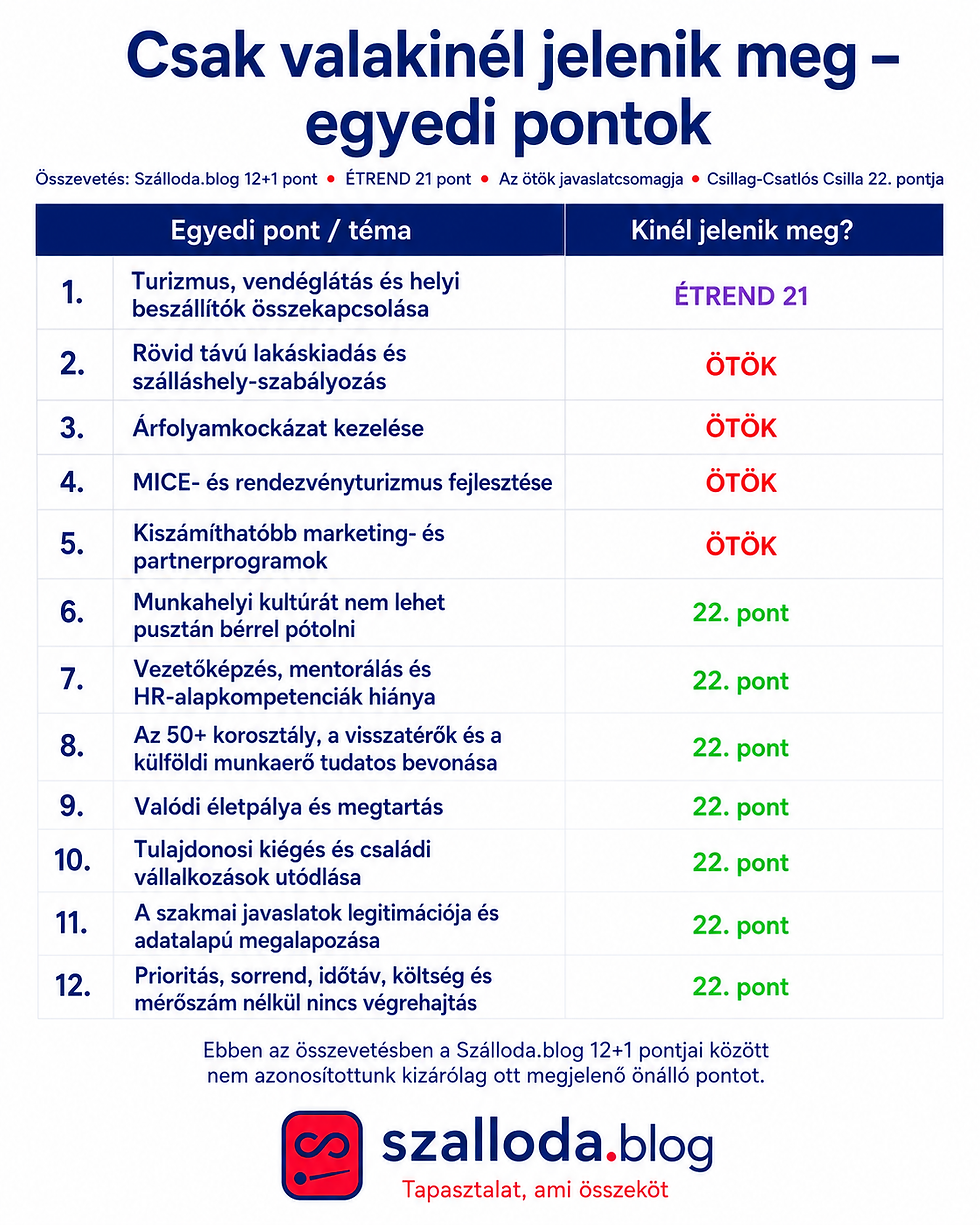
Perhaps Another List Is Not What We Need
Ideas are no longer scarce. We have a twelve-plus-one Szalloda.blog discussion paper, ÉTREND's detailed 34-page, 21-point strategy, Csilla's twenty-second point and another package covering seventeen broad areas. Their overlap is substantial and could provide a foundation for a real process.
The next logical step is not writing yet another document, but placing the existing papers side by side, consolidating shared recommendations, debating the differences and assigning each issue a responsible party, deadline, resources and performance indicator. At the same time we must agree on objective rules for who gets a seat and how an association's true representativeness is measured.
The present five associations have a place at the table. We do not want anyone removed. Asztalos's metaphor is apt: additional chairs are needed, especially when other professional communities bring problems and solutions that the Five themselves recognise as important.
An increasingly central question for Hungarian tourism is no longer whether professionals have enough proposals. It is who decides which proposals reach policymakers, who may claim to speak for the profession, and whose voice is once again left outside the door. We intend to examine the five associations' membership, representatives and economic connections in greater detail.
We increasingly feel the greatest weakness of Hungary's advocacy system is not that too many people want a seat. It is that too few have sat there for too long while speaking in everybody else's name.
Related Szalloda.blog Articles
About the Author

Tamás Pakuts has been active in aviation and tourism for almost 35 years and in hotels and hospitality for more than 25 years.
As an executive and consultant, he has worked with several airlines, hotels, hotel groups and cruise companies across operations, crisis response and development.
He and his colleagues work internationally as hospitality and aviation specialists, advisers and trainers on new projects of international significance.
This article was translated from the original Hungarian using artificial intelligence. The original language is Hungarian.


Comments