
.png)

Hungarian tourism needs a new, competent and caring home

Tourism has been placed in the wrong ministry – István Kapitány sees numbers and subsidies, while the sector is built on people and regions

In May, István Kapitány promised a dedicated state secretariat worthy of tourism’s importance to the national economy. Four months later, there is no dedicated state secretariat, no visible deputy state secretary for tourism, no public strategy, no meaningful crisis management and no answers to the many questions the industry has been asking for months.
Here is the current inventory: daily success reports, sometimes several a day. A handful of executives appointed under opaque circumstances. A funding programme inherited from the previous government, appropriated and given a new name. And a Hungarian Tourism Agency that still wants to be a marketing agency, strategic centre, data owner, funding intermediary, regulator and authority all at once.
Tourism is in the wrong place within the Ministry of Economic Affairs and Energy not because it has nothing to do with the economy, but because tourism is far more than that: it is an interconnected system of people, municipalities, regions, transport, culture, natural assets and local communities.
In a ministry already overloaded with economic development, energy, industrial policy, investment, business development and numerous other responsibilities, tourism inevitably slips down the list of priorities. It is hardly surprising that this is exactly what happened.

Inflated promises. A tourism policy that burst.
At his parliamentary committee hearing on 11 May, István Kapitány stressed that tourism must be treated in line with its importance to the national economy and would therefore receive a dedicated state secretariat. Both the trade press and national media reported it. This was not an off-the-record remark, but part of his programme as minister-designate.
The promise was unambiguous. It was not about a department, a portfolio tucked beneath another state secretariat or a deputy state secretary to be named later. István Kapitány promised a separate state secretariat for tourism.
Within days, however, the retreat began. The list of state secretaries published in the Hungarian Gazette contained no dedicated state secretary for tourism. Judit Zolnay’s name initially appeared in public discussion as a possible tourism chief, but she ultimately received the foreign economic relations portfolio.
By 26 May, trade reports were already saying that tourism would not receive a dedicated state secretariat after all. The portfolio was assigned to Ágnes Fábián’s State Secretariat for Economic Development, while the public was told that operational management would be handled by a separate deputy state secretary. That person was never named, and by mid-September it was still unclear who actually held the position.
The promise of a dedicated state secretariat was first replaced by the promise of a deputy state secretariat. Then that, too, disappeared into ministerial silence.
Ágnes Fábián has disappeared into István Kapitány’s shadow
Ágnes Fábián’s record in tourism as State Secretary for Economic Development has so far carried no weight at all. She has no publicly accessible tourism programme, no meaningful professional communication, hardly any independent public presence and no tourism policy initiative that would reveal where she intends to take the sector.
Tourism officially belongs to Ágnes Fábián, yet politically and in communications it appears to be part of István Kapitány’s personal portfolio. The state secretary disappears into the minister’s shadow, which is bad not only for her but for the entire sector. The industry does not know whom to approach, who makes the decisions, who bears responsibility or who represents tourism inside government.
In June, Szálloda.blog submitted 25 questions to the ministry, later expanding the list to 35 as the range of issues grew. The State Secretariat for Economic Development confirmed in writing that it would answer. The answers never arrived.
The silence is particularly telling because our questions were not political slogans. They concerned tourism governance, organisational structure, strategy, responsibilities and professional consultations — precisely the information that could not be secret in a transparently run ministry.

“I appointed them” – István Kapitány’s one-man show
István Kapitány consistently announced the new tourism executives in the first-person singular: “I asked”, “I appointed”. This is more than a matter of wording. The minister’s language reveals a model of leadership in which he places himself at the centre of every decision, while the selection process, professional criteria and prior consultations remain invisible.
Tourism, however, is not a petrol-station network that can be commanded centrally through uniform sales targets and performance indicators. It depends on cooperation among hotels, restaurants, travel agencies, tour guides, attractions, spas, transport operators, municipalities, destinations, event organisers, airports and hundreds of thousands of employees.
ú
Tourism cannot be run as a one-man company. The sector needs dialogue, teamwork, trust and the coordination of stakeholders whose needs and interests differ enormously.
We already had a taste of this system under Zoltán Guller. What tourism needs is not another governance model built around one individual, but an open institutional structure capable of debate and subject to public accountability.
István Kapitány’s multiple daily success reports on social media are becoming increasingly irritating as well. The visuals may be modern and the packaging colourful, but the method evokes the world of communist newsreels: every visit is an achievement, every meeting a breakthrough, every subsidy a historic success on Facebook and TikTok.
The volume of success reports is no substitute for government performance. The louder the communication about what has been completed, the more conspicuous the silence about what has not.

New executives, old circles and an opaque selection process
In August, István Kapitány announced a “major clean-out” in tourism governance and appointed new heads to three organisations. Yet the announcements revealed almost nothing about how those personnel decisions were made.
Olivér Csendes returned to lead the Hungarian Tourism Agency. His career cannot be separated from the system in which he previously worked: the shadows of Zoltán Guller, Ráhel Orbán and the former NER tourism establishment follow him. István Kapitány did not explain Csendes’s new mandate, how he is expected to run the agency differently or which previous practices he must dismantle.
Andrea Róna’s appointment is the most controversial. Her professional past bears the imprint of Quaestor and Csaba Tarsoly, Sándor Demján’s business environment, and the network of interests around Hunguest Hotels and Lőrinc Mészáros. Her former consultancy was later acquired by interests connected to the Rahimkulov family. She now heads an organisation with a decisive role in administering tourism subsidies, yet the ministry has not explained the selection, vetting or conflict-of-interest criteria behind the choice.
Andrea Tóth is a returning figure, and of the three appointments hers is the easiest to justify professionally. She previously worked at the Hungarian Tourism Agency and on preparations for Hungary’s presence at Expo 2020 Dubai. Even so, neither her selection process nor her mandate and performance expectations have been made public.
The silence does the appointees no favours either. In the absence of an explanation, the public is left to draw conclusions from their former connections, positions and business environments. Transparent selection is not an attack on executives. It would be their first and strongest line of defence.

Freedom-of-information request: a retrospective extension instead of an answer
On 16 August, Szálloda.blog submitted a freedom-of-information request to the Ministry of Economic Affairs and Energy concerning the selection of the new tourism executives, the preparation of the decisions, the application or selection process, the assessment of professional suitability and the appointment documents.
The statutory deadline expired on 31 August. By then, the ministry had provided neither a substantive answer nor notice of an extension. On 1 September, we alerted the ministry to its failure. Only then did the extension arrive.
This is not a technical detail. The purpose of extending a deadline is not to allow a public body to buy itself more time after the statutory deadline has expired and only once the applicant has chased it.
The episode captures the ministry’s attitude to transparency perfectly: while nobody asks, there is nothing to explain; when somebody does ask, it first remains silent and then asks for more time.
The central question remains unchanged: was there a genuine, documented selection process; who took part; which candidates were considered; what suitability and conflict-of-interest criteria were applied; and what performance is expected from the new executives?

Why these “five” — and whom do they really represent?
For the first round of sector dialogue, the ministry involved five major organisations: the Hungarian Hotel and Restaurant Association, VIMOSZ, MaReSz, MUISZ and MABEUSZ.
These are important organisations, but even together they do not represent the whole of Hungarian tourism. Their leaders, influential members and business backgrounds are connected at several points to the tourism elite that also held decision-making positions during the NER era and has had a permanent seat at government negotiating tables since 2018.
Kapitány and his team might just as well have negotiated directly with the strongly Orbán-related Hungarian business men Sándor Csányi, István Garancsi or László Szíjj, given the countless links to these business circles through the five organisations’ leaders, major companies and members.
That does not make the opinions of the five organisations unimportant. But why were they first? Who decided that they could represent the sector? Why were rural small businesses, tour guides, spas, attractions, active tourism, rural tourism, river and lake transport, regional aviation, tourism technology companies and independent providers absent from the first round?
Neither the ministry nor the five organisations disclosed the precise sequence of consultations, whom they consulted, the agendas, proposals, outcomes or what would follow from them.
Dialogue does not become sector-wide because a ministry invites five old acquaintances to the table. It becomes sector-wide when selection is public, participation is diverse, the process can be followed and the results can be scrutinised.
The most important question is therefore not what the five discussed. It is who was left out, why they were left out, and whether this was a deliberate decision or simply the result of being unprepared.
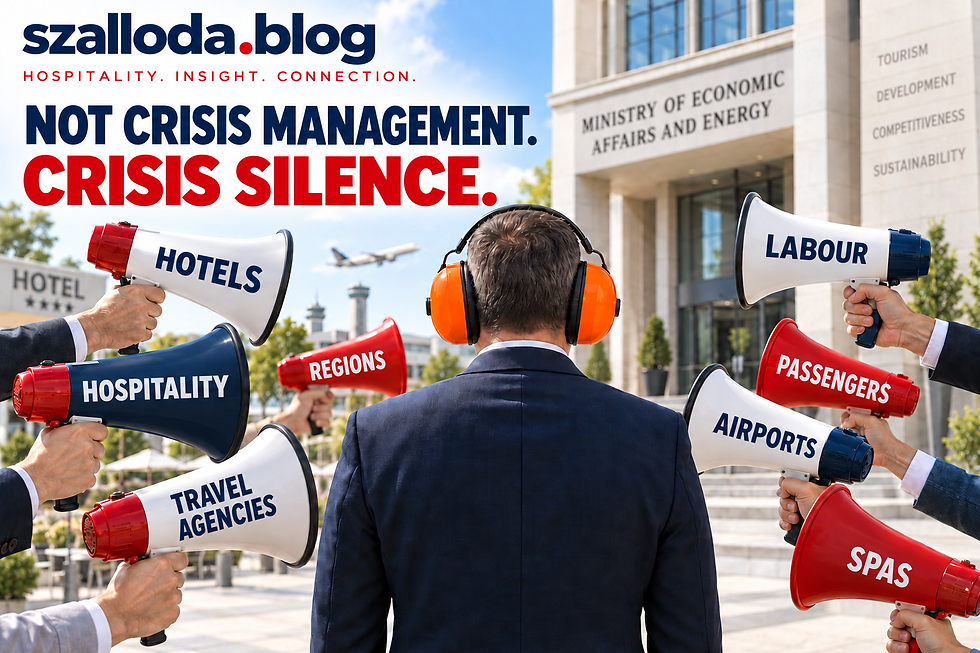
Neither the Hungarian Tourism Agency nor the ministry responded to the summer crises
In the summer of 2026, Hungarian tourism faced several mutually reinforcing problems at once. The strong forint weakened the price competitiveness of Hungarian providers while costs denominated in forints continued to rise. Profitability deteriorated at some hotels, room for manoeuvre narrowed and solvency risks increased.
Alongside the strong forint, the drop in Danube cruise traffic also caused tangible losses in inbound tourism. Weaker group demand hurt not only hotels, but coach operators, restaurants, attractions and tour guides.
Tour guides were among the direct casualties of the summer season, yet no targeted ministerial measure was introduced for them. With fewer groups, cancelled cruises, shorter programmes and unpredictable bookings, many lost work and income while official communication continued to talk about records and success.
The position of regional airports also remained unresolved. The problems facing Pécs-Pogány, Hévíz-Balaton, Debrecen and Hungary’s other regional airports cannot be addressed through one-off subsidies and occasional route announcements. They require thinking in terms of networks, regional economic development, tourism demand and long-term accessibility.
Szálloda.blog regularly sent these analyses to the ministry. Yet the ministry offered no meaningful policy response. Pénzcentrum later covered the adverse impact of the exchange rate on hotels in detail on 20 August and 22 August.
The ministry’s summer performance on tourism was not crisis management. It was crisis silence.

Robinson Tours: when even passengers no longer know which state will protect them
The Robinson Tours case demonstrated more clearly than anything before it that Hungarian tourism currently has no functioning crisis-management or accountability system. While hundreds of passengers tried to discover what would happen to the money they had paid and to their cancelled holidays, the ministry said nothing. It offered no assessment, did not explain the government’s responsibility and did not say whether regulation and supervision needed reform or whether it was consulting its Bulgarian counterpart.
The company operated cross-border as a Bulgarian-registered tour operator while in practice working almost exclusively in the Hungarian market. The Hungarian licensing office responsible for the register did not exercise the rights or make use of the powers available to it.
The company was removed from the Hungarian register only after its operations had collapsed. MTI also reported the removal, citing the Budapest Government Office.
The events show that the freedom to provide cross-border services cannot mean freedom from supervision. A tour operator serving Hungarian consumers must be subject to meaningful oversight even if the company is registered in another EU member state.
The Robinson affair revealed another structural absurdity: nationwide travel-authority functions are performed by the Tourism and Public Warehousing Supervision Department within the Budapest Government Office.
Cramming public warehousing and tour-operation supervision into the same department says everything about the importance the state administration assigns to consumer protection in tourism. These functions belong in a national tourism authority with adequate staffing, expertise and serious inspection powers.
That authority cannot be the Hungarian Tourism Agency, nor can it be a professional trade association. Hungary needs an accountable state institution connected to strategic governance but independent of it in both structure and decision-making.

The 5+5 scheme emerged from the hat
By the end of the summer, it had become increasingly obvious that the ministry had few tangible results to show in tourism. Something had to be produced quickly, so the 5+5 programme was pulled from the hat: preferential financing and non-repayable grants for small tourism businesses.
The scheme may be useful and could offer genuine assistance to many businesses. According to the announcement, around 800 companies may receive a combined HUF 4 billion in loans and HUF 4 billion in grants.
The problem is not that the support exists, but that it has been politically appropriated. The 5+5 scheme was prepared during the previous government term. István Kapitány’s ministry inherited it, renamed it the Ganz Ábrahám Programme and then presented it as its own success. Politically clever, perhaps. Professionally and in communications, it is dishonest.
Szálloda.blog therefore examined the story in detail: The NER wrote the call and István Kapitány claims the success – how did 5+5 become TISZA’s Ganz Ábrahám Programme?
We submitted freedom-of-information requests concerning the programme to the ministry, the Hungarian Tourism Agency and the Kisfaludy organisations. The response deadline has not yet expired, but the list of successful applicants remains unavailable to the public.
When public money is distributed, publishing a programme name and total budget is not enough. The public must know who received support, according to which criteria, through what decision-making process and under what system of oversight.

The Hungarian Tourism Agency is still confusing its role
The previous system gave the Hungarian Tourism Agency powers that do not belong in a tourism marketing and development agency. The agency is simultaneously attempting to build markets, run campaigns, collect data, distribute funding, devise strategy, prepare regulation and supervise market participants.
That is not strong tourism governance. It is an institutional conflict of interest.
The Hungarian Tourism Agency and its institutional network cannot act as an authority. Nor should professional associations be anointed with official or quasi-official powers. An organisation cannot represent businesses and simultaneously supervise those same businesses through the power of the state.
The agency’s role could be to market Hungary as a destination, develop markets, conduct research, support product development and prepare the professional analysis required for policy decisions. Instead, its current portfolio remains too broad and difficult to navigate, repeatedly blurring the boundaries between state, market and regulatory functions.
Operating NTAK should not be the agency’s primary task either. The principal data owner and professional supervisor of a national statistical system based on mandatory reporting should be the Hungarian Central Statistical Office. The tourism agency could access the data as a partner and user, conduct analyses and use them to support tourism decisions. Data collection, market development, funding and supervision, however, cannot be concentrated in the hands of a single organisation.

Accommodation rating and regulatory powers must return to the state
Accommodation rating and every other regulatory power that directly affects the operation of market participants must return to the state. These duties cannot be entrusted to the Hungarian Tourism Agency, professional associations or the personally and commercially interconnected circle that includes the “five”.
The role of professional organisations is advocacy, consultation, knowledge-sharing and support for service providers. It is not rule-making, mandatory classification or the supervision of businesses they also represent.
The exercise of public authority is a state responsibility, with clear avenues for appeal, public procedures, uniform requirements and accountable decision-makers. The legal framework of the current accommodation-classification system is set out in Government Decree 40/2025 (11 March), but the existence of regulation alone does not resolve the operational and conflict-of-interest problems.
Professional associations should comment, the state should regulate and an independent authority should supervise. These three roles must never again be confused.
Hungary has already had a state secretariat for tourism in the right place

The previous government system included a genuinely useful and professionally well-designed body: the State Secretariat for Active Hungary.
It belonged to the Ministry of Public Administration and Regional Development and could work effectively precisely because it understood tourism not merely in terms of guest nights, but through regions, routes, infrastructure, local communities and quality of life.
According to information from within the sector, some of the colleagues who worked there have now been placed within the Ministry of Interior. The expertise built up there must not be scattered and hidden. It must be brought back into a renewed system of state tourism governance.
This experience also proves that locating tourism within rural and regional development is not a theoretical construct. Hungary has already had a state secretariat that addressed an important branch of tourism in its regional, transport and community context.

Why would tourism be better placed within rural and regional development?
A substantial share of Hungarian tourism operates outside Budapest: Lake Balaton, Lake Tisza, Lake Velence, thermal spas, wine regions, historic towns, rural accommodation, active-tourism routes, national parks, regional airports and cross-border regions.
Their problems cannot be solved through business-development programmes alone. Transport, healthcare, labour, housing, public services, urban and rural development, water management, landscape protection and the local economy jointly determine whether a destination works.
In its mindset, rural and regional development is closer to the reality of tourism than an economic super-ministry built around figures, financing programmes and corporate performance indicators.
This does not mean that the Ministry of Economic Affairs and Energy would have no role in tourism. It would remain an indispensable partner in finance, SME policy, taxation, investment, productivity and digitalisation. Strategic ownership, however, should sit with the rural and regional development ministry through a dedicated state secretariat for tourism.
According to our professional sources, the problems in tourism have also been discussed at cabinet meetings, partly as a result of the public professional debate strengthened by articles published by Szálloda.blog. The rural and regional development side has indicated that it would be prepared to assume strategic responsibility for the sector.
This opportunity should be treated not as a matter of personal prestige, but as an organisational correction. Correcting a bad decision is not defeat. It is responsible government.

Szalloda.blog warned for months that something was wrong
We did not invent these problems after the event. From April to September, we continuously analysed tourism’s economic importance, the missing strategic shift, active tourism, transport, regional airports, hotel profitability, labour, regulation, trade associations and the Robinson Tours affair.
The chronology alone shows that the warnings, questions and proposals have been on the ministry’s desk for months:
28 April – Tourism is not a marginal industry – one in every seven forints is linked to the sector. Even before the government was formed, we warned that tourism could not be treated as a peripheral area of the economy.
7 May – National Tourism Development Strategy 2030 – a change of direction or fine-tuning business as usual? We called for a genuine review of the strategy.
11 May – István Kapitány promised a dedicated state secretariat for tourism.
18 May – Is active tourism the greatest missed opportunity in Hungarian tourism policy? We called for the expertise built up previously to be preserved.
20 May – Public transport is one of Hungary’s greatest untapped tourism and economic reserves.
26 May – It became clear that tourism would be assigned to Ágnes Fábián’s State Secretariat for Economic Development instead of receiving the promised dedicated state secretariat.
28 May – Pécs-Pogány Airport: another failure or a strategy that was flawed from the outset?
29 May – What does the new TISZA government’s first foreign trip tell us about Hungary’s transport culture?
15 June – Why has tourism become the neglected stepchild of the new TISZA government? The headline itself made clear that something was wrong — and that it would get worse.
After 15 June – Szálloda.blog sent 25 questions to the ministry, later expanded to 35. The State Secretariat for Economic Development confirmed in writing that it would answer. The answers never arrived.
18 June – Record tourism or a genuine strategy? Hungary faces a crucial crossroads in the summer of 2026
19 June – A Michelin star does not pay the bills
23 June – Who will serve the guest tomorrow?
24 June – Who will throw Lake Velence a lifeline?
25 June – Hungary’s regional airports – gateways to regional opportunity
12 July – Not more tourists, but more value
24 July – The Hungarian Tourism Agency has its old-new leader – but why is his mandate still a secret?
26 July – Hotel association: advocacy group or talking shop?
2 August – Can Hungarian tourism succeed at all without a modern, renewed strategy?
4 August – Strong forint, weak summer – who will survive Hungary’s 2026 tourism season?
5 August – Robinson Tours: how Hungarian passengers can submit their claims
8 August – HUF 5.5 billion for regional airports – enough for survival, but too little for a restart?
8 August – Twelve points for renewing Hungarian tourism — plus one
10 August – Twenty-one proposals for renewing Hungarian tourism from the Étrend Association of Hungarian Chefs
13 August – The EU is tightening the rules for travel agencies
15 August – The five said what many of us had already written — but on whose mandate, and whom do they represent?
16 August – We submitted a freedom-of-information request to the ministry concerning the circumstances surrounding the appointment of the new tourism executives.
19 August – Hotel More or Hotel Less?
20–21 August – Protect and support tourism, hotels, hospitality businesses and attractions that operate fairly
22 August – Do not ban Airbnb. Put the market in order at last — a 15-point proposal
24 August – Who rates the hotel raters?
25 August – Robinson Tours: when did the money really run out?
27 August – Politics should stay out of the stewpot — not less for Bocuse, but more for Hungarian gastronomy
31 August – The response deadline for the freedom-of-information request concerning the executive appointments expired. The ministry neither answered nor announced an extension by that date.
1 September – We alerted the ministry to its failure. Only then did the belated deadline extension arrive.
1 September – Robinson Tours: what turnover and activities did it declare to its insurer and the authorities?
3 September – European tourism breaks records — while nine countries are already in decline
5 September – The ministry announced the Ganz Ábrahám Programme — the 5+5 scheme inherited from the previous term.
8 September – Robinson Tours: Bulgarian ministry says charter packages require minimum insurance of BGN 500,000
8 September – The NER wrote the call and István Kapitány claims the success — how did 5+5 become TISZA’s Ganz Ábrahám Programme?
These are not a handful of isolated criticisms. They document a five-month professional process to which the ministry responded not with substantive answers, but with silence, delayed communication, consultations behind closed doors and the repackaging of an inherited funding programme.
Kapitány and his team are repeating the very failures for which TISZA and the prime minister loudly criticised Orbán's NER
The ministry’s failures bear an uncanny resemblance to the practices for which TISZA repeatedly and sharply criticised the Orbán government and the NER: one-man decisions, opaque appointments, preferential treatment for the same insider circles, withheld documents, unanswered questions, centralised power and relentless success propaganda.
Change is not proved by putting a different logo on the ministry’s backdrop, giving an old programme a new name or having a different politician deliver the same success report. It must be proved by how government operates.
István Kapitány is far too visible, while the governance of tourism is barely visible at all. Ágnes Fábián is too invisible for the industry to believe it genuinely has a state secretary responsible for tourism. The Hungarian Tourism Agency continues to hold too many mutually incompatible roles. The ministry, meanwhile, has too many other responsibilities to give tourism the attentive and responsible leadership it needs.
There is much to do, and it is clear that Kapitány and his team embarked on the governmental management of tourism unprepared and without sufficient knowledge of the sector. This cannot be repaired through another communications campaign. It requires structural correction.
Tourism must be removed from the overloaded Ministry of Economic Affairs and Energy and placed within rural and regional development as a dedicated state secretariat.
Hungarian tourism does not need more months without an owner, more glossy posts, more old programmes with new names or another hand-picked inner circle.
It needs a new, competent and caring home.

Sources and Related Documents
Kapitány István külön államtitkárságot ígért a turizmusnak – HírBalaton/MTI
A gazdaságfejlesztési államtitkárhoz került a turizmus – Turizmus.com
A Robinson Tours magyarországi tevékenységének törlése – MTI
40/2025. (III. 11.) kormányrendelet a szálláshely-minősítési eljárásról
Az erős forint és a szállodák veszteségei – Pénzcentrum, augusztus 20.
Az erős forint hatása a magyar szállodákra – Pénzcentrum, augusztus 22.
The legal, regulatory, industry and international information used in this article reflects the situation as of 12 September 2026. Artificial intelligence tools (ChatGPT, Claude) were also used to assist with the collection, comparison and organisation of information; the final editing, interpretation and conclusions reflect the editorial position of Szalloda.blog. AI-based applications were also used in the creation of certain illustrations and infographic elements accompanying the article.
This translation was generated automatically using an AI-based translation tool from the original Hungarian-language article.


Comments