

.png)
Customer service or payment blocking system?
- Pakuts Tamás
- 3 nappal ezelőtt
- 6 perc olvasás

When it's time to pay, the real person behind the airline disappears
The airline knows everything about us – until it has to pay us.

Buying a ticket is now just a few clicks away. The airline’s system recognizes our routes, dynamically adjusts the price, recommends baggage, seats, priority boarding, accommodation and rental cars, and then charges our credit card in seconds. However, when the airline has to pay due to a flight cancellation, significant delay, denied boarding, incorrect rebooking or non-refundable expenses, this same digital intelligence often loses its ability.
The passenger is faced with chatbots, roundabout menus, hidden forms, automatically closed cases, and template responses that do not reveal whether their request was even reviewed. The problem is not that airlines are using artificial intelligence, but when AI does not support the work of the human agent, but removes the agent himself and with it the responsibility.
This is particularly concerning because all errors in the system point in the same direction: the passenger loses and the airline saves money.
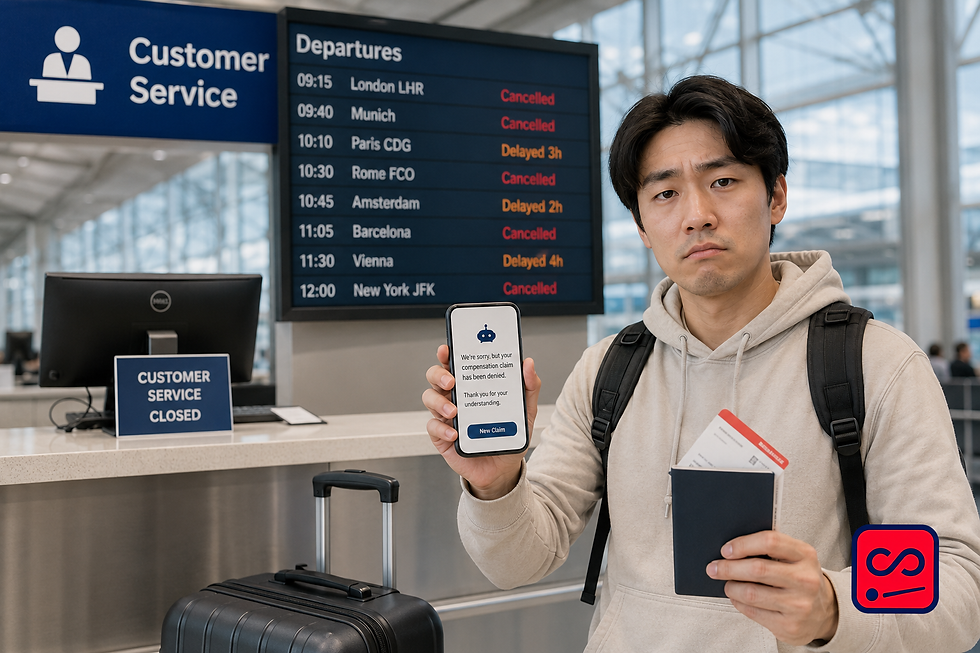
AI cannot take responsibility
AI can identify a booking, collect flight details, check arrival times, request documents and prepare a case. However, deciding on a disputed compensation claim is no longer a simple matter of data processing. It must be determined what actually caused the delay, whether extraordinary circumstances really occurred, whether there was a causal link between the event and the disruption to the flight in question, and whether the airline took all reasonable measures to avoid the consequences.
Under EU rules, the affected passenger may be entitled to a flat-rate compensation of 250, 400 or 600 euros, depending on the distance of the flight. This is a separate right to a refund of the ticket price, rebooking, and reimbursement of meals, accommodation and reasonable expenses incurred. If the airline claims extraordinary circumstances, it must prove the connection between the event and the flight disruption and that the delay or cancellation could not have been avoided despite all reasonable measures.
In contrast, the passenger often receives only the following response: “Due to extraordinary circumstances, compensation cannot be paid.” It is not clear what happened, what evidence was used to make the decision, what alternative measures were considered, or whether the request was even seen by a human. This is not a justification, but a statement that is often misleading.

Airline rankings 2026: even the best customer service is just mediocre
The Flightright 2026 Index examined twenty well-known European airlines between November 15, 2025 and May 14, 2026. The rating consisted of three areas: reliability, payment behavior related to compensation claims and customer opinion. A maximum of five points could be achieved in each of the three categories.
The most important message of the ranking is not that Austrian Airlines necessarily has excellent customer service, but that even the first place carrier only scored 3.04 out of 5. Aer Lingus, Air Europa and Vueling only received one point in the payment behavior category.
Of course, Flightright is also a claims-handling company, so its index is not an official rating. However, it does highlight the very area that traditional passenger satisfaction surveys often overlook: how cooperative an airline is when it is not earning revenue but incurring a payment obligation.

AirHelp’s 2025 global rankings used a different methodology. The index, which examined 117 airlines, gave equal weight to punctuality, passenger reviews and claims handling. Qatar Airways came in first place, while Virgin Atlantic and KM Malta Airlines were among the best from Europe. The difference in the two lists also shows that defining the “best airline” depends heavily on what we measure: punctuality, in-flight experience or how the company behaves after a claim is filed.
Elliott Advocacy: when the rightful amount of money is only obtained after external pressure
American Elliott Advocacy handles specific consumer cases, reaches out to corporate executives, and publicizes cases in which the client has not achieved results through standard customer service channels.
The organization's current Green List includes Singapore Airlines, Southwest Airlines and Air New Zealand. The Red List, meanwhile, has American Airlines at the top, but Ryanair and TAP Air Portugal are also among the ten worst-rated companies. Elliott itself emphasizes that the list is largely based on the cases it receives, so it cannot be considered representative market research. However, it is suitable to show which companies experience recurring difficulties in reaching customers, delayed solutions, opaque conditions or liability avoidance.
In one documented case, American Airlines upgraded a passenger to economy class because of a faulty business class seat, but later claimed, citing its own records, that no downgrade had occurred. The airline only acknowledged the fact and refunded the difference after presenting a retained boarding pass. In another case, a passenger spent nearly seven months trying to get a $403 refund that should have been automatic under US rules.
An Aer Lingus passenger missed his connection due to the airline's inadequate airport staff and then paid a significant rebooking fee. Although he was promised a refund on the spot, customer service did not resolve the matter for six months; the money finally arrived nearly seven months after the trip.
These cases do not prove that all customer service agents intentionally mislead passengers. What they do show is that the system can treat an incorrect internal record, a poorly chosen category, or an automated assumption as fact and then place the burden of proving that the airline's own records are wrong on the passenger.
Dr. Matthias Böse, whose very name terrifies airlines
Dr. Matthias Böse, a Düsseldorf lawyer specializing in air passenger rights and travel law, has handled cases that show that airlines can resist not only clear-cut claims for compensation, but also for reimbursement of rebooking, service fees and other costs.
In a case brought by Böse on behalf of the German consumer protection organization, the German Federal Supreme Court ruled that after a flight is canceled, a passenger can request replacement transportation on the original airline’s flight at a later date, subject to seat availability. Lufthansa had previously wanted to charge a surcharge of several thousand euros for rebooking to a later date.
In a 2025 Cologne case, the airline tried to include the fee for the seat reservation that was not provided in the compensation of 600 euros per person due for the cancelled flight. The court rejected this: the fee for the separately paid but not provided service had to be refunded in addition to the flat-rate compensation.
The question is not just whether the passenger ultimately won the case. More importantly, why did he have to go to court at all for rights that should have been recognizable during the first customer service inquiry.

The business model of auto-rejection
An automatic rejection costs almost nothing. However, an individual investigation by an experienced officer with access to operational data requires time, expertise and money. It may therefore be more economical for the airline in the short term to initially reject the application and then only deal in detail with cases in which the passenger files a complaint again, contacts the authorities, hires a lawyer or seeks publicity.
There doesn’t have to be a demonstrable intent to deceive in every case for the system to create an anti-consumer outcome. It’s enough that the payment requires more customer effort, more documentation, and more contact than the rejection. Every passenger who gives up after the first template response represents a direct saving. This turns customer service into an anti-payment system.

We need a more responsible system, not fewer people
The AI should collect the data, separate refunds, compensation, rerouting and justified additional costs, and then prepare the case for the human decision-maker. However, the final rejection of a disputed claim should be a verifiable human decision.
A human review should be possible in a single, visible step for the passenger. The refusal should state the specific facts, the legal basis applied, the evidence taken into account, and whether the decision was made by an automated or human decision. In clearly legitimate cases, automatic information and payment should be provided, rather than additional forms and proof requirements.
The new rules of the European Union, which will be finally approved in July 2026, also require stronger information, easier communication and clearer claims management. Airlines will have thirty days to pay or explain why they are citing extraordinary circumstances and what further complaint handling options are available to the passenger. The fact that these basic requirements need to be reinforced in separate legislation says a lot about the current system.
Airlines have the right to automate their customer service, but they do not have the right to automate denial without evidence. AI cannot replace a human who must understand the case, weigh the facts, recognize the system's error, and, if appropriate, say: the airline was wrong and the passenger must pay, because as long as all systems are working when buying a ticket, it is unacceptable that intelligence and human responsibility disappear just when the money should be going in the opposite direction.
We will soon write about what the airlines think about all this.

About the author:
Tamás Pakuts has been actively involved in aviation and tourism for almost 35 years, and in the hotel industry and catering for more than 25 years.
As a manager and consultant, he had insight into the operations of several airlines, as well as hotels, hotel chains, and shipping companies, successfully taking on a role in their operational management, crisis management, and development.
He is currently present in many countries around the world with his colleagues as an expert, consultant, and trainer in the hotel industry and aviation, and he and his colleagues are working on the development of numerous new, internationally noteworthy projects.