.png)


Artificial intelligence won't take away hotel jobs, but poorly organized work will

AI in the hotel industry: it does not replace human power, but optimizes it

Conversations about artificial intelligence usually boil down to the same questions: how many jobs will it take, when will robots appear at the reception desk, and whether there will still be a need for waiters, chefs, or hotel managers. But this is probably not the most important question for the hotel and hospitality industry. It's more about which business will learn to use artificial intelligence well first?
AI is not coming to the industry in the distant future. It is already here in reservation systems, revenue management, guest communications, demand forecasting, inventory management, marketing, and a growing number of hotel operating systems.
In June 2026, Oracle introduced AI capabilities built directly into OPERA Cloud to help employees work more efficiently, operate more consistently, and improve guest experience. In Mews’ systems, AI is no longer a separate feature, but an operational layer connecting revenue, operations, and the entire guest journey.
So the change is not theoretical, the only question is whether hotel management recognizes what it can really be used for.
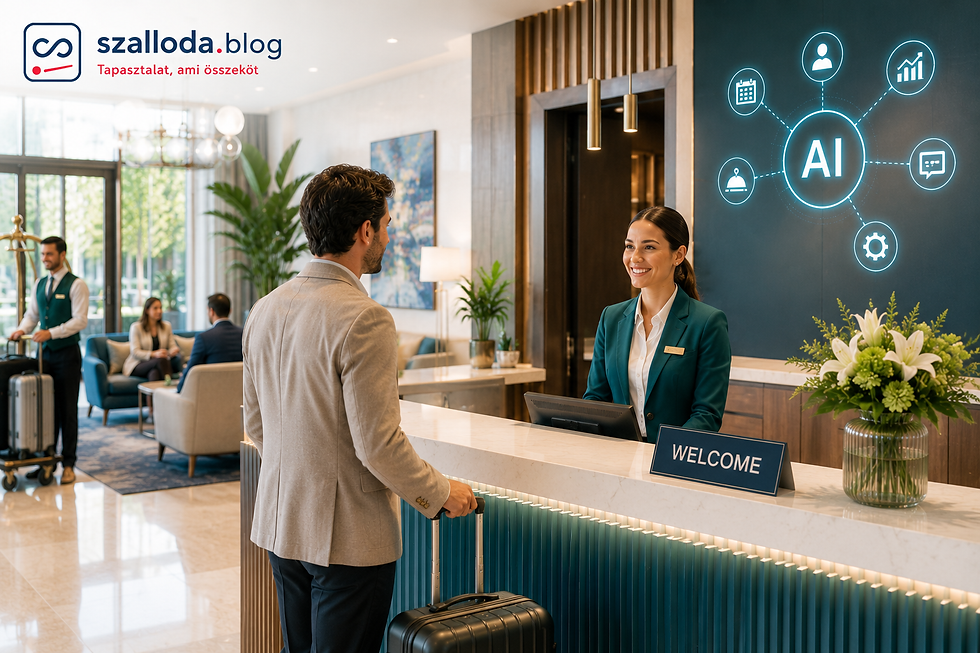
It's not about the robot receptionist
When we talk about artificial intelligence, many people still imagine humanoid robots, talking kiosks, and unmanned hotels. It's a spectacular but misleading image.
In the hotel industry, the biggest impact of AI will likely not occur where the guest directly sees it, but in the background processes.
Where today, operations are still controlled by spreadsheets, hand-written lists, systems that do not communicate with each other, intuition, phone calls, and subsequent firefighting.
The value of artificial intelligence is not in trying to smile at the guest, but in noticing in time when something is going wrong.

A new level of revenue management
Some hotels still set prices by monitoring last year's numbers, occasionally checking competitors, and then manually adjusting room rates.
Meanwhile, a modern, AI-based system can simultaneously analyze:
the booking schedule,
changes in cancellations,
competitors' prices,
local events,
the weather,
air and rail capacities,
the behavior of individual guest segments,
as well as the profitability of different sales channels.
The system not only provides data, but also makes suggestions, predicts, and within certain limits is able to react independently.
Modern AI-powered revenue systems now track the market in real time, learn from data, and can adjust prices automatically. This doesn’t mean the role of the revenue manager is gone. It means you spend less time collecting data and manually adjusting prices, and more time on strategy, segmentation, and business decisions.
Artificial intelligence therefore does not necessarily replace the revenue manager, but rather the revenue management that consists exclusively of routine, intuition, or copying competitors.

Housekeeping: where every minute counts
Few hotel areas are affected by as many variables as housekeeping.
It's not enough to know how many rooms need to be cleaned, you should also know:
when the guest actually leaves,
which room does early check-in arrive in,
where is the technical problem,
which room requires deep cleaning,
which employee works how quickly and with what quality,
where congestion is expected,
when additional people need to be reassigned.
In traditional operations, this information often reaches those involved by phone, radio, paper, or with a delay. A well-integrated system, however, can prioritize tasks in real time, optimize workflow, indicate expected delays, and coordinate the work of reception, housekeeping, and maintenance.
The goal is not to make the room attendant run faster, but rather to avoid having to wait unnecessarily, go back, make phone calls, or deal with a room that cannot yet be taken over.
Automation of housekeeping, maintenance, and service tasks is increasingly becoming a priority because they still involve a significant amount of repetitive, predictable, and manually coordinated workflows.

Maintenance: not to repair, but to prevent
Hotel maintenance is traditionally reactive. The air conditioner breaks down, the faucet drips, the refrigerator stops, the elevator breaks down, and someone tries to fix it as quickly as possible.
AI-based predictive and proactive maintenance, on the other hand, not only detects that something is broken, but also tries to predict when it will fail.
Based on energy consumption, vibration, temperature, operating time and previous errors, a system can indicate if a piece of equipment is operating abnormally.
This way, repairs can be made before the failure causes guest complaints, loss of revenue, or major technical damage.
The difference is significant. It's not the same to maintain an air conditioner on a Tuesday morning in an empty room as it is to move a guest on a Saturday night in front of a full house.
Personalization – or digital intrusion?
One of the most talked-about promises of AI is personalized guest experiences.
In principle, the hotel may know:
what room the guest previously chose,
Which side do you like to sleep on?
What kind of pillow do you want?
Do you have any food allergies?
what kind of wine do you drink,
whether you use the wellness area,
you are coming for business or leisure purposes,
and what offers you respond to most.
All of this can be valuable, but only if it doesn't become an inconvenience. Good personalization doesn't mean following the guest's every move and then trying to sell them something at every moment.
Good personalization is discreet, it doesn't demonstrate how much data we have, it simply eliminates repetition and unnecessary friction. So a returning guest doesn't have to explain again that they are allergic to feather pillows, a family doesn't have to indicate again that they require a crib, and a regular guest doesn't have to re-enter their arrival habits every time.
AI creates luxury when it remains invisible.
According to Mews' summary, one of the most important roles of technology is to enable a more personal experience by inferring guest behavior and preferences, while automation reduces routine tasks for employees.
Chatbot is not hospitality
Automating guest communication is undoubtedly useful. A well-functioning system can instantly answer simple questions about parking, breakfast, check-in time or wellness opening hours. In multiple languages, 24 hours a day. This can significantly reduce the burden on the reception and reservation department.
IHG, for example, reported a 53 percent increase in AI-powered, fully self-service customer processes in 2023 compared to the previous year.
But a chatbot can’t solve every situation because it can’t always recognize the uncertainty behind the voice. It can’t necessarily sense that a guest’s question is actually a complaint, and it can’t authentically empathize with a lost luggage, a sick child, or a ruined anniversary.
Simple tasks can be automated, but complex situations still need to be handled by humans.
Moreover, the more routine tasks are transferred to technology, the more important the communication intelligence of the human employee becomes.

AI in the kitchen and restaurant
One of the biggest problems in hospitality is that many decisions are still made based on estimates:
How many servings of breakfast will be consumed?
How much fresh produce should we order?
How much traffic will the terrace get?
Which dish is left untouched on the plate too often?
Which raw material has become so expensive that the recipe is already unprofitable?
AI can make much more accurate predictions based on past sales, bookings, weather, events, guest mix, and current inventory. It can help you:
in determining order quantities,
in controlling food costs,
in recognizing inventory losses,
reducing food waste,
in analyzing the profitability of the menu,
in workforce planning,
and in managing allergens and dietary needs.
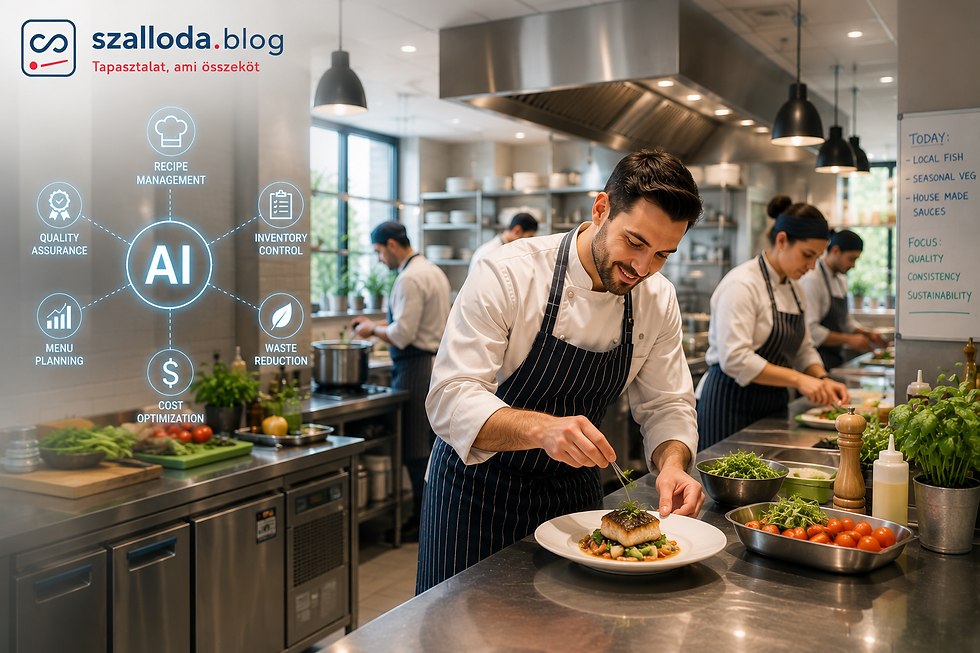
However, this does not mean that an algorithm should write the menu. AI can show which dishes are profitable, which sell well, and which are too often wasted, but it is up to the chef and restaurant manager to decide what the restaurant represents.
Gastronomy is not just about optimized use of ingredients, but rather about identity, creativity, culture and guest experience.
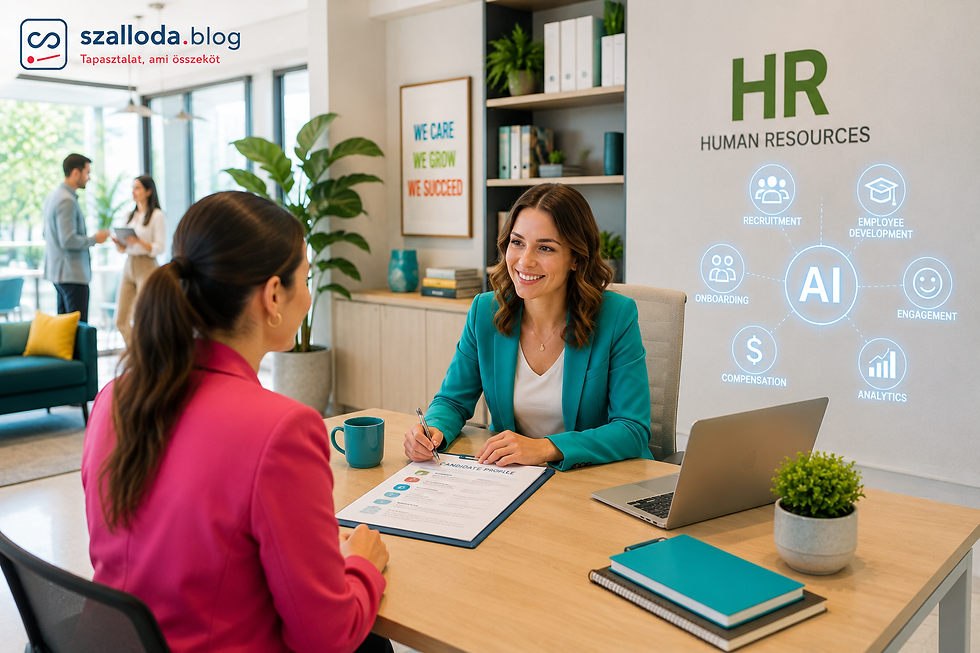
HR: the most sensitive area
Artificial intelligence also offers significant opportunities in workforce planning.
It can predict expected staffing needs, help with shift scheduling, identify training gaps, and recognize patterns that indicate increased risk of turnover or burnout.
This can be extremely valuable in an industry that is simultaneously struggling with labor shortages, high turnover, and rising labor costs.
But this is also where the greatest danger lies, because an employee cannot be judged solely on performance data, speed, absences or guest reviews. The system does not necessarily see that someone is slower because they are training a new colleague. It does not know that an employee is going through a family crisis. It does not always understand cultural differences, language barriers or the different workloads of individual departments.
AI can help spot the problem, but it should not be allowed to judge people on its own.
The new role of the hotel manager
Artificial intelligence does not make hotel managers redundant, but it will transform management work.
The director of the future will be less and less a mere collector of reports, a transmitter of spreadsheets, and a troubleshooter of daily operational problems. The system will collect data faster, recognize discrepancies, and prepare analysis.
The leader's task will be to:
ask the questions well,
interpret the relationships,
check the system's suggestions,
takes responsibility for the decision,
develop employees,
and create a culture in which technology is not fear but support.
AI may indeed require less managerial administration, but it will require more real leadership.
The danger is not just in technology
Artificial intelligence can make mistakes, hallucinate, draw biased conclusions, and work from bad or incomplete data. It can also repeat the organization's previous mistakes and turn previous prejudices into seemingly objective decisions. Its use also raises data protection, labor law, and ethical issues.
Yet many hotels are starting to use it without clear policies about what data can be uploaded, what the results are used for, who will review the decision, and when human intervention is required.
A 2026 Mews survey of hotel managers found that 92 percent of respondents were optimistic about the role of AI, and 83 percent trusted AI-supported decision-making. However, 41 percent did not have a formal AI policy in place.
This accurately shows the problem: technology is spreading faster than the leadership culture needed to use it.
The chance for smaller hotels
It would be a mistake to think that AI is only a tool for international chains. A smaller, independent hotel will not necessarily develop its own algorithm. It does not need to.
AI features are increasingly being integrated into the systems that hotels already use:
to PMS,
to the RMS,
to the channel manager,
into the POS system,
in accounting,
into the marketing platform,
guest communication,
and operational applications.
The difference will therefore not necessarily be determined by the size of the investment, but by the openness of management, the quality of existing processes and the orderliness of data. AI alone does not automatically correct the causes of poor functioning of organizations.
If a hotel does not have a clear system of responsibilities, data is inaccurate, standards are not followed, and departments do not communicate with each other, then artificial intelligence will at most show the same chaos faster.

It's not the one who buys the most AI who wins.
In the coming years, it is likely that every hotel technology provider will claim that their product uses artificial intelligence, but this in itself does not mean anything.
The successful hotel will not be the one that buys the most AI features, but the one that knows exactly:
what problem do you want to solve,
what data does it work with,
who controls the system,
when can you decide automatically,
and where one must remain human in the process.
A guest doesn't return because an algorithm made the shift schedule faster. They return because their room was clean, they didn't have to wait, their needs were remembered, their problem was handled well, and they felt important. When AI helps employees do this, it creates real value.
However, if the hotel wants to attract human attention, it can easily lose the very purpose for which hospitality was created.
The essence of hospitality is still not technology, but people. And the task of artificial intelligence is not to change this, but to give it more time.