.png)


The ship will become a bus, and the passenger will find it somehow?

Record low water levels, river cruises replaced with buses and hotels, passenger rights mostly left out of announcements, and crisis management transferred to staff

On the morning of August 2, the Budapest water gauge showed 13 centimeters. The National Water Signal Service's forecast on Sunday predicted a water level of around 9 centimeters for August 5–6, although with increasing uncertainty as the time horizon increases. Of course, this does not mean that the Danube is only a few centimeters deep, since the water level is compared to a fixed water gauge zero point, not to the riverbed. The number is still historic: the previous negative record in Budapest, measured in 2018, was 33 centimeters, which the river broke at the end of July, and since then it has receded by almost twenty centimeters. The current values can be followed in Hydroinfo's Budapest forecast .
At this time, stones, riverbed parts and shipwrecks that were previously underwater appear on social media, the Ínség Rock is revealed, and then speculation begins about whether it is possible to slowly cross the Danube on foot. However, this is not the really important story for river navigation. Much more interesting is what happens to the river cruise sold for several thousand euros, whose ship does not reach Budapest, awaits passengers in Passau instead of Regensburg, starts in a hotel in Strasbourg instead of Basel, and some parts of the river are bypassed by bus.
Cruise lines often refer to this as a re-routing, alternative program, ship replacement, or operational measure to preserve the travel experience. Passengers usually put it more simply:
Nem ezt vásároltam meg.The bus may be comfortable, the hotel may be five-star, and the other ship may be an almost perfect copy of the original. However, this does not make the bus a ship, the hotel room a cabin, and the highway the Danube.
The Danube is not just a visual element, but a transportation system
Low water levels do not only affect tourist shipping. In freight transport, ships can travel with smaller loads, and the same amount of goods may require more ships, more turns or road and rail substitution. This increases costs, causes delays and partly weakens the very environmental benefits that Europe wants to shift more goods from road to rail and inland waterways. Low water levels on the Rhine and Danube already restricted cargo in July 2026, stalled ferries and ships, and caused significant disruption to industrial and tourist traffic.
However, in river passenger shipping, it is not simply a matter of transport capacity. Shipping itself is the product.
One of the most important promises of river cruises is that the guest does not have to pack every day, move from hotel to hotel and spend half the day on a bus. They sleep in the same cabin while their accommodation, restaurant, bar and means of transport travel with them through Europe. They wake up in the morning to the sight of a new city or landscape, go on excursions during the day and return to the same ship in the evening.
In my previous article , Luxury is Not the Size of the Ship, I wrote that the value of luxury river cruises is not primarily determined by marble, cabin size, or glitz, but by the continuity, personalization, and efficiency of service. At low tide, this continuity is disrupted. The guest experience is fragmented between ships, buses, hotels, temporary ports, and last-minute programs.
Lehet ezt továbbra is folyami hajóútnak nevezni. Csak nem biztos, hogy az utas is így gondolja.Hungarian shipping also depends on the Danube
The problem does not only affect international hotel ships. According to a statement from MAHART PassNave , due to low water levels on the Danube, some Budapest and Danube Bend cruises will operate on modified routes between July 13 and August 9, 2026.
This is not a simple schedule inconvenience. In the case of Budapest, Szentendre, Vác, Visegrád and Esztergom, the boat is both a means of transport and a tourist attraction. If the service is discontinued or only partially operational, not only will one ferry disappear, but the entire day's excursion chain may fall apart, the time spent at the destination may be shortened, and the money spent in local hospitality, commerce or attractions may decrease.
In the article One Ticket, One Day, One Entire Region, I used the example of the Lucerne–Rigi region to show how the ship, the cogwheel railway, the regional train, on-board catering and the tourist attraction can become a single, coordinated service system. There, the passenger does not see a separate ship company, railway and mountain attraction, but a functioning excursion. The same goal would be in Hungary: the guest would not have to piece together information from water management, ship companies, railways, buses and local tourism websites to determine whether he or she will even get to where he or she bought a ticket.
The low water level shows how much we still don't have a real intermodal system that works even in a crisis. There is water level data, there is a separate boat announcement, there is a train and bus timetable, but no one takes responsibility for the entire journey.
What are the shipping companies saying now?
There are significant differences in the communication between the major river cruise lines. Some name a specific ship, departure date, hotel and transfer, while others hide behind general reassuring phrases. However, almost all explain in detail how they are trying to save the departure, while much less is said about the choices and financial rights of a passenger who no longer receives the service originally purchased.
Viking: large fleet, high self-confidence, few specifics

Viking’s July 30 statement acknowledges that the water levels on some parts of the Danube and Rhine are extremely low, which could lead to changes to some routes. The company’s communication, however, is not focused on the problem itself, but on why Viking is better positioned than its competitors: it claims to have the largest privately owned and operated river fleet in the industry, with over a hundred owned or controlled berths, and identical sister ships sailing in the opposite direction. This means that it can arrange a ship exchange if necessary, in which the passenger and their luggage are transferred to the same cabin number on a ship waiting on the other side of the river. This is a real operational advantage.
With a large, unified fleet, there are indeed more options for bridging a problematic river section. However, the public information does not reveal exactly which departures are affected, how many sailings will be canceled, how many hours of bus transfers are expected, and what options are available to passengers who no longer consider the journey involving ship changes and land detours to be equivalent to what they booked. We learn how strong Viking is , but less so what the passenger specifically loses.
AmaWaterways: safety first, details will be sent via email

AmaWaterways announced on July 15 that unusually low water levels on some sections of the Rhine and Danube have necessitated operational changes to certain sailings. These may affect ports, embarkation and disembarkation locations, ship schedules, and may require bus transfers. Affected guests will be notified by individual email.
The changes in the announcement are by no means insignificant. A different embarkation city, a different ship, or a longer bus transfer could affect the essential part of the trip. Yet the public information concludes all of this with the priority of the comfort and safety of guests.
Of course, safety cannot be argued with. However, the fact that a modification is necessary for safety reasons is not an answer to the question of what service the passenger will lose, what he will get in return, and whether the value of the trip will be reduced.
"Safety first" cannot become a corporate mask behind which the issue of refunds, price reductions, and termination of the contract without penalty disappears.
Scenic: at least it says where you can't sail
Scenic has published one of the more detailed announcements. It specifically names the section between Regensburg and Passau, around Pfelling, the Dürnstein and Melk area, and the section between Vienna and Budapest. On the Rhine, it reports disruptions between Koblenz and Rüdesheim and around Maxau, and also states that some sections are currently not suitable for navigation.
The company lists possible solutions as transferring to another ship, changing embarkation or disembarkation points, staying overnight in a hotel, or bypassing the affected river sections by bus. It has already started informing guests departing in the next fourteen days.
This is much fairer than the meaningless “route may change if necessary” formula. However, Scenic also promises to preserve the overall experience of the trip and the content of the route where possible. The question is what happens where this is no longer possible.

Uniworld: the most specific information and the most uncomfortable questions
Uniworld doesn't talk about general options, but names specific ships, dates, hotels, and addresses.
The SS Victoria was unable to reach Basel on 1 August 2026, so passengers began their journey at Les Haras Hôtel in Strasbourg. The SS Maria Theresa was unable to reach Budapest for embarkation on 2 August, so guests were accommodated at the Kempinski Hotel Corvinus, from where they were later transferred to the ship. The SS Beatrice, originally scheduled to embark in Regensburg, was moved to Passau. Passengers with Uniworld transfers made it to the ship; the rest had to travel to Passau at their own expense or take the free group bus departing from Regensburg train station at 2pm sharp.
This communication is exemplary in terms of operational specificity. The passenger at least knows which hotel or port he needs to go to and when the bus leaves. At the same time, it is precisely this level of detail that makes the consumer protection problem visible.
If the company moves the embarkation point from Regensburg to Passau, why should the passenger have to travel to the new port at his own expense if he cannot fit on the only bus that leaves at a fixed time? If the ship does not reach Basel, is it really the passenger's risk to reach Strasbourg?
The answer depends on the content of the booking, the applicable law and the terms of the contract. However, it is certainly not a given that the business will change the place of performance and then pass on some of the additional costs to the passenger.
Avalon Waterways: sometimes it's fairer to cancel than to start at any cost

Avalon Waterways has cancelled several July Danube Dreams sailings due to low water levels. The company has released specific sailing codes and dates and said it will be contacting affected passengers and their travel advisors directly to discuss their options.
The public announcement does not clarify whether these options included a full refund, rebooking, future travel credit, or a combination of these. However, canceling an unfulfillable trip is often a more straightforward decision than maintaining the departure at all costs, even though a significant portion of the program is no longer river cruising.
There comes a point when the "saved cruise" actually only saves revenue.

Riviera Travel: at least he'll tell you when he's going to say something

Riviera Travel said in a statement on July 28 that water levels on some European rivers are at historic lows and could change from hour to hour. The company is considering changes to sailing times, excursions and ports, as well as ship changes.
The communication schedule is relatively straightforward: guests departing by August 5th will be contacted in person, passengers on later departures will receive an email approximately fourteen and then seven days before travel, and finally 24–48 hours before departure, they will be informed of the latest situation and available options.
This is better than complete uncertainty, but being informed of a significantly changed trip 24-48 hours before departure can be a serious problem for someone who has purchased separate flights, trains, accommodation or transfers. In principle, the passenger has nothing to do. In fact, they may have to decide within a day or two whether to accept a completely different program.
A-ROSA: May generality is no longer information in August

According to A-ROSA's public statement, the company checks each river section daily, is in constant contact with ports and water authorities, and can modify the route and the embarkation or disembarkation point if necessary. The statement also emphasizes that navigation is possible at both lower and higher water levels, and that only from a certain point does the original program become impossible.
All of this is technically true, but it doesn't say much about the current situation. The last update on the page is May 20, 2026, while other companies are already listing August ships, hotels in Budapest and Strasbourg, and a boarding moved to Passau.
Lack of information is also communication. Especially when it comes to trips worth thousands of euros.
The passenger does not ask if the tour is still in the system
The company and the passenger often have very different meanings for successful completion. For the company, a result may be that the departure did not have to be canceled, two hundred hotel rooms and several buses were found, the guests finally reached most of the planned cities, and the next round somehow also started.
But the passenger didn't buy a corporate performance indicator. He doesn't want to know whether the departure could have been put into an "operated" status in the internal system. He wants to get what he booked.
In the article Rail & Fly: real intermodality or green-washed ticket package? I examined the same problem in another transport area. The passenger does not see separate airlines, railway companies, bus companies and baggage handlers, but a single journey. If something goes wrong, he or she rightly expects not to have to find out which company is willing to take responsibility for which sub-problem.
The situation is even clearer with river cruises. The ship is not just a means of transport between two cities, but the central element of the journey. It is not enough to claim that Vienna, Budapest and Passau were eventually shown anyway. The passenger has also bought the fact that he is travelling between them by ship.

PASSENGER RIGHTS: refund, price reduction and compensation are not the same
To understand passenger rights, you must first distinguish between a scheduled cruise and a multi-day river cruise.
Scheduled passenger shipping
Regulation (EU) No 1177/2010 regulates passenger rights in maritime and inland waterway transport. In the event of cancellation of a scheduled service or an expected delay of at least ninety minutes, the passenger has the choice, in principle, between re-routing at the earliest possible opportunity or reimbursement of the ticket price. In the event of certain arrival delays, compensation of 25% or, in more serious cases, 50% of the ticket price may be payable. The company may also be obliged to provide information and, in certain cases, to provide food and accommodation. A comprehensible summary can be found on the European Union's ship passenger rights page .
However, low water levels may be considered a weather condition that endangers the safe operation of the ship. In such cases, the carrier may be exempt from certain delay compensation and accommodation obligations if it can prove that the disruption was a direct result of this.
However, this does not mean that the passenger should not be informed or offered a refund or re-routing in the event of a cancelled flight.
Multi-day river cruise
A passenger on a multi-day cruise is not subject to the delay and automatic compensation rules of Regulation (EU) No 1177/2010 in exactly the same way as a passenger on a scheduled ferry or passenger ship. However, a multi-day cruise is usually considered a package travel because it combines transport, accommodation, meals and other tourist services. In this case, the Package Travel Directive 2015/2302/EU and its national transposition become decisive.
If it becomes known before departure that a significant element of the trip will have to be modified significantly – for example, boarding will take place in a different city, several cruise legs will be replaced by buses, or several nights will be spent in a hotel on land – the tour operator must inform the passenger clearly and on a durable medium. In the event of a significant change, the passenger may accept the modified program, but under certain circumstances may terminate the contract without penalty.
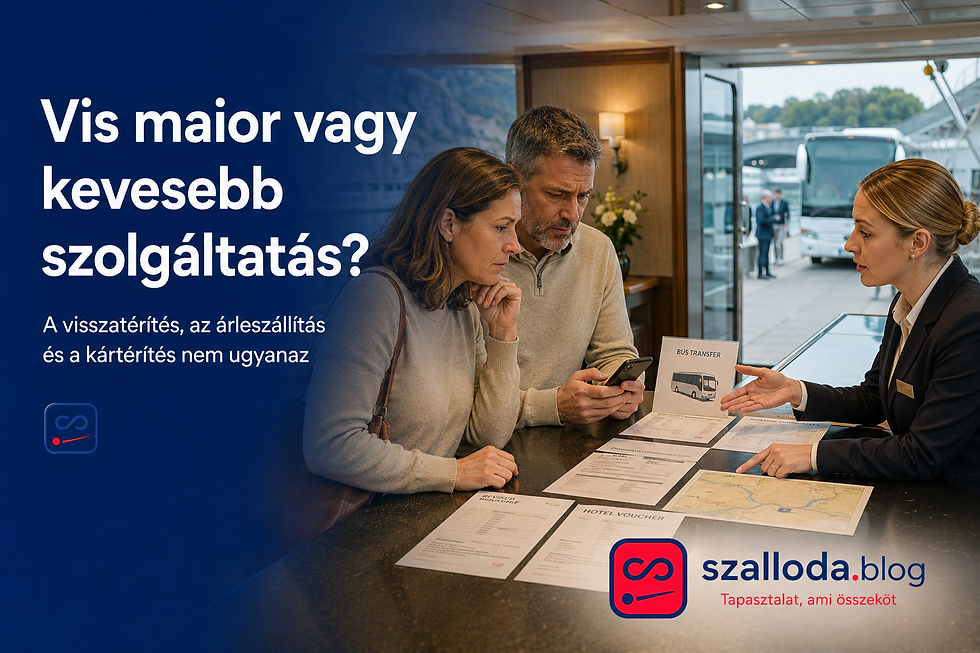
If the problem occurs during the trip, the organizer must provide an appropriate substitute service, preferably of the same or higher quality, at no additional charge. If the alternative is of lower value or quality, an appropriate price reduction may be granted. According to the summary of the Hungarian European Consumer Centre, the traveler may be entitled to a discount on the price for the duration of the inadequate performance, and in some cases, compensation.
This is the most uncomfortable legal issue in river navigation. A five-star hotel room may be of high quality, but it is not necessarily equivalent to a cabin on a moving ship. A modern bus may be comfortable, but it does not automatically replace the view of the Wachau, the Danube Bend or the Rhine Valley from a boat.
The mode of transport is not an incidental technical detail. It is part of the purchased product.
Force majeure is not an excuse
Low water levels may be considered an unavoidable and extraordinary circumstance, but force majeure is not a magic word that, when uttered, will erase all of the company's obligations.
A distinction must be made between a full or partial refund , a price reduction for a lower-value service, compensation for additional damages, and a future travel credit voluntarily offered by the company. These are not the same thing.
An unavoidable and extraordinary circumstance may exclude compensation for further consequential damages. However, it does not necessarily exclude the passenger from requesting a proportionate price reduction for not receiving a significant part of the originally purchased service.
A discount or voucher offered for a future cruise does not necessarily replace a cash refund. Under EU law, the passenger's mandatory rights cannot simply be overridden by general terms and conditions.
I wrote about similar practices of airlines in the articles Customer Service or Anti-Payment System? and New EU261: Passengers Won, Airlines Would Already Submit the Invoice . The danger in shipping is the same: a general reference to extraordinary circumstances can easily turn into an automatic rejection, while no one examines what exactly the guest received instead of the original service.
What can the passenger do?
It is not enough to verbally tell the reception that you are disappointed. The original itinerary, daily program, booking confirmation and terms and conditions must be kept. The same applies to emails about changes, app notifications, on-board announcements, bus sections, hotel nights and invoices for any additional costs.
The complaint should be reported in writing during the trip and, if possible, a record should be requested. The Hungarian European Consumer Centre also recommends this. If the contract was concluded with a foreign, European Union company, the European Consumer Centre Hungary can help resolve the cross-border complaint free of charge, after the passenger has already tried to reach an agreement with the company directly.
Insurance is not a general guarantee against dissatisfaction
Travel insurance does not in itself mean that the insurer will pay if a significant part of the cruise becomes a coach cruise. Trip cancellation, interruption and delay insurance only provides coverage for those events that are specifically listed in the terms and conditions. This is also clearly emphasized by the Hungarian Association of Insurers.
If the cruise line cancels the trip and refunds the price, the insurer usually has nothing to reimburse. However, if the trip is still carried out in some modified form, the insurer can easily claim that the trip cancellation or trip interruption event specified in the contract did not occur.
Some specialized cruise insurance policies offer separate coverage for route changes or river cruise cancellations. For example, one of Travel Guard’s American products includes a separate “River Cruise Diversion” service in the event that the ship is unable to operate due to insufficient or too high water levels and the operator only provides on-shore accommodation. However, the trip cancellation coverage of the same insurance policy specifically states that if the cruise line provides alternative transportation instead of cancellation, the reimbursement will not apply.
This clearly shows how product-dependent insurance is. It is not whether the policy name says “premium” or “cruise”, but whether it specifically covers cancellations due to low water levels, route changes, missed ports, extra accommodation or additional transport costs.
First, you should always clarify what you are entitled to from the cruise line or tour operator. The insurance company is primarily considered for remaining losses that are not recoverable from elsewhere and are specifically insured in the policy.

The center decides, the entire system bears the consequences
Low water levels are not simply a problem for the captain or the shipping department. A single route change can have a ripple effect throughout the entire company.
The central operation must constantly evaluate water level forecasts, the ship's current draft, fuel, drinking water and supply levels, bridges, locks, berths, official restrictions and expected developments in the coming days. Moreover, when deciding on a ship, it is not only the current schedule that must be taken into account. If it does not reach the next port of embarkation, the departure of the next group of passengers, crew changes, food and beverage deliveries, laundry, technical support, waste and sewage treatment, and the entire system of pre-arranged ports and excursions are at risk.
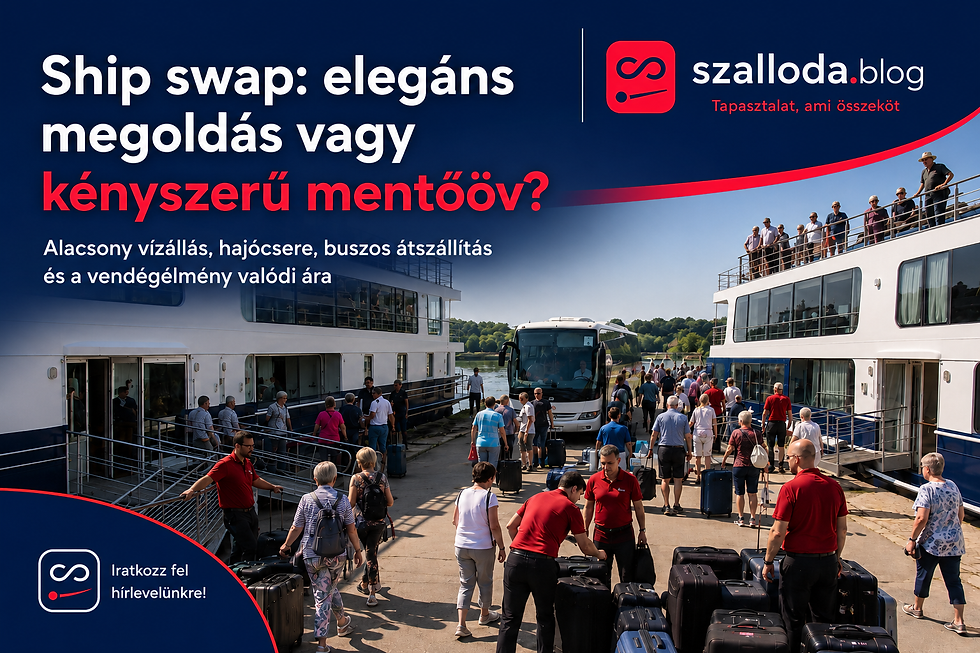
From the outside, a ship swap may seem simple. Two identical ships meet on opposite sides of a non-navigable section, passengers transfer, and then everyone continues their journey. The reality is much more complicated. Up to one hundred and fifty to two hundred guests and all their luggage have to be moved, and cabin assignments, onboard bills, special diets, allergies, needs of guests with reduced mobility, medications, lost items, excursion groups, and meals have to be coordinated. In the best case, the passenger moves into the same cabin number. However, in the background, two entire floating hotels exchange residents in a matter of hours.
If there is no suitable sister ship, buses and land-based hotels come in. In high season, it is necessary to find suitable quality rooms, buses, drivers, guides, luggage handling and meals in a short time. In the meantime, the company continues to pay the fixed costs of the ship, the crew, the technical operation and, in many cases, the ports.
A "saved" cruise can therefore be much more expensive than the original program, while the value perceived by the passenger is still significantly reduced.
The most difficult decision for management is not necessarily whether the trip is technically still feasible. It is more about when to say: while the program can still be put together with buses, hotels, and a few cruises, the product originally sold can no longer be delivered fairly.

Staff is not a corporate lightning rod
As a river hotel manager, I have experienced firsthand how quickly a navigation problem can turn into a full-on shipboard crisis.
Decisions are usually made by central operations and corporate management. However, the passenger does not meet with them. He expects answers from the receptionist, the cruise director, the hotel manager, the captain, the waiter or the cabin crew as to why the ship is not in Budapest, why he needs to pack up, why there will be a bus program from the next day, and who will reimburse part of the trip.
The reception desk becomes an information centre, complaints office, luggage storage and logistics control point in a few hours. The cruise director often rewrites the next day's entire programme at night. The kitchen prepares breakfasts in advance or packed for the early departure buses. Housekeeping helps with luggage movement, servers adapt to the many times changed meal times. The navigation and technical department, meanwhile, deals with safe passage, mooring, power supply and possible relocation, expected and unexpected changes.
All this is done with the same number of staff that were planned for normal operations. The center usually sees tables, ship positions, water level forecasts, bus capacity and costs. Meanwhile, on board, real people are asking questions, complaining, crying or angry. The company often simply shifts the consequences of the decision to the ship, and the complaint handling is left to the staff who often only learned about the change a few hours or minutes before the guests.
The staff cannot say that the center made a mistake. They cannot promise financial compensation on their own authority. They cannot trivialize the passenger's disappointment. At the same time, they must inform confidently even when they themselves are not sure which port, hotel or ship will be the final solution the next day.
In my article , Speaking a Common Language Is Not Enough , I wrote about how intercultural competence in multinational crews directly impacts safety, complaint handling, and guest experience. This is magnified in a crisis. Inaccurate, late, or contradictory central information can quickly escalate into conflict on board.
Longer working days, early departures, late arrivals, moving luggage at night and constant emotional stress pose not only service risks but also occupational and safety risks. You cannot expect the same smiles, patience and flawless performance from tired, overworked staff indefinitely.
The center makes good or bad decisions regarding navigation challenges, but passenger disappointment must be handled personally by the onboard crew.
How long will something that is happening more and more often remain unpredictable?
Shipping companies rightly say that they cannot order rain, and that it is not possible to predict the water level of the Danube or Rhine to the nearest centimeter months in advance.
The point is not whether the 13 centimeters in Budapest on August 2, 2026, could have been foreseen, but whether it was foreseeable: river navigation will increasingly encounter extremely low or high water levels, persistent heat, and rapidly changing navigation conditions.
The answer is clearly yes. In the spring of 2026, the Danube Commission specifically discussed safe and reliable navigation during increasingly long periods of low water levels. In addition to the climate resilience of waterways, European transport regulations also mention the development of inland waterway vessels with shallower drafts that can be used at low water levels as an adaptation direction.
It is not enough to simply point to nature every time. More accurate forecasts, more up-to-date waterway information, shallower draft ships, more flexible route planning, backup ports, pre-booked bus and hotel capacities, and adequately staffed crisis management teams are needed.
Maintaining the riverbed and dredging it as needed can be an important part of the solution, but it is not the answer in itself. The river cannot be endlessly adapted to the needs of ever-larger ships. Ships, routes and business models must also adapt to the river.
The same applies to communication. All affected passengers should receive clear, comparable information about how much of the original cruise leg will be missed, how many hours of bus transfers are expected, whether the ship or embarkation point will be changed, whether a land hotel will be included in the program, what additional costs the company will cover, and what refund, price reduction or cancellation options are available.
It shouldn't be stated that "we are trying to minimize inconvenience", but rather it should say exactly what will remain of what the passenger purchased.
It's not enough that the path somehow becomes a reality
River navigation needs flexibility. No company can guarantee that every ship will reach every port every day, and safety cannot be overridden by any guest demand or business interest.
However, the priority of safety cannot mean a consumer protection exemption. A change necessary due to nature and the company's responsibility towards passengers can coexist.
Cruise lines must not only demonstrate their ability to arrange buses, hotels, and ship transfers, but also their ability to communicate clearly, provide real choice, compensate fairly, and not shift the entire operational and emotional burden onto either the passenger or the crew.
Low water levels are a natural phenomenon. However, it is a corporate decision what kind of ship a company builds, what routes it sells, what it promises, when it provides information, what alternatives it provides, and what else it considers to be the same product.
Extreme water levels may be a force majeure, but the lack of adaptation is increasingly less so.
About the author:

Tamás Pakuts has been actively involved in aviation and tourism for almost 35 years, and in the hotel industry and catering for more than 25 years.
As a manager and consultant, he had insight into the operations of several airlines, as well as hotels, hotel chains, and shipping companies, successfully taking on a role in their operational management, crisis management, and development.
He is currently present in many countries around the world with his colleagues as an expert, consultant, and trainer in the hotel industry and aviation, and he and his colleagues are working on the development of numerous new, internationally noteworthy projects.
The original post is written in Hungarian. The text is translated automatically with AI.